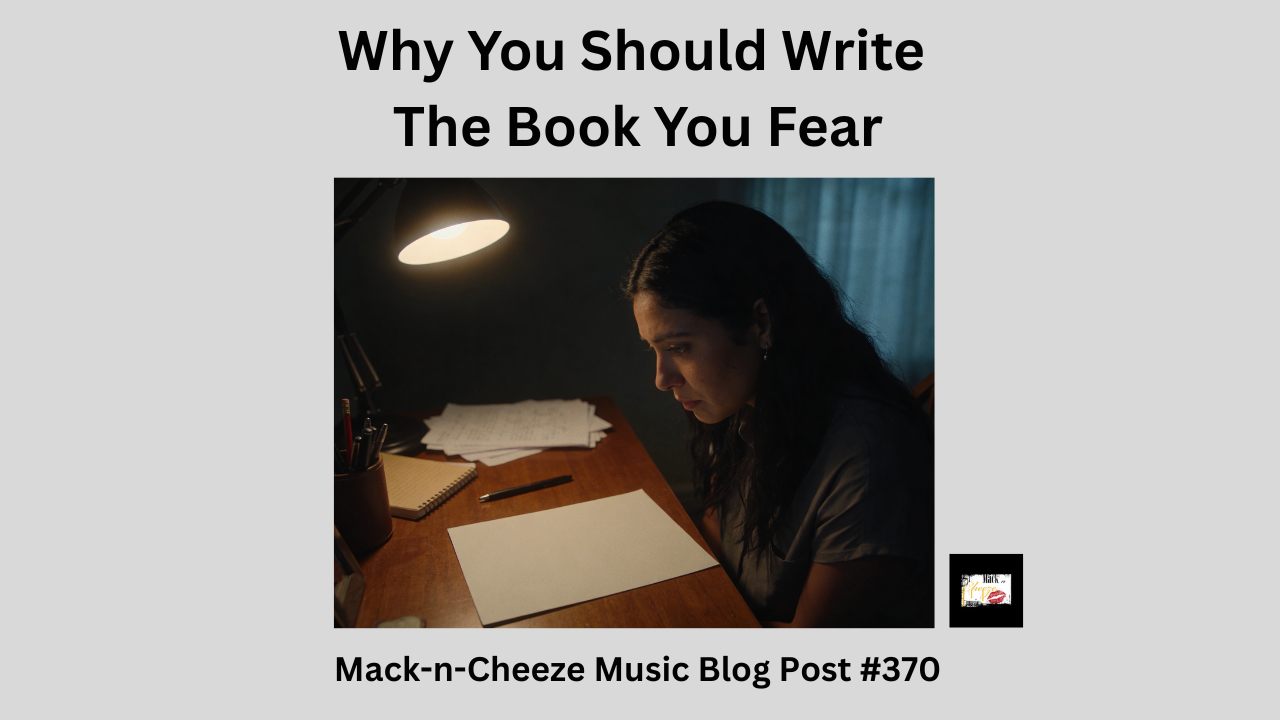
Some people say they want to write a book.
Estimated reading time: 11 minutes

Table Of Contents
Write The Book
People often treat writing a book like a hobby, similar to building a birdhouse. It becomes something they plan to do when life finally slows down.
Life doesn’t calm down.
The idea of the book lingers in the background, not crushing you, but weighing on you for years.
I’ve met these would-be authors, and you probably have too.
You already know what holds you back. It’s not ignorance or lack of talent. There’s a cost to the work.
Writing a book takes time you don’t feel you have. It uses up weekends and disrupts your plans. It asks for rewrites even when you think you’re done, and it pulls you away from other work that feels easier and more rewarding.
The hardest part is that writing a book comes with no guarantees.
You can expect a long wait, wondering whether you’ll follow through on your intentions.
That’s why the book you’re afraid of is the one you should write.
Fear is the price you pay, and you realize it quickly. It’s your mind realizing this project could take a big part of your life.
Good.
That’s what real work feels like. Isn’t this what you’re already doing?
The real question isn’t if you have a book inside you but whether you’re willing to pay the price to write it.
Defining Fear

Fear isn’t always acute anxiety, such as experiencing shaky hands and sleepless nights. It’s simply being aware.
It’s the moment you realize writing a book isn’t a creative weekend project. It will take evenings that could’ve been spent with friends, weekends that could’ve been used to rest, gig, and record. There are several time-stealing reasons.
And then there’s the social cost. People stop inviting you. Or they keep inviting you, and you keep saying no. Eventually, the silence shifts. They assume you’ve disappeared, you’re stuck-up (I have been accused of that), or they assume you’re “too busy.”
Then come the rewrites, the part no one talks about. This is when the dream becomes hard work. You realize your first draft was just practice. Rewriting is when the book asks for humility. It’s when the work stops being fun and becomes real.
The fear keeps building. While you write, everything else slows down. Other projects remain unfinished, and ideas are left behind. You see others sharing their work and getting attention, while you’re still working in private on something no one else can yet see.
Beneath it all is the hardest fear: that after all your time and effort, no one will care.
That fear makes sense.
A book doesn’t just need creativity. It asks for a piece of your life.
A Book Is Not Content
Content is disposable. It’s something people skim while waiting for coffee, scrolling in bed, or staring at a phone in a parking lot. There might be a few likes or a quick comment, then it disappears as if it never existed.
A book sits still and does not beg for attention. It doesn’t need timing or trending audio. It doesn’t care if you posted at the wrong hour or when the noise fades.
A book is an artifact. Not a performance.
A performance is built to impress. An artifact is built to last.
And that’s the difference. A book has weight in the world. Not metaphorical weight, actual weight. It can sit on a shelf. Or can be handed to someone and opened again years later. It can outlive the mood that created it.
Forced Coherence

Short-form lets you live in fragments.
You can post thoughts, quotes, sharp sentences, or hot takes. You can sound brilliant for sixty seconds without ever proving you understand what you’re talking about. Welcome to social media.
A book doesn’t let you get away with that.
A book demands structure and forces you to build a spine. It forces you to connect one idea to the next and make them hold together. You can’t hide behind scattered insights. You can’t survive on style alone.
A book also forces an argument in the human sense. It makes you answer the question: What are you really saying, believing, or claiming is true?
You have to show up with the same mindset, page after page, without contradicting itself or collapsing into nonsense.
A book presents intellectual honesty. When you stretch an idea across chapters, the weak parts start to sag. The holes become obvious. The fake confidence doesn’t survive the distance.
A book is where your thinking either becomes solid or doesn’t.
Credibility The Hard Way
Books are not sacred objects. Paper and ink do not carry mystical power. A book doesn’t make you smarter, make you right, or even mean you’re capable. Or even competent.
It means you finished.
And that alone separates you from most people.
We live in a world flooded with starters. People start podcasts, brands, and businesses. They announce it, post about it, then vanish. They get bored, distracted, tired, scared, broke. The project is never finished.
A book doesn’t let you hide like that.
A book is a long-haul, endurance work. It’s staying with the same set of ideas long enough to shape them into something tangible. It’s showing up when it isn’t fun; when you battle with repetition and doubt and rewrites.
That’s why a book signals seriousness. Not because books are magical.
Because finishing one is rare.
Separating Creators From Talkers

A lot of people start books. They scribble ideas, write a few chapters, maybe even get halfway through. Then life happens. The manuscript ends up sitting in a folder on a laptop for years. And they keep telling people, “Yeah, I’m working on a book,” the same way people say they’re “going to start working out.” It turns into part of their identity, even though the book never actually gets finished.
Very few publish.
That’s where the truth lives.
A book is a filter.
Because the gap between a draft and a published book isn’t skill, it isn’t even discipline. It’s nerve.
That’s the line of demarcation. Not writing.
Releasing.
Because once the book is out, the world gets a vote.
The Bill Comes Due
Not every book gets written in blocks of dedicated time. A lot of us do not have the ability to write 300 words a day, let alone a thousand.
A book rarely gets written in some magical block of free time. Unless your occupation is writing. Sometimes it happens, but most of the time it doesn’t.
Often, it’s written in scraps.
Ten minutes before the shift. Fifteen minutes after dinner. One sentence while the house is loud. A paragraph typed half-distracted because that’s all the day gives you. Some days, you fix one line. You move one paragraph or cut two sentences. That’s progress.
A book is a resource allocation.
Writing a book is about how you make conscious decisions about how time, attention, and mental energy are to be spent. It’s choosing the grind over the short reward.
A book demands priority.
Priority shows up in the small blocks and ten-minute decisions; in what gets done when nobody’s watching. And in the midst of long sessions of flow state.
Rewrite the Script
The first draft is the easy part. Sorry for the bad news.
It feels like movement. It feels like building. Pages stack up, and you start believing the book is real.
Then you reread it.
That’s when the work changes. Not because the writing is hard, but because the ego gets involved. You see what doesn’t fit and what drifts. You see the parts that only sounded good because you were tired and proud.
Humility. That’s what has to be faced. You need to be able to tell yourself that you are not that smart.
In the words of Arthur Sullivan-
“Merely corroborative detail, intended to give artistic verisimilitude to an otherwise bald and unconvincing narrative.”
In other words – Twaddle.
You need to admit this to yourself and deal with it.
It’s where you cut what you want to keep. Where you admit the chapter doesn’t belong, and remove the clever lines that do not serve the book.
Most people don’t quit the process because they can’t write.
They quit because rewriting forces a decision: protect the dream, or finish the artifact.
And finishing requires brutality.
Changes
A book changes the creator.
Not in the ‘Get Ready For Your Ted Talk’ way.
There is an internal correction.
The expectation of quick results fades. Your inspiration is more of a mindset.
Dull stretches, dry weeks, and the same text looking back at you day after day: you learn what real work is.
Patience stops being a virtue and becomes a requirement.
Discipline stops being a strategy and becomes a default setting. Because if you wait to feel ready, nothing gets finished. You learn to work while uncertain, write while tired and uninspired. You put your emotions aside as diligence becomes your foothold.
Your standards rise because you start seeing what weak work looks like. You see it in yourself and others. You can’t unsee it.
Excuses shrink because the process exposes them. You can’t blame a bad day or your schedule.
You can’t blame the world. The book doesn’t care. The page stays blank until you do something.
That’s what writing does.
It rewires how you approach everything else. Music. Practice. Business. Relationships. Creative projects.
Once you’ve carried one long project across the finish line, smaller projects stop feeling intimidating.
They start feeling like warm-ups.
A Book Might Not “Work”

Can you handle the truth?
Your book might not sell, get praised, or even be reviewed. Those who do read it might not share it. It is quite possible your work will land with a dull thud. There is a place where creative work goes to die; your book may very well go there.
Be clear about the result of your toil: no one owes it any attention.
Don’t live in a fantasy world. Your book is not a lottery ticket. There is no guarantee of relevance.
It’s a long bet placed in a world that doesn’t care how hard you worked.
Yet, your book still matters.
Because it becomes proof of completion. Proof that you can carry something heavy across the finish line, that you didn’t just have ideas. You had follow-through.
Most creators are surrounded by unfinished projects. A finished book is different.
It doesn’t promise success. It proves seriousness.
Reasons To Write Your Book
The real reason to write a book isn’t money.
Money is unpredictable. A book can take years and still sell almost nothing.
It isn’t fame either. Fame is a weather pattern. It changes fast and disappears even faster.
And it isn’t the title of “author.” That word doesn’t mean what it used to. Too many people wear it without earning it.
The real reason to write a book is to stop drifting.
To stop living in fragments. Half-finished projects. Loose ideas. Notes that never become anything. Creative motion that looks productive but leaves nothing behind.
A book forces a decision, embracing standards, and moving to completion.
It turns you into someone who finishes.
And once you become that person, everything else changes.
And In The End
At some point, you have to release the work.
Not because it’s perfect. Not because you’ve finally reached the finish line in your own mind. But because the book has taken what it’s going to take.
All you can do is all you can do.
And the truth is, no book will ever be a total reflection of you.
A book is only a reflection of who you were when you wrote it. Your limits and focus. Your knowledge and the season of life. That’s all.
That’s what justifies the toil.
Because the point isn’t to capture your entire identity in one object. The point is to put a stake in the ground and say: this is what I built here and now.
That’s enough.
That’s real work.
Can We Help You?
Are you ready to write your Book?

Comment with the title of the book you keep avoiding writing.
Share this with one creator who’s been “working on it” for years.
Subscribe. Because the next post is for finishers, not talkers.
Thank you for reading. It means a ton.
Want More Mack-n-Cheeze?
Videos - Bryan At Mackncheeze on YouTube
Podcasts – Bryan At Mackncheeze Apple Podcasts, Fountain, Spotify