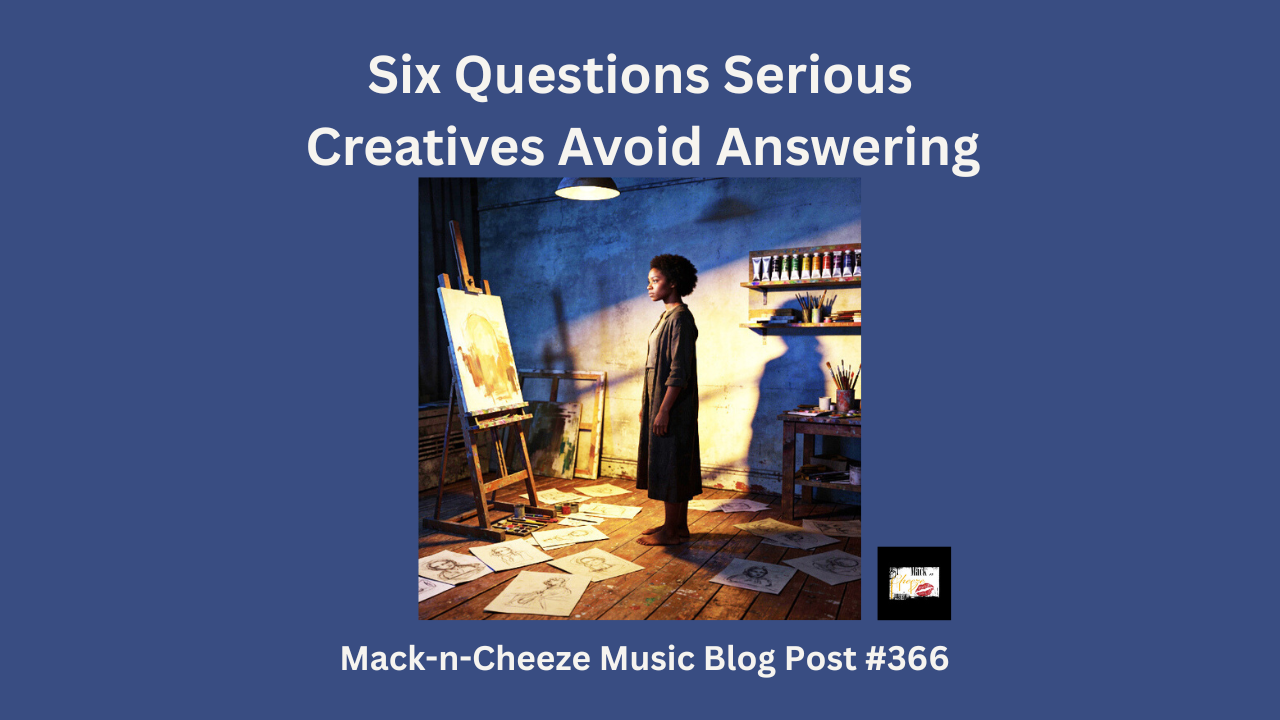
This is a piece about creative accountability, where responsibility sits when no one else is keeping score.
Estimated reading time: 1 minute

Table Of Contents
What Are The Questions You Are Afraid Of?
The soft lights overhead whisper their 60-hertz hum, and the chair creaks as you settle in. A guitar waits on its stand. The DAW screen glares back, blank, daring you.

You hit a chord; too hard. Not music yet, just muscle. Your hands know the part, but something else is riding shotgun. The echo of a fight you lost. A promise you don’t believe anymore. That one artist you can’t stop stalking online. The one person you love enough to keep going, or hate sufficiently to prove wrong.
You usually suppress the memories, those wrapped in guilt, loss, and fear.
It’s not always there. But the gnawing echoes surface enough to trouble you, especially in this personal space where you forge your craft.
These are the static that fills your head before something more defined appears.
Because once the body settles and the hands start moving, the work begins to press back. It asks for decisions, demands direction, and forces implication.
That’s when hesitation can creep in. Not as doubt. As a restraint. An avoidance.
It’s in quiet, familiar, and unguarded moments that the work stops being technical.
Because once something starts to take shape, it isn’t just sound or structure anymore.
Not everything you’re avoiding is a feeling.
Some of it is an answer.
Before you move forward, you get to decide if it’s worth asking:
What are the questions you are afraid of?
Some of this is going to be really hard to face.
Identity & Self-Image
Who am I if this work doesn’t justify the years already spent?
When I put it down for a season, it was ten years. Coming back meant catching up to a world that didn’t wait.
Who was I after spending years walking away, anyway?
Circling. Trying to accommodate other people’s vision. Cultural expectations. A job that slowly took over.
Coming back was slow. But here I am.
I joke that someone will have to pry the drumstick out of my cold, dead hand.
Effort & Exposure
What excuse dies if I give this everything and it still goes nowhere?

I told you this is going to be hard.
“If I give this everything.” What does that mean?
Everything is: this body of work, the direction, voice, standard, and the integrity of yourself and your art.
What “excuse” is going to die?
“This isn’t the real me. Yet.”
And that collapses into “I was never really seen.”
And this can lead to any number of excuses that remove accountability for our art from ourselves.
This responsibility carries a lot of weight. It keeps identity deferred, judgment suspended, and failure theoretical. If “this” doesn’t work, it wasn’t you that failed.
That’s the same move Marlon Brando makes in On the Waterfront.
“I could have been a contender.”
Not I tried and lost.
Not I chose and paid for it.
But you never got to see who I really was.
Time As The Constraint
What happens if I don’t become who I know I’m capable of becoming?
Time doesn’t change. It accumulates. And it enforces the consequences.
What are you capable of becoming? This is not necessarily about wanting more, dreaming bigger, or chasing ambition.
This is a self-evaluation based on what you already know. You know what the work requires and how your consistent effort produces. You also see what you could do if you had better conditions and resources.
Then you get to ask yourself, “Given my data set, how do I judge myself if I do not close the gap?” That is self-judgment without appeal.
The crux is this: this kind of approbation is an internal measurement.
And when the ruler is internal, this is unbearable for many people. And it doesn’t stay quiet.
Artistic Honesty
What truth keeps showing up in my work that I keep sanding down?
Truth here is not an opinion, belief, or intention. Truth is the recurring content your work produces on its own.
What keeps appearing across different pieces, even when you try to steer away from it?
It often shows up as a fixation: subjects or tones you return to again and again.
Taking out what feels too specific or uncomfortable, and defending it as taste or acceptability.
When people edit to satisfy social platforms, they’re responding to format pressure.
Where Algorithm Sanding Becomes Artistic Dishonesty
The artist changes the piece before it knows what to say. The work is shaped around retention metrics instead of necessity.
There is fear that ambiguity might cause a drop-off; therefore, it is removed.
Tension is resolved by formulae. Specificity is diluted for “broader appeal.”
Obedience to the algorithm isn’t just influencing delivery.
It’s editing the truth out of the work.
The artist doesn’t think, “They won’t like this.” Instead, the thought is, “This won’t work.”
Ownership Of Silence
What if silence is my fault? Not the industry’s, not the algorithm’s, not the culture’s?

Failure. It’s time to address it.
Up to this point, a lack of traction can be blamed on systems: the industry, algorithms, timing, and culture. Each one moves responsibility somewhere else.
Now every possible response points back to you and me. Specifically, the choices we made, the process, what was avoided, what we did not stand behind, and lastly, what we did not finish.
That’s why the question is terminal.
Not because it’s cruel.
Because once it’s asked honestly, blame can’t fall anywhere but on you and me.
And that’s why the question often remains unanswered.
Irreversible Choices
What would I have to give up if I stopped trying to keep every future version of myself alive?
This question isn’t about effort. It’s about clarity.
Most of us keep several versions of ourselves in circulation because choosing one means letting the others go. As long as they stay alive, nothing has to be decided or proven.
As long as the future is plural, you can always say:
“That path wasn’t the real one.”
“I haven’t committed yet.”
“I’m still exploring.”
But optionality has a cost.
Serious progress requires killing alternatives. To become the highest level of yourself, other versions of you need to be put aside. You can’t feed every identity. You have to pick which one gets the calories.
Can We Help You?
What are you willing to be responsible for, even if nothing comes back?

Thank you for reading this to the end.
Agree. Disagree. Leave a comment.
Share it with someone who needs this.
Subscribe if you want writing that demands accountability.
Postscript
Joni Mitchell didn’t protect future versions of herself. She committed to the one she could live with, even when it cost her audience, ease, and approval.
Leonard Cohen refused to sand down the truth to protect relevance, comfort, or potential.
He stayed with the same themes for decades, accepted the cost of time and silence, and chose one version of himself instead of keeping every future version alive.
Nick Cave never optimized for comfort, relevance, or palatability.
When the work darkened, slowed, or became harder to sit with, he followed it anyway. Audience loss was accepted as part of telling the truth.
Want More Mack-n-Cheeze?
Videos - Bryan At Mackncheeze on YouTube
Podcasts – Bryan At Mackncheeze Apple Podcasts, Fountain, Spotify