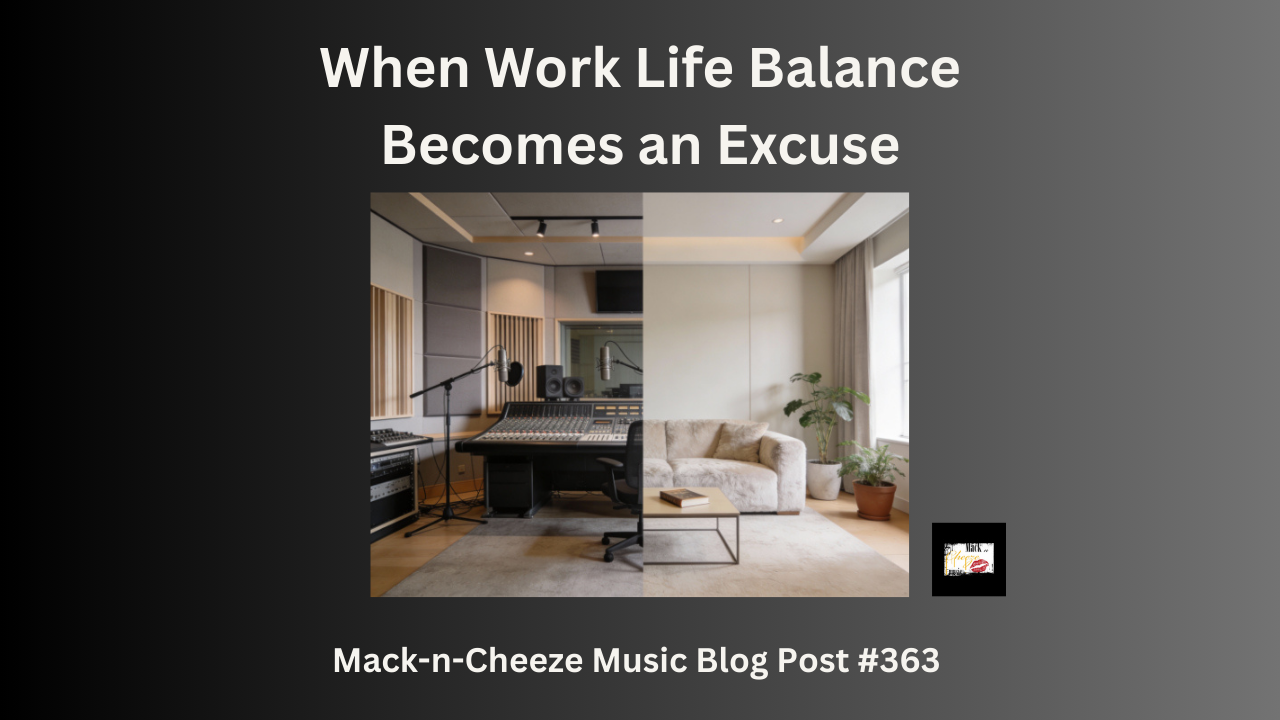
Work–life balance sounds reasonable. It’s clean. Responsible. It fits on a poster and doesn’t offend anyone.
Estimated reading time: 7 minutes

Table Of Contents
Work-Life Balance: What Is It?
The first time I heard the phrase “work-life balance” wasn’t from an artist. It came from an employer. It was presented as a concern, but it functioned as a boundary.
Work was supposed to stay at work, and your personal life was supposed to remain separate. Ask any manager if this even holds a shred of truth.
The work-life balance philosophy makes sense for organizations that require stability. It creates boundaries that keep effort predictable.
It makes far less sense for creative work that doesn’t respect office hours or job descriptions. The problem isn’t the phrase itself. It’s what happens when a concept designed to regulate employees gets imported into a life built around unfinished work.
Most of us are working from the same position: trying to build something that matters while holding a job and operating under real limits. This is the reality the balance conversation skips.
I am not rejecting taking care of yourself. Rather, I reject the confusion around work-life balance, especially when resources are limited.
Some practices keep you functional, and others keep you comfortable.
The difference shows up in your work.
Creative effort doesn’t ask for symmetry. It asks for continuation. Pretending otherwise is how people stop without admitting they’ve stopped.
Here’s how stopping hides.
Maintenance And Avoidance
Not everything that looks like ‘taking care of yourself’ keeps creative effort alive.
That’s the part people miss. From the outside, maintenance and avoidance often look the same. Both are orderly, defensible, and can consume huge chunks of time.
Maintenance is necessary because the body and mind have limits.
Sometimes it’s physical, or if you need space.
Sometimes taking care of yourself doesn’t feel like relief. It just keeps you from tipping over.
Avoidance survives by becoming reasonable.
Avoidance stacks reasonable delays: an hour to reset, a day to prepare, a week because the timing feels wrong, whatever.
Sounds like the truth, right? But this ‘truth’ can be used to distance yourself from the work and what you need to accomplish.
This is how you give momentum away:
People stop asking what helps and start defending what sounds right and feels good. If you are working your ass off and aren’t content, for whatever reason, you start looking for ways to avoid the work.
Rest becomes a virtue. Preparation becomes ongoing. Care turns into identity. And the work, unfinished and unresolved, waits off to the side.
There’s no reliable visual cue to distinguish between maintenance and avoidance. Therapy can be either. Exercise can be either. Prayer, conversation, solitude, and even exhaustion, none of these decides anything on their own.
The only test comes after.
Do you return to the work, or do you return to explaining why you aren’t moving forward?
I do not care who you are. You don’t have unlimited time or energy.
Your choices either restore capacity or dissolve urgency.
There are times when ‘balance’ is not the correct decision.
Respectable Excuses
Have you ever told yourself these things about your art?
I don’t want to rush my creativity.
A cleaner signal is needed.
I need to refine this.
The timing is terrible.
None of these things are false; instead, they are incomplete.
And that’s enough to keep the work untouched while everything still feels reasonable.
Staying in preparation avoids exposure. Avoid exposure long enough and nothing ever fails. That’s how the self-image stays comfortable.
Finishing invites judgment. Shipping your work removes control. Keeping deadlines fuels momentum.
That’s the trade. You either accept the consequences of finishing, or you stay in preparation.
Toni Morrison

Toni Morrison was an American novelist, editor, and professor. She wrote some of the most important American novels of the 20th century, including Beloved, Song of Solomon, and The Bluest Eye. She won the Pulitzer Prize and later the Nobel Prize in Literature.
Toni Morrison worked full-time as an editor for Random House while raising two children on her own. She did not wait for ideal conditions to write. In interviews, she described working when time was available, not when there was a work-life balance.
Access Is The Real Constraint
Access to the work is what disappears first when everything else expands.
Jobs expand. Obligations expand. Explanations expand. The work is what gives way.
Creative work doesn’t require heroic effort. It requires regular entry. You have to be able to step back into it without having to negotiate with yourself every time.
Once that access erodes, the work doesn’t stop loudly. It thins out, gets postponed, and becomes theoretical.
This is where most people misdiagnose the problem. People don’t usually notice what’s gone missing. They keep adjusting for time and rest while the work quietly becomes harder to enter.
An artist needs to set boundaries within their constraints.
Permission is not granted by comfort but is earned by repetition.
Neutral ground does not exist here. Every system you build either preserves access or blocks it. If a habit makes returning harder, it’s not maintenance. That is more like interference, no matter how reasonable it sounds.
The work doesn’t need your life to be balanced.
It needs a door that stays open.
Philip Glass

Philip Glass is an American composer and pianist. He is one of the most influential figures associated with minimalist music, though he has often rejected the label himself. His work includes operas (Einstein on the Beach), symphonies, film scores, chamber music, and solo piano works.
For years, Philip Glass worked full-time jobs that had nothing to do with recognition. Taxi driving. Plumbing. Moving furniture. Work that paid the rent and was not pretend temporary.
At the same time, the composing continued.
He did not assume the work would ever pay off, and did not pause until conditions improved. He did not wait for validation, funding, or balance to appear.
In Words Without Music: A Memoir. ( Liveright Publishing Corporation, 2015. ISBN 978-0871404381 ), Glass is clear about this: the work moved forward alongside unfinished circumstances.
None of this is heroic. It’s structural.
If you keep composing while nothing is rewarded, the work stops being theoretical. It gets tested. It either holds up, or it doesn’t. And once it’s tested, you lose the protection of potential.
That’s the pressure most people back away from.
And In The End
Are you seeking life-work balance? Maybe your art is flourishing because of the practice. Maybe not.
I’m in the maybe not camp. The work I put out is what balances me.
The notebook stays open.
A line is crossed out. Another starts and goes nowhere.
The light over the desk hums.
I close the book and leave it where it is.
Can We Help You?
What are you doing that lets you return to the work tomorrow without negotiation?

Can you relate to this post? If you do, say so.
Leave a comment. Push back if you disagree. Add what you’re seeing in your own work.
If you know someone circling the same problem, share this. Not as advice. As recognition.
And if you want more writing that doesn’t hand out permission or shortcuts, subscribe. That’s where this conversation continues.
No hacks. No balance talk. Just the work, and what it costs to keep it alive.
Want More Mack-n-Cheeze?
Videos - Bryan At Mackncheeze on YouTube
Podcasts – Bryan At Mackncheeze Apple Podcasts, Fountain, Spotify