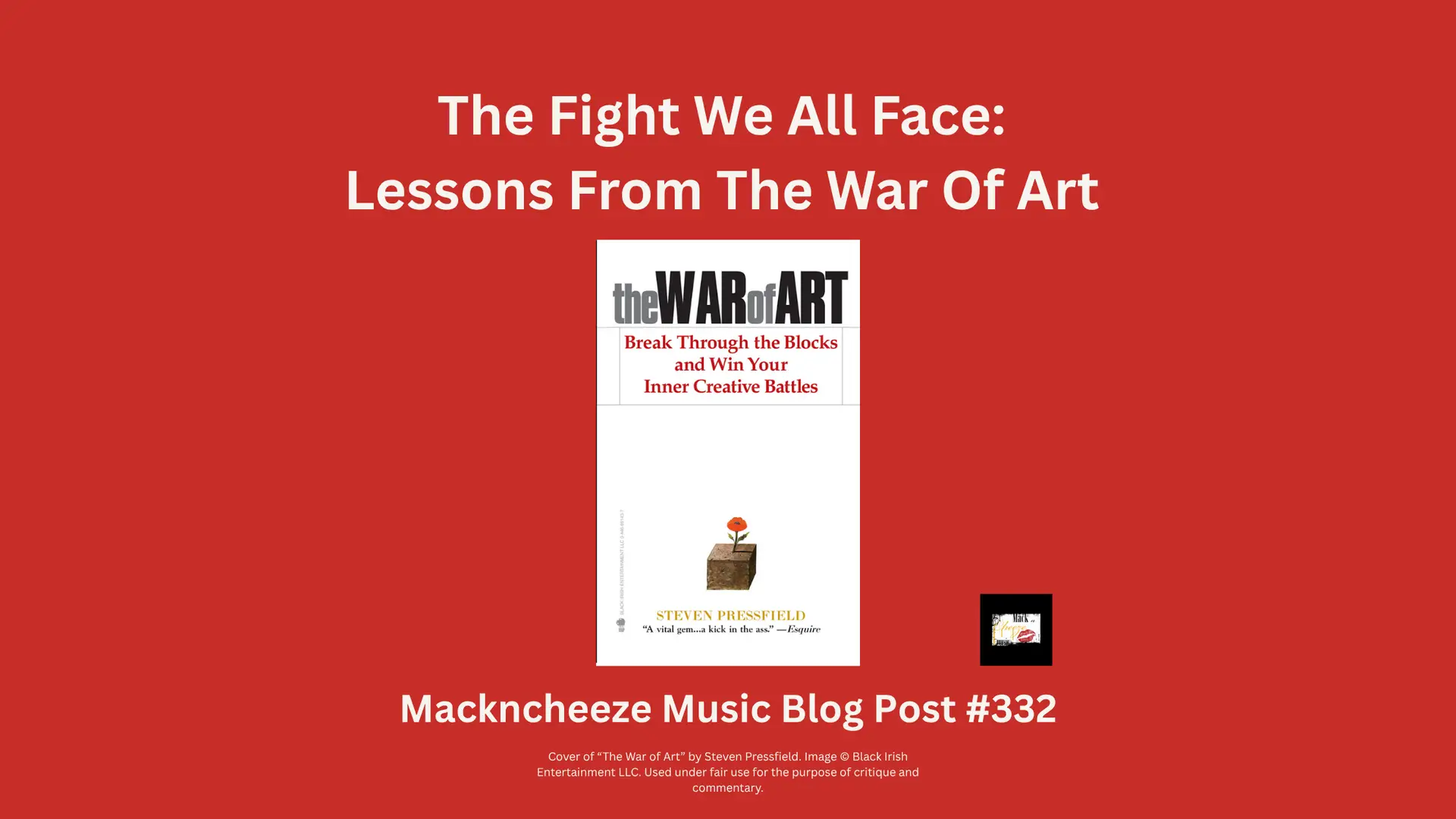
Steven Pressfield’s “The War of Art” didn’t tell me anything I hadn’t sensed. What the book did do was to say it out loud.
Estimated reading time: 12 minutes

Cover of “The War of Art” by Steven Pressfield. Image © Black Irish Entertainment LLC. Used under fair use for the purpose of critique and commentary.
Table Of Contents
Resistance
That low-grade friction you feel every time you sit down to create? Pressfield named it Resistance. Once seen, it can not be unseen.
The War of Art didn’t inspire me. Turns out, I wasn’t losing the battle, only fighting the same war every real artist does, that there is reason and purpose in sacrifice and discipline. This is a fight every serious artist knows.
And if you are on the hunt, you’ll know exactly what he’s talking about.
“Discipline equals freedom.” That’s Jocko Willink’s line, and he’s not wrong.
Self-help types follow up with “Own your morning, own your day.”
And, of course, the old favorite: “The early bird gets the worm.”
But here’s the part they leave out: getting up at 5 a.m. after going to bed at 1 a.m. isn’t discipline, more like exhaustion. Especially if you’re not wired that way. And a lot of people aren’t. Life doesn’t always allow it, either.
Some of us do our best thinking when the world shuts up at midnight. That’s not laziness; it is more like biology. Our rhythm doesn’t match the societal productivity mechanism.
Getting up early for no reason? That’s just fatigue with a time stamp. If those hours aren’t protected and tied to real intention, it’s performative.
Nothing New, My Friend
Been there. Done that.
The War of Art doesn’t push that morning-routine gospel.
What matters is clarity, not recycled advice repackaged as guaranteed success. If 5 a.m. gives you that clarity, good. If 11 p.m. gives it to you, that’s just as valid. Don’t confuse early with effective.
Discipline equals freedom. Every time I show up, the noise loses volume.
Some days, the hardest part isn’t the work; it is the starting. Not because I procrastinate; I don’t. Not because I’m buried in distractions; I have learned to handle those.
Some days I do not want to get out of bed, like this morning.
The drill is to show up. Work. That is the discipline.
Still, there’s that quiet drag. That internal question arises when things get heavy: “Why am I doing this?” That slow pull on the brakes, even when nothing obvious is in the way.
The War of Art didn’t uncover something new. It confirmed what I already sensed. Pressfield gave it a name. Resistance is the name, changing my perception of everything I am doing.
I recognized Resistance like an old, worn-out T-shirt, my close friend.
Nothing was broken. My imagination was not running amok with notions of futility.
I faced the same force every serious artist encounters when pushing toward something real.
That’s the war. And it doesn’t come from the outside.
The Unseen Enemy
RESISTANCE IS INVISIBLE. “Resistance cannot be seen, touched, heard, or smelled. But it can be felt. We experience it as an energy field radiating from a work-in-potential. It’s a repelling force. It’s negative. It aims to shove us away, distract us, prevent us from doing our work.”
Pressfield, Steven. The War of Art (pp. 6-7). Black Irish Entertainment LLC. Kindle Edition.
Pressfield had me at hello. Just like that, I knew I was in the right place.
Resistance isn’t loud. It doesn’t kick the door in but slips in quietly and makes it home.
Pressfield defines it as internal, shape-shifting, and always present. It shows up in a hundred disguises: boredom, anxiety, overplanning, self-doubt, and even sudden bursts of productivity in everything but the work that matters.
It’s not about laziness. Resistance doesn’t want you to rest but keeps you distracted. It would be better if you cleaned your inbox, reorganized your studio, chased a dozen side projects, or did anything else to keep you from doing the real work.
And the more critical work is to your growth, the louder Resistance becomes.
That’s the catch. Resistance doesn’t fight the trivial. It shows up strongest when the stakes are real.
The Quiet Assassin Of Ambition
RESISTANCE IS INSIDIOUS. “Resistance will tell you anything to keep you from doing your work. It will perjure, fabricate; it will seduce you. Resistance is always lying and always full of shit.”
( paraphrase )
Pressfield, Steven. The War of Art (pp. 8-9). Black Irish Entertainment LLC. Kindle Edition.

Image generated by GeniGPT
Resistance rarely shows up wearing a name tag. It doesn’t say, “Hey, I’m here to wreck your progress.” It is more insipid than that.
Resistance hides behind busy work, staying active without moving forward. You tell yourself you’re productive, but the real work is untouched.
It disguises itself as perfectionism. “I’ll start when it’s right.” “It’s not ready yet.” That lie buys time and burns it.
Sometimes, it shows up as a comparison. You scroll through someone else’s success, and your work suddenly feels smaller. So you stall, wait, and doubt.
And then there’s the most convincing disguise: “One day.” One day, when life settles down. One day, when things are just right. But that day never comes, not without action.
Resistance wears whatever mask will get you to pause.
Book One: Resistance – Defining the Enemy
The first part of The War of Art doesn’t ease you in. Pressfield comes straight for your throat.
He names the enemy Resistance. And once you see it, it’s everywhere.
Resistance is subtle. It doesn’t scream but is pervasive, like a quiet whisper. It says things like, “You’re tired.” Or “You’ve got time.” Or “You should probably clean your space first.”
In other words? It sounds like a typical day.
Wake up, check your phone, and make coffee. Maybe scroll for “inspiration.” You tell yourself you’ll get to the real work soon, but you should probably answer that email first. Maybe run that errand. Maybe reorganize your files. Perhaps take a break.
Before you know it, the day’s gone, and the one thing that mattered never happened.
That’s Resistance. It doesn’t always show up as a monster. Most of the time, it shows up as routine. It blends in. And if you’re not paying attention, you’ll call it productivity.
Resistance wears many masks. Pressfield lists them like he’s reading your mind: fear, self-doubt, perfectionism, criticism, overthinking, drama, self-medication, and isolation. It begins to become clear, not because it is new but because it is so recognizable.
This Isn’t A Diagnosis. It’s A Mirror.

Image generated by GeniGPT
Pressfield is not diagnosing a problem. He’s describing your routine. Your stalls and “productive” detours; identifying our internal negotiations to do work on it later.
The creative artist might find this uncomfortable, but I found it freeing. Because the moment I named it, the excuses started sounding thinner.
Resistance isn’t a mood, bad timing, the job, schedules, or your studio space.
More like the invisible hand hits the brakes every time you try to move forward.
In Book One, Pressfield leaves no room for denial; you’ll see it for precisely what it is.
Book Two: Combating Resistance-Turning Pro
Pressfield puts it plainly:
“Aspiring artists defeated by Resistance share one trait. They all think like amateurs. They have not yet turned pro.”
Pressfield, Steven. The War of Art (p. 62). Black Irish Entertainment LLC. Kindle Edition.
No interpretation is needed; only a mirror.
Turning pro is not about a paycheck or having an audience or a title.
How do you think and how do you act.
The amateur waits. The pro works.
Pros don’t wait for clarity. They work through confusion, do not rely on the correct mood, the right conditions, or the right gear. They show up because it is what they do. It is the job.
Book Two lays out that distinction without softening the edges. If Resistance is beating you, Pressfield says it’s because you haven’t turned pro yet.
Does that hit you hard? What if you are unsure of being validated for your creativity? The answer lies in your dedication.
I’ve seen the difference in my own work. When I approach it like a professional, I do not wait for permission. I stopped negotiating with myself, stopped explaining why I did not start, and sat down and went to work.
That’s the shift. That’s what separates people who finish from people who stall.
Defining Professionalism
“Technically, the professional takes money. Technically, the pro plays for pay. But in the end, he does it for love.”
Pressfield, Steven. The War of Art (p. 74). Black Irish Entertainment LLC. Kindle Edition.
The conversation is reset.
A professional may get paid, but that’s not why they show up. Pay is a byproduct. The work is the point.
Pressfield lists what makes someone a pro; none of it has glitz.
The committed professional shows up damn day. No debate, no drama. Just clocking in and staying on task, even when it’s tedious or messy.
They’re in it for the long game, not just for an individual project but for the path itself.
They act in the face of fear. Fear doesn’t vanish, but it does not dictate the terms.
Professionals don’t tolerate excuses from others or from within.
No posing. No shortcuts. Just relentless and honest effort, straight down the middle.
They don’t confuse outcomes with identity. Wins and losses are beside the point. The work stands apart.
They weather the storm because they never expected sunshine. They’re built to endure because they have learned to survive.
Does this list make you uncomfortable? It clarifies and reveals the gaping chasms in the approach to my work.
This is not about being perfect but rather about being consistent. You show up, stay late, care about the work, even when nobody’s watching.
And if you do get paid, you’d still be doing it if you didn’t.
That’s what it means to turn pro.
Book Three: Beyond Resistance, The Higher Realm
“Just as Resistance has its seat in hell, so Creation has its home in heaven. And it’s not just a witness, but an eager and active ally. What I call Professionalism, someone else might call the Artist’s Code or the Warrior’s Way. It’s an attitude of egolessness and service. The Knights of the Round Table were chaste and self-effacing. Yet they dueled dragons. We’re facing dragons too. Fire-breathing griffins of the soul, whom we must outfight and outwit to reach the treasure of our self-in-potential and to release the maiden who is God’s plan and destiny for ourselves and the answer to why we were put on this planet.”
Pressfield, Steven. The War of Art (pp. 108-109). Black Irish Entertainment LLC. Kindle Edition.

Image generated by Dalle
“Beyond Resistance” is where Pressfield gets spiritual but not soft. Book Three is about plugging into something bigger than yourself. After grinding like a pro and staring down Resistance, this final section explores the deeper reason behind the work: why we create.
Pressfield calls it the “muse,” the divine spark, the mystery that meets us when we show up and do the work. For the serious artist, it’s not just about talent or hustle but rather the surrendering of our egos and becoming servants to the craft.
This is our identity until providence allows otherwise. We are the driven, the underdogs burning our own fuel and resources to stay in the fight.
Book Three reminds us that creativity isn’t just self-expression. It is a calling. And when you show up like it is life or death, something sacred also appears.
Steven Pressfield
Steven Pressfield’s first published novel, The Legend of Bagger Vance (1995), was a retelling of the Bhagavad Gita, framed through a golf match in Depression-era Georgia. The book found commercial success and was later made into a film directed by Robert Redford, with Will Smith and Matt Damon in lead roles.
But for most creatives, Bagger Vance wasn’t the work that left a mark. That came later, with The War of Art in 2002.
The War of Art found its way into studios, notebooks, rehearsal rooms, and unfinished manuscripts. Artists handed it to each other not for motivation but for clarity. It became a go-to text for people doing serious work, not because it offered comfort but because it provided recognition.
Other Notable Works
After The War of Art, Pressfield continued to write about the creative process and the demands of discipline:
- Do the Work (2011) – A direct guide to moving forward when things stall.
- Turning Pro (2012) – A look at the shift from dabbling to showing up like it matters.
- The Warrior Ethos (2011) reflects honor, sacrifice, and mental toughness.
- Govt Cheese (2022) – A memoir that lays out his early failures, dead ends, and the long road to finding his voice.
Alongside these, he’s written several respected historical novels:
- Gates of Fire (1998) – Centered on the Battle of Thermopylae.
- Tides of War (2000) – Focused on Alcibiades and the Peloponnesian War.
- The Virtues of War (2004) – A look at the life and campaigns of Alexander the Great.
Can We Help You?
What are you currently working on that scares you—in a good way?

If you’re bleeding for your art. Good. That means you’re still in the fight. Leave a comment, share this post, and subscribe if you’re tired of waiting for permission to do the work that matters.
Want More Mack-n-Cheeze?
Videos - Bryan At Mackncheeze on YouTube
Podcasts – Bryan At Mackncheeze Apple Podcasts, Fountain, Spotify
Leave a Reply