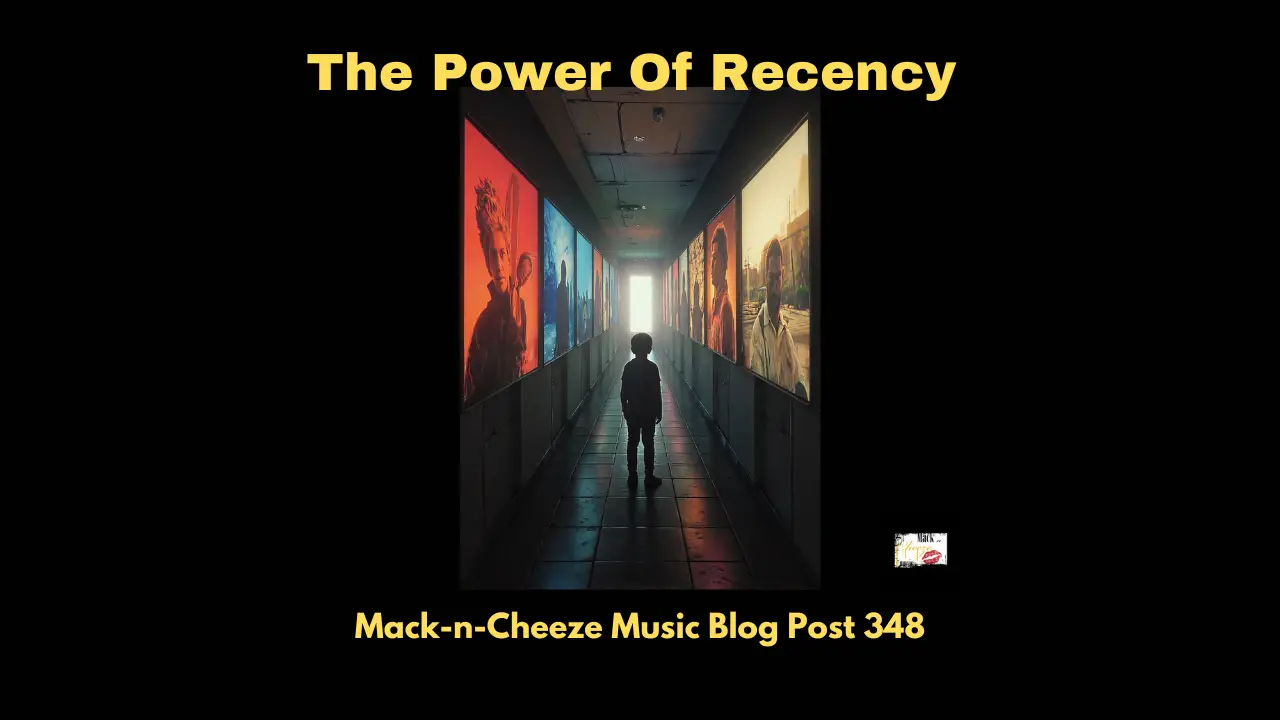
The power of recency is a cognitive behavior we respond to automatically.

Image generated by GeniGPT
Estimated reading time: 9 minutes
Table Of Contents
We give disproportionate weight to the last thing we hear, see, or experience. The encore at a concert, the closing line of a book, the most recent news headline, all impact us more than what came before. In art, this bias cuts both ways.
The Power Of Recency In Memory And Art

Image generated by GeniGPT
Recency creates urgency. Take our over-driven digital world. Every platform is engineered to feed on it.
The last notification lights up your phone and hijacks your focus. The latest post pushes the older one off the feed, even if the older post had more depth and relevance. News cycles churn not because the story is finished, but because something newer is available. Twitter, sorry, X, runs on nothing but recency; what’s trending is whatever just happened, not necessarily what matters. I left the platform because it was too noisy.
Streaming services aren’t much different. Spotify doesn’t promote your best track; it highlights your newest one. YouTube rewards the most recent upload with discovery boosts. TikTok buries last week’s viral clip under today’s trend. Algorithms don’t ask “is it good?”, they ask “is it new?”
Even banking is built on it. Real-time payments, Venmo, FedNow, and UPI in India have all leveraged recency. You don’t judge your bank by its century of stability; you judge it by how fast the last transfer hit your account. The power of recency shapes trust: one smooth instant payment, and you forget the years you spent waiting three business days for ACH to clear.
Psychologists call it the Recency Effect, a bias wired into memory. We don’t take in the whole arc evenly; we latch onto what just happened. That’s why the last brushstroke can define the painting, even if the earlier layers conveyed resonance. It’s why critics frame an author’s career around their latest book, not the dozen that came before.
Recency In Creative Art Forms
In music, that last encore is what really seals the deal. You can be bored to tears in the middle of the show, but if the band closes hot, the crowd will eat them up.
Movies aren’t much different. We can forgive the slow start, and often expect it, but we want the end to have a lasting impact on us, both psychologically and physically. Turn it around, and the film becomes almost incongruent. It does not make sense.
Art history is full of this distortion. Van Gogh’s last canvases, his turbulent skies and darker strokes, obscure his earlier, softer work. People see Rothko’s late somber fields and read his whole career backward through them. One closing period, one final show, one “last work,” and often the entire body of art is judged through that lens.
That’s recency bias at work in art: it doesn’t measure totality, it spotlights the finish. The mind rewrites the entire experience through the last moment.
Recency isn’t neutral. It bends memory, and sometimes it confuses it. When everything tilts toward the latest, the brain overwrites the long story with the most recent page.
One bad review can feel louder than a hundred good ones. A single rejection email can outweigh months of progress. I know that one well.
That’s the distortion: the last impression sticks sharpest, so it’s easy to mistake it for the only thing. You might be building your career brick by brick, but the brain zooms in on the last crack in the wall as if it defines the whole structure. Recency doesn’t just shift perception outward; it warps how you see yourself.
Orson Welles

Image generated by Dalle
Take Orson Welles. Everyone knows Citizen Kane is a masterpiece, often crowned the greatest film ever made. He was 25 when he pulled that off. But decades later, in Mike Nichols’ 1970 film Catch-22, Welles turned up as General Dreedle. By then, he was overweight, erratic, and by many accounts, sloppy in performance. Rumors swirled that he’d shown up drunk. Whether true or not, that image stuck.
For audiences at the time, this wasn’t the genius of Citizen Kane, but rather the caricature of a washed-up director cashing a paycheck. One flat performance outweighed thirty years of innovation. That is recency bias. The last stumble becomes the story, while the brilliance that built the reputation fades into the background.
Only with distance do we see the broader canvas: Citizen Kane, The Magnificent Ambersons, Touch of Evil, Chimes at Midnight. But in the moment, Welles’s late-career struggles rewrote the story. A weak “now” overshadowed a monumental “then.” By the late 1970s, he wasn’t remembered as the prodigy of Kane but as the booming voice in Paul Masson wine ads, intoning, “We will sell no wine before its time.”
Recency cuts both ways in feedback. The last compliment can inflate your ego; the last insult can hollow you out. Neither is the truth, but both feel definitive because they’re fresh. It’s natural to let the last compliment lift you or the last insult cut you, but living only in those moments can leave you vulnerable. That fragility burns out careers. Tying yourself to the latest reaction makes it harder to notice the longer story you’re actually building.
More Examples Of Recency Across Art Forms
Literature
Writers live and die by the “Last Book Bias.” A novelist with a long career can publish one weak title late in life, and suddenly critics frame it as evidence of decline. Ernest Hemingway’s The Old Man and the Sea (1952) was hailed as a comeback, while his posthumous True at First Light (1999) was panned and used to prop up the “washed-up” narrative. Recency skews the lens.
The same bias plays out inside a single book. Readers judge a novel not by the whole storyline but by how it ends. A strong closer redeems a sagging middle; a botched finale can poison an otherwise brilliant work. That’s Kahneman’s peak-end rule in practice: memory overweights the last impression.
Historical bodies of work ignore recency. Shakespeare wrote clunkers as well as masterpieces. Is his place in history judged by the last play he penned?
Visual Art
For painters and sculptors, the latest exhibition often carries more weight than the many that came before, even if it’s a minor show. A single flat gallery outing can reframe decades of strong work. Death magnifies this: an artist’s last canvases are treated as a summation, a “final statement,” whether or not that was true.
Pablo Picasso’s late works, looser, sometimes dismissed as crude, are often read as the whole story of his career, even though his Blue and Rose periods carried very different weight.

Image generated by Dalle
Georgia O’Keeffe’s late abstractions, painted while her eyesight was failing, are treated as her final verdict, while her earlier flowers and landscapes defined modernism.
Film
Directors are often defined by their last release. Francis Ford Coppola’s career is forever tethered not only to The Godfather and Apocalypse Now but also to his uneven late projects. Orson Welles, as we discussed, became in his later years the caricature, not the prodigy.
Even within a single film, endings dominate memory. A slow start is forgiven if the closing lands (think The Sixth Sense). But a bad final act, like many bloated Hollywood blockbusters, can erase the brilliance of the first two hours.
Some films break through recency bias. Citizen Kane wasn’t Welles’ last, but it defined him anyway.
Casablanca outlives Michael Curtiz’s later, weaker films. Some works are so strong they outlast the pull of “latest.”
Theatre And Dance
Stage performances live in the moment, and memory is dictated by the last one. A curtain call that brings people to their feet erases the stumble in Act II. A flat ending sends people into the night muttering, no matter how strong the beginning was.
For choreographers and playwrights, the most recent staging of a piece can also distort the work itself. A clumsy production of Hamlet colors the audience’s view of Shakespeare, as though the text itself faltered. Dance is even more susceptible: one awkward closing sequence can reshape the perception of the entire performance.
Revival classics outlast recency. Every new staging of Swan Lake or A Streetcar Named Desire offers another chance to reset perception.
Music
No art form feels recency bias more directly than music. Spotify and YouTube prioritize the newest release over the best track. A band can spend years perfecting an album, but what drives discovery is the last upload.
Critics and fans fall into the same trap. A weak final tour can cast a shadow over decades of brilliance. A bad last album can skew legacy. Bob Dylan’s later uneven records are judged against his 1960s peak, sometimes unfairly. Recency crowns the “now,” even when the “now” doesn’t matter.
Timeless catalogues always rise again. The Beatles haven’t released new music in decades, yet their body of work continues to find new audiences. Miles Davis’s 1980s pop experiments didn’t erase Kind of Blue. Recency shapes short-term perceptions, but over the long haul, endurance wins.
The Thread Through All Of It
Last impressions carry more weight than the whole body of work. Yet the counterweight is just as strong: over time, endurance, repetition, and recognition break the spell.
That’s the tension. Recency rewrites the story in the short term, but art that endures eventually escapes its grip.
Recency has a way of distorting the measure of truth.
So the question isn’t whether you should fight it or embrace it. The real question is how you use it. Do you let recency hijack your decisions, pulling you into the churn of “what’s next” at the expense of depth? Or do you bend it, wield it, design with it?
Keep recency in mind, but don’t mistake the finish for the legacy. The moment gets attention; the body of work gives it weight. And if this is the only line you remember, well… that’s recency doing its job.
Can We Help You?
Are you building for the moment, or for the body of work that will outlast it?

Thanks for reading. If this resonates with you, please share it with someone who could use a reminder. Drop your thoughts in the comments; we want to hear how recency shows up in your world. And if you don’t want to miss what’s next, hit subscribe. The conversation’s bigger than one post.
Want More Mack-n-Cheeze?
Videos - Bryan At Mackncheeze on YouTube
Podcasts – Bryan At Mackncheeze Apple Podcasts, Fountain, Spotify