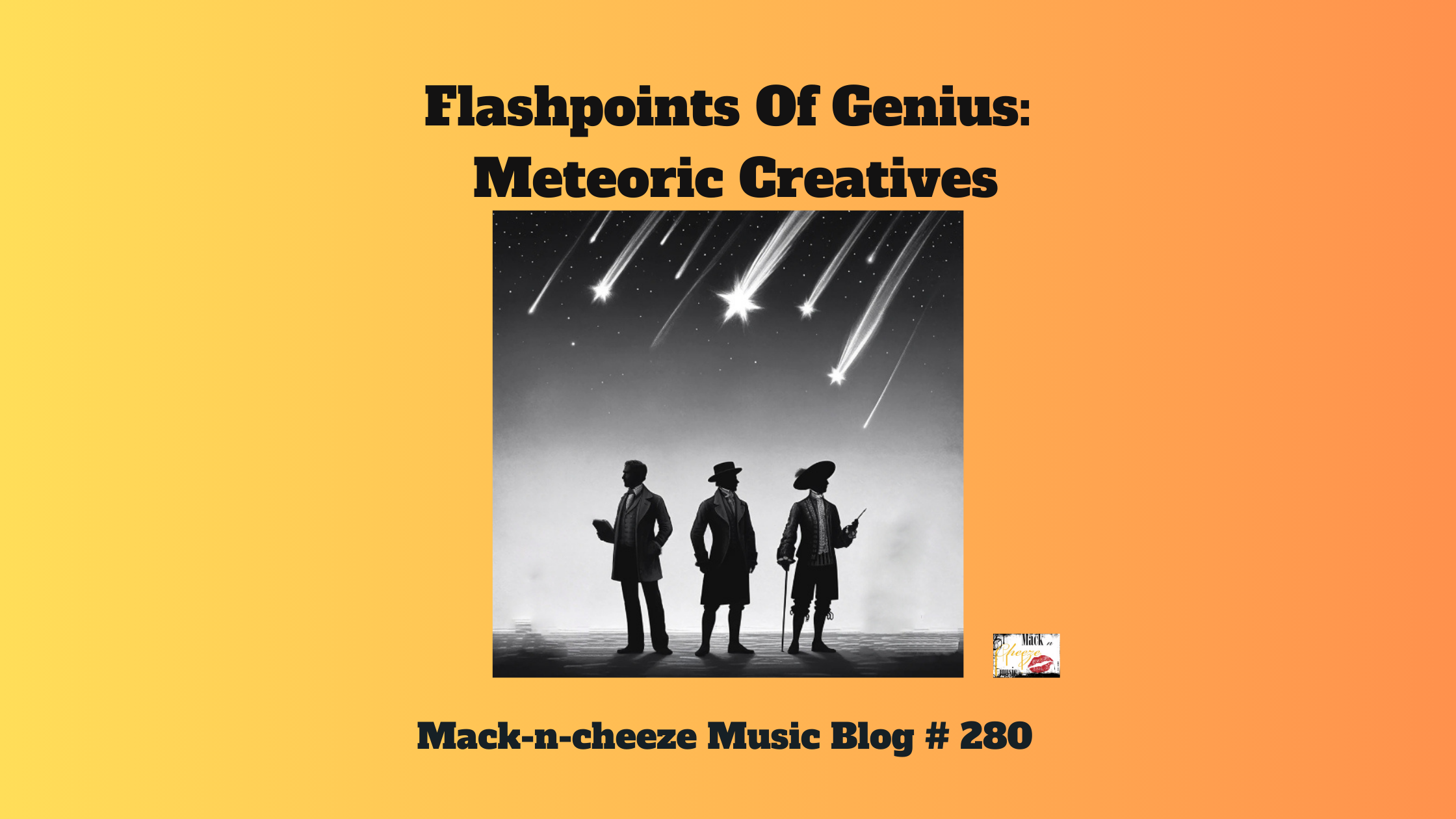
In the brief arc of a shooting star, we sometimes find the brightest light. “Flashpoints of Genius: Meteoric Creatives” explores the lives of three such luminaries. Each burned with a fierce fire. We lost them while they were still in their prime. They left behind legacies that still influence and inspire.

Estimated reading time: 11 minutes
This is their story – simple, direct, and profound.
Table Of Contents
The Fleeting, Enduring Impact Of Brilliant Genius
“Meteoric creatives” are extraordinary individuals whose careers were brief. Yet they mirror the fleeting, brilliant path of a meteor streaking through the sky.
Time on earth was short-lived for these artists, writers, musicians, and thinkers. Their creative genius left a lasting legacy. Their enduring mark continues to influence and resonate within cultural consciousness.
‘Meteoric creatives’ often introduce new styles, perspectives, or techniques, disrupting established norms. Their vision pushed the boundaries of their art form, and the importance of their contributions remains relevant for years after their passing.
From them, we learn of the interplay of brilliance and brevity. The work they have left us gives us insight into the human condition. We gain knowledge of creativity’s potential to transcend the limitations of time.
Georg Büchner, John Keats, and Jean-Michel Basquiat are captivating and rich in their narratives. These three figures, each from different epochs and expressing distinct artistic mediums, embody the intense burst of creative brilliance and the tragic brevity of life.
Georg Büchner

Georg Büchner was a German dramatist, writer of prose, and a revolutionary. Büchner was born on October 17, 1813, in Goddelau, Hesse-Darmstadt, Germany. His father, a well-educated man and a strict bureaucrat., ensured that Georg received a robust education from a young age. This foundation set Büchner on a path of intense intellectual curiosity.
By the age of 16, Büchner enrolled at the University of Strasbourg. Here, amidst the backdrop of student life and revolutionary ideas, he studied medicine and steeped himself in philosophy and political science. The atmosphere in Strasbourg, alive with the ideals of freedom and equality, sharpened his political sensibilities. This period marked a formative phase in Büchner’s life, laying the groundwork for his future literary and political endeavors.
In 1834, at just 21 years old, Büchner covertly penned the radical pamphlet “The Hessian Courier,” critiquing social injustices and calling for political upheaval. The pamphlet’s incendiary content made him a target for authorities.
Undeterred by the threat of arrest looming, Büchner fearlessly pursued his academic and creative passions. Amid this peril, he began crafting ‘Danton’s Death,’ a play that delved into the heart of the French Revolution. This work, completed in a mere five weeks of 1835, was a testament to his unwavering commitment to societal and ethical exploration.
In 1836 Büchner moved to Zurich, where he accepted a position as a lecturer in comparative anatomy. Amidst his academic responsibilities, he continued to write. Leonce and Lena, a satirical comedy, emerged during this period, showcasing his versatility in moving from the gravely severe tones of “Danton’s Death” to the absurd.
Büchner’s Genius
His final major work, the play “Woyzeck,” remained incomplete at his death. This fragmentary narrative, based on the real-life case of a soldier who murdered his lover, delved into themes of poverty, mental health, and societal oppression. Even in this unfinished state, Büchner’s ability to encapsulate complex human emotions and social critiques in his texts was evident.
Büchner’s life was profoundly shaped by his political engagement, a facet that significantly influenced his work. He was a radical, actively participating in the revolutionary movements of his era. His political endeavors included the establishment of the Society for Human Rights in Giessen, a platform that sought to advance revolutionary ideas and was inspired by the July Revolution of 1830 in France.
Büchner’s work, though limited in quantity, stands out for its innovative use of language and its exploration of profound themes such as existential despair, social injustice, and human suffering. His distinctive ability to blend poetic language with stark realism has left an indelible mark on numerous writers and playwrights. A Testament to this is the various adaptations of his work, including an opera by Alban Berg titled “Wozzeck,” based on Büchner’s “Woyzeck.”
Georg Büchner’s profound impact on literature is remarkable, considering the shortness of his life and career. His works continue to be studied and performed, resonating with contemporary themes and challenges.
Timeless Genius: Reflecting Society Through Art
Büchner, Keats, and Basquiat: How Are They Similar?
Though separated by time and artistic medium, each responded to the cultural climate. Their works served as profound commentaries on respective societies. Each delved into the core of human existence, societal norms, and personal anguish. With power and emotion, their work transcends time and place. These visions speak to universal experiences that resonate across generations.
Each master possessed a distinctive and powerful artistic voice. This allowed them to create works with profound emotional and intellectual depth. Büchner’s plays dissect the mechanics of power and morality. Keats’s poems render the poignancy of the human condition through sensory experience. Basquiat’s paintings confront issues of race and class with vibrant, chaotic intensity. This fervor in their work commands attention and compels reflection. What remains is a lasting impact on audiences and readers.
All three artists explored universal themes: mortality, identity, suffering, and injustice. Each work delves into these profound subjects, provoking deep philosophical reflection. As a result, their art remains relevant across generations and cultures.
Each artist challenged prevailing ideologies and invited their audiences to reconsider established narratives. Büchner critiqued the political disillusionment of his era. Keats responded to the mechanization and rationalism encroaching upon the natural and spiritual realms. Basquiat highlighted the stark realities of racial and economic disparities in modern America.
Despite their short lives, the impact of their work has been extensive and enduring. Each has influenced not only their own fields but also broader cultural discussions. Their works have inspired countless artists, writers, and thinkers, creating a powerful legacy. These creations continue to be revered for their innovation and deep insight.
John Keats

John Keats, a unique voice in the Romantic movement, was born in London on October 31, 1795. His literary career was brief, lasting only four years. Keats’s poetry left an indelible mark before his untimely death at 25. Lord Byron and Percy Bysshe Shelley were notable contemporaries.
Keats experienced early trauma with the death of his father at age eight. His mother succumbed to tuberculosis six years later. The eldest of four children, these losses ushered in a period of emotional and financial turmoil. Keats initially pursued a career in medicine. Yet, after securing a surgeon’s license, he soon abandoned medicine for poetry.
In 1817, Keats published his first volume of poems, which, despite a lukewarm reception, hinted at his potential. However, it was during the years 1818 and 1819 that he experienced a significant artistic breakthrough. This period saw the creation of his most celebrated works, including “Ode to a Nightingale” and “Ode on a Grecian Urn.” These poems, renowned for their vivid imagery and contemplative nature, marked a turning point in his career, solidifying a place in the literary canon.
Keats’s Genius
Keats’s poetry often featured a deep engagement with the sensory world, balancing the dualities of pleasure and pain, life and death. His philosophical approach to embracing uncertainty, termed “negative capability,” became a cornerstone of his poetic identity.
Health issues plagued Keats from 1820, as he showed signs of tuberculosis. Following medical advice, he relocated to Italy, hoping its milder climate would improve his condition. Nonetheless, Keats passed away in Rome on February 23, 1821, and was laid to rest in the Protestant cemetery there.
Keats’s lifetime saw little commercial success, and he often faced critical harshness. Yet, posthumously, his reputation flourished, positioning him as one of the great British poets whose influence persists in global literary circles. His letters, too, are valued for their insightful and candid reflections on literature and life. Though his life and career were short, John Keats’s contributions to poetry endure.
The Intertwining Of Genius
Büchner pioneered modernist and existential literature techniques, with his play “Woyzeck” influencing Expressionist and Absurdist movements. Modern playwrights use his approaches to character complexity and socio-political issues, exploring psychological depths and societal critiques. His life underscores the power of art as activism.
Keats is known for blending aesthetic philosophy with the human condition. His concept of “negative capability” has broadly influenced arts and philosophy. Today, his works remain crucial to understanding the roles of beauty and emotion in art and inspire a focus on sensory experience and emotional truth.
Basquiat transformed the art world with his graffiti-inspired works. He challenged traditional art norms and focused on marginalized voices. His impact continues in how contemporary art addresses social inequalities and incorporates street culture. Basquiat exemplifies the importance of authenticity and cultural commentary in art.
These masters demonstrated how art transcends individual creators to reflect and influence broader societal issues. Their enduring legacies inspire artists to embrace integrity and pursue creativity in all circumstances, significantly impacting society.
Jean-Michel Basquiat

Jean-Michel Basquiat was an influential American artist known for his raw and vibrant vision. This perspective of often confrontational paintings emerged from the New York City graffiti subculture of the late 1970s and early 1980s. Born on December 22, 1960, in Brooklyn, New York, to a Haitian father and a Puerto Rican mother, Basquiat’s cultural heritage profoundly influenced his work.
Basquiat was a precocious child who learned to read and write by age four. His mother encouraged his interest in art, frequently taking him to museums in New York. As a teenager, he was hit by a car, which led to a long convalescence during which he read and drew extensively. He attended Edward R. Murrow High School but dropped out at 17, eventually receiving a GED.
Basquiat began his artistic career as a graffiti artist in the late 1970s under the pseudonym “SAMO” (short for “same old shit”), collaborating with his friend Al Diaz. The graffiti featured enigmatic epigrams in Manhattan’s Lower East Side. By the early 1980s, he transitioned from street art to painting. His work incorporated words, symbols, stick figures, and a mashup of imagery from different cultures and histories.
Basquiat’s Genius
His art gained recognition quickly, and in 1982, he exhibited internationally. Basquiat’s work was characterized by a frenetic, raw style with bold colors and complex compositions that mixed text and figurative elements. His paintings often addressed themes such as race, politics, and urban life, and he drew inspiration from his heritage, music, and pop culture.
Basquiat was part of the 1980s art scene, including artists like Keith Haring and Kenny Scharf. He also collaborated with Andy Warhol, which was one of the most significant professional relationships in his career. However, this collaboration was sometimes seen as controversial and speculated to be exploitative.
Basquiat struggled with fame and the pressures that came with it. His work was both lauded and criticized, and he faced racism and misunderstanding in the art world. He used drugs heavily, and his heroin addiction worsened over time. Jean-Michel Basquiat died on August 12, 1988, of a heroin overdose at his art studio in Manhattan.
Despite the brevity of his career, Basquiat left an unforgettable mark on the art world. His work, renowned for its profound depth, unbridled energy, and fearless exploration of identity and social issues, continues to resonate.
Basquiat is now hailed as a neo-expressionist pioneer, and his paintings grace the walls of prestigious museums worldwide. His artistic vision remains a guiding light for contemporary artists, and his works are highly coveted in the art market, often fetching staggering prices at auctions.
And In The End
The legacies of Büchner, Keats, and Basquiat teach that art can transcend the individual. Creative vision can act as a conduit for broader societal reflection and change. Their lives and works inspire us to pursue our work with integrity and courage. This is a stark reminder that creativity can flourish under any circumstance. Our imagination’s eye can profoundly impact our world.
Can We help You?

Thank you sincerely for engaging with our journey through the lives and legacies of some of the most meteoric creatives in history. Your interest and time are deeply appreciated as we continue to explore and celebrate the brilliance of these incredible figures.
If this exploration of boundless creativity and profound impact has moved you, please share this blog with friends, family, or anyone who cherishes the power of art and history. Help us spread the word about these remarkable stories that echo through generations.
Your thoughts and perspectives enrich our community immensely. We invite you to leave a comment below – whether a reflection, insight or personal connection to the stories shared here. Your voice is crucial in continuing these vital conversations around art, legacy, and the human experience.
TPlease subscribe to our blog to continue this journey and take advantage of future explorations. Be part of a community that values deep dives into the lives of artists who have shaped our cultural landscape. Let’s keep the flames of inspiration burning brightly together.
Want More Mack-n-Cheeze?
Videos - Bryan At Mackncheeze on YouTube
Podcasts – Bryan At Mackncheeze Apple Podcasts, Fountain, Spotify
Leave a Reply