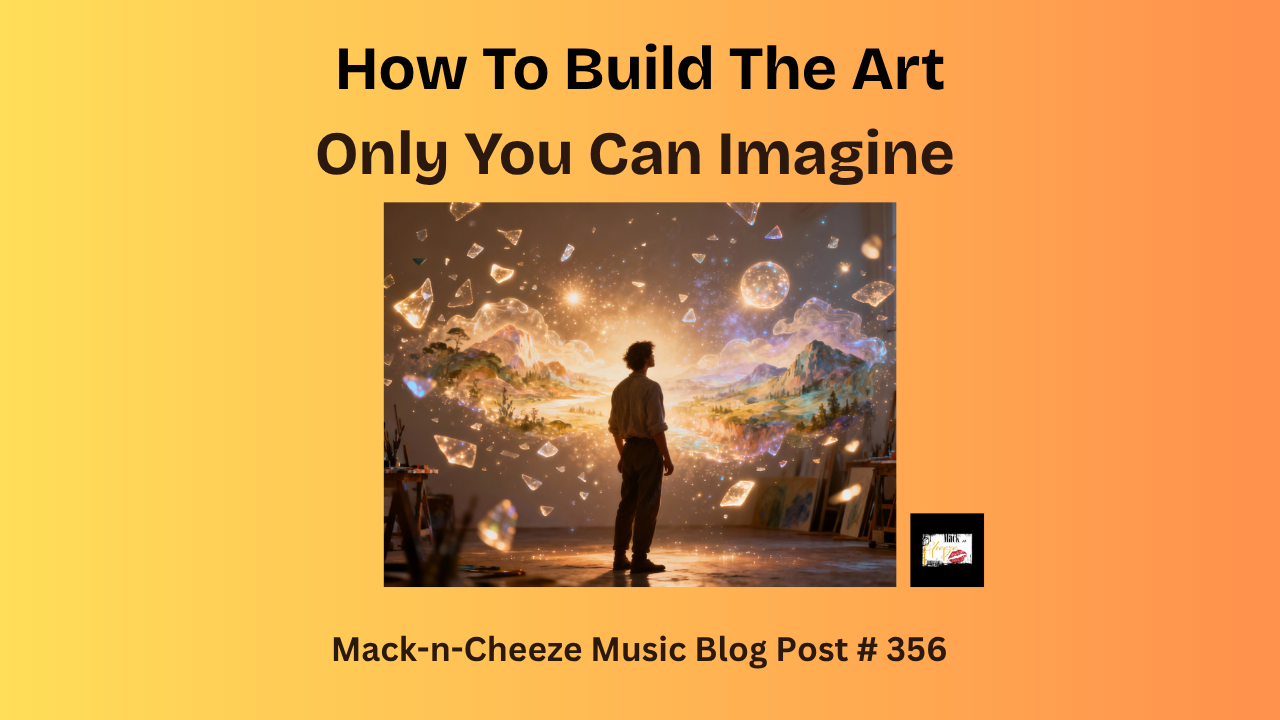
To create original art is to build a world that doesn’t exist yet. This world I speak of is our new creations, of which we have not brought into existence. If you believe God spoke the universe into being, then we, being His creation, His children, have the power to speak our worlds into existence.
Estimated reading time: 10 minutes

Image generated by GeniGPT
Table Of Contents
Perspective On Creating Art
From the evolutionist’s point of view of creative power, art isn’t a divine inheritance but an evolutionary advantage. Creation is a byproduct of the brain’s relentless drive to adapt and survive. Creativity is about anticipating what lies ahead. By recognizing changes in the environment and the seasons, and by viewing the stars, our ancestors learned to predict, prepare, and prosper. Long before tools were forged or symphonies composed, imagination was survival’s secret weapon.
Early humans who could visualize the unseen could picture the hunt before it happened, sense danger in patterns, or invent ritual and rhythm to bond tribes. These were the ones who made it. Over time, that same neural circuitry for prediction, problem-solving, and storytelling evolved into what we now call creativity.
There is no correct viewpoint. In the act of art, if we knew what we were doing, we would have done it already, time allowing.
So whether you believe in a divine spark or evolutionary wiring, the mission remains the same: to build what doesn’t yet exist. The world doesn’t need another echo; it needs a new sound to step into the unknown, to create the thing you can’t yet describe, and to let your art become the bridge between what is and what could be.
The Illusion Of Right Answers

Image generated by GeniGPT
People crave formulas because formulas feel safe. The old myth says that if you just follow the steps, get signed, noticed, and approved, you’ll make it. That’s what we did in the eighties.
Does that formula really define creation? Sounds more like compliance.
Still toady, the industry runs on the illusion of certainty: playlists, algorithms, “best practices.” It’s comfort dressed up as progress.
It is fair game to question that. There is no real map, no permission slip, or guaranteed path. You are going to face the grind of making something honest while everyone else waits for validation.
In the old days, it was the recording contract, concert tours, and airplay. Most of that used to fall on the record company to handle.
Even in those times, when the record company controlled everything, you still had to be at the top of your game.
Everyone starts from scratch, regardless of ability or the talent you began with; none of it materialized out of thin air.
A hundred years ago, take the old Hollywood studio system. Warner Bros., MGM, and RKO were factories of cinema. Writers, Producers, cameramen, musicians, and the actors themselves were all part of the factory.
And the studio developed talent. The actors themselves were put under contract for development and nurturing. For example, Judy Garland from The Wizard of Oz. Seemingly so sweet and talented. The studios brutalized her, keeping her alternatively on barbiturates and amphetamines depending on how long they needed her. Pure abuse.
But the studio created something out of nothing, guided by its vision. The persons themselves were fodder at the studio owners’ beck and call.
New Questions
For us creatives, it is about asking questions. We don’t want to answer old questions, for obvious reasons. Those answers are already there. Plus, we have innumerable resources at our fingertips, literally.
Ideally, we want to fill the gaps in all human knowledge. I’m not that smart. I’m looking for the gaps, but I’m not confident enough to believe I am the next Elon Musk or Salim Ismail. I should heed my own advice and not defend my limitations.
But what can be asked are those things deeply personal to you. Sometimes that’s about asking questions you are afraid to ask. First off, what do you fear most? That deserves addressing. What are you willing to do about that? How do you address those questions?
Is renewal vital to you? Discipline? These are old questions, but they might be new to you, or things you may not have considered.
Your Audience

Image generated by GeniGPT
Do you even know who they are? Maybe you don’t.
Here’s the thing: your audience isn’t some mysterious group out there in the digital fog. They’re versions of you. The people drawn to your work will share your curiosities, frustrations, and hungers. So start there.
Write down what moves you. The stuff that keeps you up at night, the rabbit holes you fall into, the art that makes your pulse jump. That’s your compass.
If it speaks to you, it will talk to them. If you don’t know what drives you, how can you expect to find the people who’ll care?
Start simple. Picture one person who would love your work, only one. Give them a name, an age, a job, a playlist. What frustrates them? How do they stay inspired? What are they running from, or chasing?
This isn’t about market research; it’s about empathy. You’re not trying to sell yourself, you’re trying to connect.
Once that person feels real in your head, you’ll know what they will listen to. Create for them, not at them. Empathy.
Impressionists broke from the Académie des Beaux-Arts. Funny, the Académie des Beaux-Arts is still around. I have contacts affiliated with the academy.
The Impressionists painted light, not lines. What they saw, not what they were told to see.
Punk stripped music to the bone. Three chords, no apologies. It wasn’t about polish. It was about pulse.
Hip-hop turned turntables into instruments. Beats from scraps, truth from rhythm. It didn’t wait for permission.
The folks who originated these genres saw a wall where others saw a rule. And built a new world on the other side.
The Blank Page Problem

Image generated by Dalle
We all face this, and not all of us overcome it. The silent stare of the blank page.
You have that session that won’t cooperate, an empty page, a lump of clay waiting for you to mold it.
It’s not just empty; it’s judgmental. It dares you to prove you have something worth saying.
The problem isn’t the emptiness. It’s fear, fear of starting wrong, wasting time, and of not being as good as the idea in your head. But the truth? The page only fills when you stop trying to get it perfect and start making it real.
The Examples
Coltrane
John Coltrane mastered structure, then broke it. Giant Steps proved his command of complex harmony, but A Love Supreme showed music as prayer. Critics called it “a spiritual manifesto. ” Pianist Tommy Flanagan admitted the harmonic demands of Coltrane’s work were beyond anything jazz had seen. By his final recordings, he’d left scales behind, chasing sound as a path to the divine. Coltrane didn’t just play notes; he built spiritual soundscapes that still redefine what creativity means.
Jimi Hendri
Hendrix merged fuzz, feedback, and distortion into one explosive language that the guitar had never spoken before. With the wah-wah pedal and his custom Octavia, he turned circuitry into emotion, bending electricity into voice. Tracks like Purple Haze didn’t just push limits, they erased them. That tritone-driven, octave-warped riff sounded like it came from another planet, and suddenly the guitar was no longer bound by what it was “meant” to do. Hendrix redefined the instrument. He didn’t play the guitar so much as reinvent it.
Jackson Pollok
Pollock did to painting what Hendrix did to the guitar and Coltrane did to sound; he broke it free from convention. Before him, painting was bound by form and representation. Pollock flipped the canvas to the floor, circled it like a performer, and let rhythm, gravity, and instinct take over. The motion became the masterpiece. Artistic pundits called it chaos. Pollock named his work as Energy Made Visible. Pollock’s art was rebellion in motion. Less about image, more about raw process and the pulse of creation itself.
Rembrandt
Rembrandt broke away from idealized portraits, showing flawed humanity and inner emotion. His later works — thick with paint and self-doubt — anticipated expressionism by centuries.
He painted what didn’t exist in art yet: truth stripped bare.
The Cost Of Playing It Safe
Safe art is often background noise. I look at my own work and realize I’m not cutting edge. I don’t know how to do that. Guilty of blending in, in a world of uninterrupted noise.
The world is full of creators and artists doing what everybody else is doing. Technically sound, or even great, but forgettable.
Regardless, you will never have a chance at anything unless you get started. Give yourself permission to get moving. It is imperative.
The Messy Middle
The creative process is chaos. False starts. Demos that never see daylight. Hard drives full of ghosts that no one will ever hear. It’s messy, unpredictable, and mostly invisible.
Failures aren’t wasted; they’re the price of admission. Edison called it “10,000 tries.” Miles Davis trashed entire sessions. Radiohead buried more songs than most bands ever record.
Same deal here. The grind no one witnesses. There are the rough takes, the rewrites, and endless tweaking. That is the cost to make something matter. The world only sees the final outcome. It will never see toil or smell the sweat of your endeavors. The truth is built in the foundation of your efforts, hidden by the facade of the house.
Building The World You Want
Our job isn’t to find the correct answer, but to create new answers.
What do you want your art to say that doesn’t exist yet?
That’s the question that separates the originals from copyats. The way I see it, anyone can imitate; few are willing to build what isn’t there.
Too often, my work fits too neatly into what already exists, which means I’m playing it safe, and safe art never changes anything.
What sound, image, or idea are you willing to risk looking foolish for?
What am I willing to risk for my art? Well, it’s everything. I’m putting it all on the line.
That’s where the edge lives, where discomfort meets originality. Every artist who ever mattered looked foolish before they looked brilliant.
Coltrane was called noise.
Pollock was called chaos.
Hendrix was called reckless.
But they kept going until the world caught up.
Who do you need to collaborate with to make it real? In my case, everyone I can.
Nobody does this alone. The right people don’t just agree with you. They stretch you, challenge you, sharpen you, and they will show up if you let them.
Find the ones who see what you’re trying to build before it exists. The ones who can take the spark and help turn it into a fire.
Your art is your rebellion against what’s already been done.
So build what doesn’t exist yet. And be willing to look foolish while you do it. Oh, wait, I already am.
Can We Help You?
What are you envisioning to create that doesn’t exist yet?

If this hit a nerve, good. It’s supposed to. The world doesn’t need more safe art; it needs what only you can make. So start now. Build what doesn’t exist yet.
Drop a comment below and tell me what you’re creating. Share this with someone who’s stuck staring at their own blank page. And if you believe in the fight to create original art, subscribe. We’re just getting started.
Want More Mack-n-Cheeze?
Videos - Bryan At Mackncheeze on YouTube
Podcasts – Bryan At Mackncheeze Apple Podcasts, Fountain, Spotify