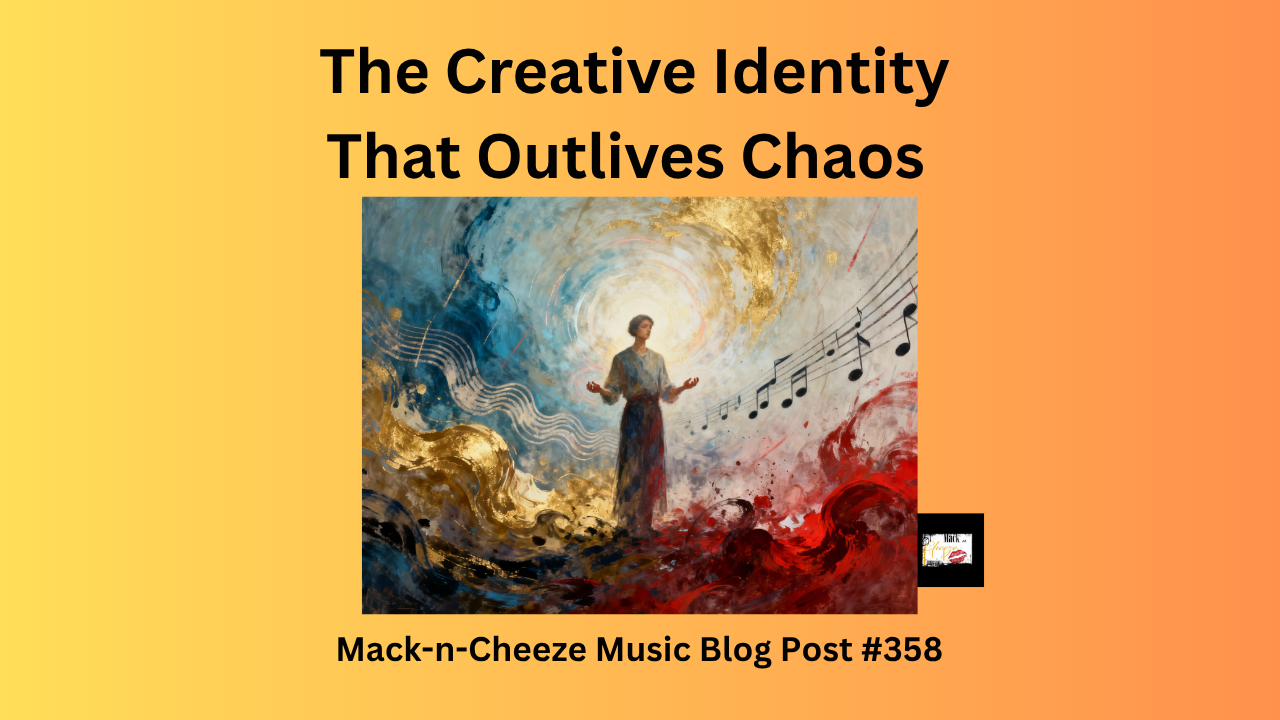
A creative identity isn’t tested when things run smoothly. It’s tested the moment the ground shifts. The test comes when the room changes, the tools fail, or the routine that held everything together suddenly becomes unstable.

Image generated by GeniGPT
Estimated reading time: 8 minutes
For some, the shift comes slowly. For others, it hits without warning.
If The Environment Cracks, Does Your Identity Crack With It?
Most creators avoid that question. It’s easier to pretend stability is permanent than to admit how much confidence depends on familiar rooms, predictable rituals, and the illusion of control.
But when those supports weaken and the crap hits the fan, it leads to the question of what part of your identity is built on the environment instead of the work?
And that’s where collapse begins.
A creative environment can fail in a hundred ways, financially, physically, emotionally. When it does, the identity built on top of it begins to wobble.
Often, the creator discovers the truth they’ve avoided. Their identity wasn’t internal. It was environmental. The fear isn’t losing tools. It’s realizing how much of the self was anchored to them.
This blog isn’t here to soothe that fear.
It’s here to examine it.
It starts with the fundamental question:
How do you build a creative identity that survives even when everything around it doesn’t?
Because once the environment shows its fragility, every assumption you leaned on breaks. The room isn’t promised. The tools aren’t guaranteed. The routine isn’t protected. And if the identity depends on any of these, then the identity is temporary.
That’s the hinge of the whole problem. Fear stops being emotional and becomes diagnostic.
The Hidden Trap

Image generated by Dalle
Most creators never notice how tightly their identity is intertwined with the environment that supports it. The room becomes the anchor, tools become the confidence, and the ritual becomes the rhythm.
The conditions that feel “right” quietly become requirements.
Nothing seems dangerous while it’s working. It feels like discipline and control. But it is a dependency.
Because the moment the environment shifts, when the room is gone, the tools fail, or the routine breaks, the identity built upon it begins to fracture. Not because the work is impossible, but because the identity was external all along.
Call it a personal flaw if you want, but it is more structural.
Most creative identities are built the way workspaces are built: piece by piece, tool by tool, habit by habit. This nails who I am.
And it all works beautifully until the first external piece moves. Then the identity shakes right along with it.
The danger is not in losing the room. The threat is discovering how much of yourself was built on it.
The Psychological Shock
When a creative environment destabilizes, the work doesn’t collapse first; the mind does. Instability affects identity before it affects output.
The imagination jumps straight to a list of endings.
Is this the end of the project, my momentum, and identity?
Is this the end of self?
That reaction isn’t dramatic or irrational. It’s mechanical. A creative identity built on external stability interprets disruption as an existential threat because, in a way, it is. The architecture wasn’t designed to survive instability.
The point is that what collapses can be rebuilt. And rebuilt correctly.
A Case Study in Survival: Maisara Baroud
When the war in Gaza started, Maisara Baroud lost everything. He lost his home, studio, and tools. All he had left was a sketchbook, a phone, and the refusal to stop creating.
Every location he fled, Jabalia, Khan Younis, and Rafah, took something from him. The drawings continued anyway.
His series, ‘I Am Still Alive,’ represented the purest form of identity stripped down to its creative essence without conditions. His resources were depleted, and only the act of creation remained.
That act of art carried his identity when everything else was erased. And because the work survived, the world responded. Exhibitions. Print sales. Licensing. His visibility reached far beyond Gaza.
In June 2025, that visibility became a matter of survival. A French evacuation program for endangered artists rescued him and his family from Rafah and brought them to Marseille. The environment changed. The safety returned, and his work didn’t change.
His identity wasn’t tied to the room. It was tied to the practice.
Identity Rooted in Practice, Not Place

Image generated by Dalle
Here is the takeaway: Your identity comes from the work, not your space.
A workspace shapes rhythm. Tools shape workflow. Conditions shape momentum. However, none of these can serve as the foundation of identity. They’re supports and tools, practical, but temporary.
Identity built on process can travel. Identity built on place cannot.
This isn’t about grit or toughness, but it is about mental architecture.
Build on what you can carry.
Jon Morrow: Creating Without a Functional Body
Jon Morrow has spinal muscular atrophy. He can’t use his arms, legs, or hands. Writing isn’t a choice between laptops or notebooks. He has built a successful career in blogging and business by using assistive technology. His tools include a lip-operated mouse and voice-controlled software.
His physical environment fails constantly: medical emergencies, hospital stays, equipment malfunctions, and the ongoing reality that his body can’t support the work in any traditional way.
Yet he built multiple million-reader blogs.
Not because conditions were favorable, but because he built a creative identity that didn’t depend on physical stability, routine, or ideal tools. His environment is unpredictable by definition, so he works with what remains. And that is his mind, and whatever technology keeps him connected.
There are lessons to be learned from Morrow’s example. A creative identity collapses only when it’s built on things that can be taken away. He built his foundation on his thinking, clarity, and his commitment to show up in whatever limited form was possible that day.
John Morrow is a modern case study of someone whose environment is permanently unstable, yet whose creative output remains intact because the identity doesn’t depend on the room or the body.
Minimal Viable Creativity
Nothing about unstable conditions is ideal. But they’re the real test. A creative identity that survives constraints is internal. One that collapses under inconvenience was never identity. It was a controlled environment propping up the work.
This is where minimum viable creativity matters. The smallest repeatable action that keeps the identity alive.
Grab A few minutes or one line. Grasp the idea before it evaporates.
One idea before it evaporates.
This is not performance or productivity. It is maintenance.
Because once creativity can move, the identity becomes free of the environment, ritual, and routine. You become adaptable because you want to survive.
Remove the Single Point of Failure
The single point of failure is always the same:
Identity is built on one condition. Call me guilty.
A resilient identity isn’t a pillar. It’s more like a framework. If one part breaks, the rest holds.
A resilient creative identity doesn’t negotiate with conditions. It adjusts internally instead of begging the environment to cooperate. It finds the next workable angle, functional method, and the next available fragment of time. Not because it’s heroic, but because it’s designed to function that way. When identity is built correctly, disruption isn’t an ending, it’s just the next constraint to work within.
Jean-Dominique Bauby: Success, Then Collapse
Before everything fell apart, Bauby was exactly what most creators claim to want.
He was the editor-in-chief of French Elle, a respected figure, connected, and moving through Paris with the kind of professional momentum people post online to prove they’ve “made it.” He had the room, the team, the deadlines, the meetings, the entire creative machine behind him.
Then one stroke shut his body down. Locked-in syndrome.
No movement, speech, or any way to communicate except one eyelid.
Everything that had defined his creative identity was erased in a single moment. His previous success didn’t cushion the blow, buy him time, or save him. It evaporated with the rest of his physical autonomy.
The only thing left standing was the part of him that could think.
So he used that. One blink at a time.
He wrote an entire book, The Diving Bell and the Butterfly, by blinking letter by letter while someone read the alphabet to him on repeat.
His identity and creative desire were stripped down to their most essential components. He was left with intention and the smallest possible method of expression.
Bauby forces a question most creators avoid:
If your environment disappeared tomorrow, if the conditions that make you feel creative were to go up in smoke, would anything be left?
He proves that when identity is internal, it continues.
When it’s external, it dies with the environment.
The Unavoidable Truth
Every creator will eventually face the collapse of their environment.
The only real question is: What survives after the conditions disappear?
You already know the answer.
The work you can carry is the work that will carry you.
Can We Help You?

Your environment can fail. So can your tools and routine.
Your identity can’t.
Take one small, portable action today that demonstrates your work can be easily moved with you.
Then comment with your takeaway, share this with a fellow creator, and subscribe so you don’t miss what’s next.
Want More Mack-n-Cheeze?
Videos - Bryan At Mackncheeze on YouTube
Podcasts – Bryan At Mackncheeze Apple Podcasts, Fountain, Spotify