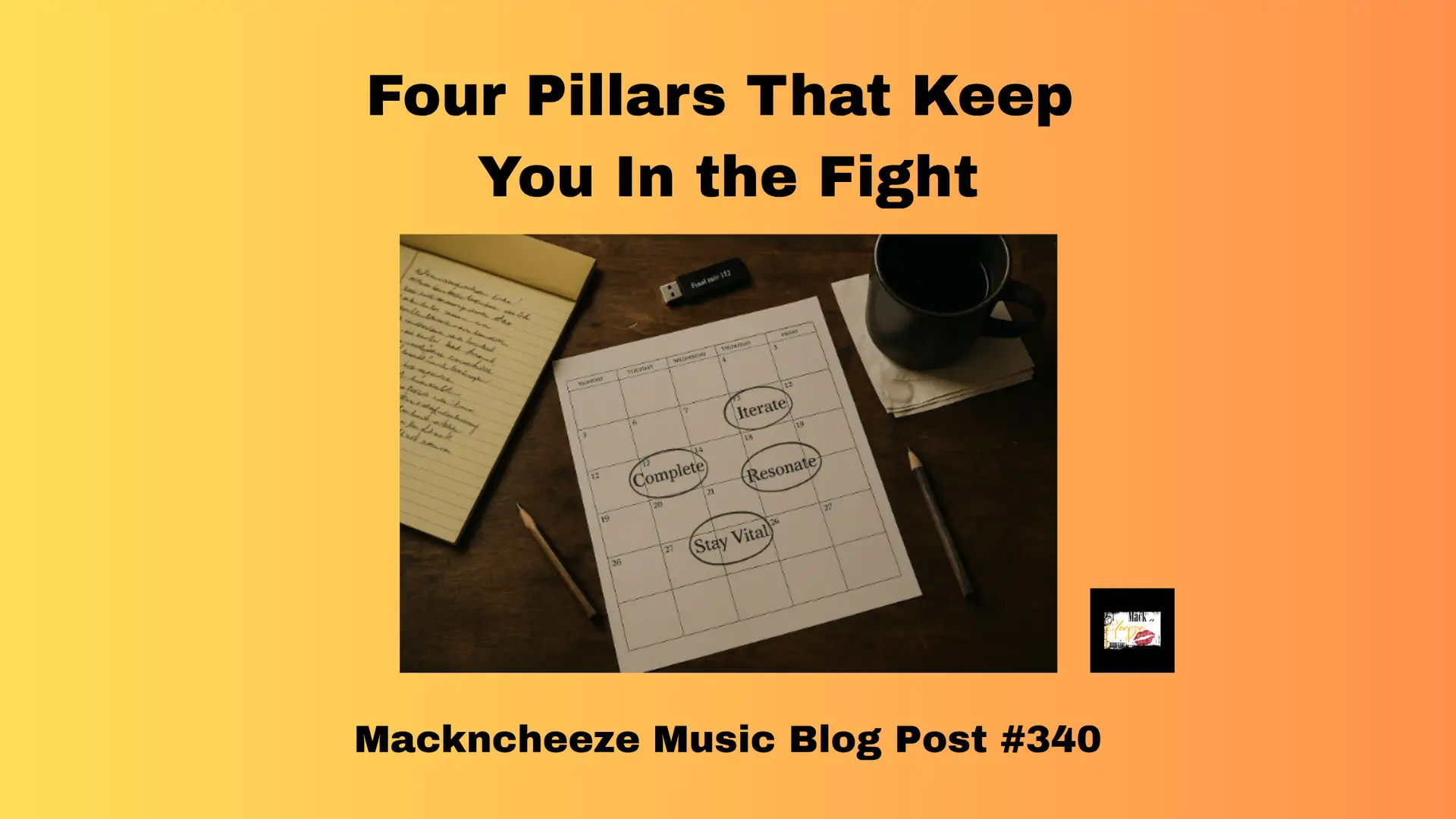
The Four Pillars aren’t just principles; they are the foundation I keep building on that stops everything from collapsing.
Estimated reading time: 11 minutes

Image generated by Dalle
Table Of Contents
Your creative life can fall apart in an instant, though it’s unlikely. What is more probable is that your creativity will slowly rot in half-finished projects, lead to quiet burnout, or you will live through the creeping erosion from “making art” to just “getting by.”
Talent is everywhere and that’s your competition. Discipline is not enough. It’s way too easy to lose focus and drift.
What most of us lack is something that cuts closer to the bone: a foundation strong enough to help us stay alive while we sort through the wreckage.
These Four Pillars emerged the hard way, when the rubber met the road, through collapse, recovery, and facing the pressure to give up.
Each one keeps the structure of my art standing. Remove one, and the whole thing shakes.
This is not about thriving. It’s about not walking away. It’s about staying in the fight long enough for something tangible to be built.
I gave them names:
Complete. Iterate. Resonate. Stay Vital.
These are the Four Pillars. I didn’t choose them; they came with the struggle.
Here’s what they mean, and why every one of them had to be embraced.
Pillar One: Complete

Image generated by Dalle
To complete is to finish.
Not when it’s perfect. Not when it’s easy.
But when it’s real. Released. Out there.
As Seth Godin puts it in Linchpin (Kindle ed., p. 82):
“Real artists ship.”
This is the habit. The Discipline. The code I have learned to live by. And I didn’t live it until I read Linchpin. Then I Understood.
Ideas don’t count until they leave your head and confront the world.
The book gets published. The track gets bounced. The blog goes live.
Until then, it’s just potential, and potential doesn’t amount to anything. Finished work does.
Most people never ship. Their ideas die on hard drives and in “someday” folders.
Completion Is a Discipline, Not a Mood
Completion is what separates creatives from fantasists.
The excuse “It’s not ready” is often fear in disguise. Perfection is a cage. Finished work evolves, fantasies don’t. What you do is what earns you feedback, momentum, and most importantly, a sense of identity.
Because finishing teaches what dreaming never can. It puts you in service, not just to your craft, but to those waiting to find it.
Completion is not an ego trip; it is a matter of respect. For the work, yourself, and the people who need what you make. If you want to grow, start by finishing what you’ve begun. Version one is the price of version two. Every evolution starts with something concrete on the table.
Want to stay in the fight? Then learn to finish what you start, publicly, honestly, and without apology.
Finish. Move On
“A work of art is never completed, only abandoned.”
— Paul Valéry, Tel Quel, 1957, later included in Œuvres Volume 3 (pp. 334–335)
How many of us waste months, or years, reworking the same project. Endless tweaks. Another “final” mix. One more revision that leads to another rabbit hole.
Once it’s good enough. I’m done. That’s living by the deadline.
Could I improve it later? Of course. I could rip it apart six months from now with fresher ears or a harsher lens. But that’s hindsight, not progress.
“To finish a work … means to be through with it, to kill it, to rid it of its soul, to give it its final blow—the coup de grâce.”
— Pablo Picasso, in a 1942 letter reprinted in Picasso on Painting: A Selection of Views (Giles, 1964), p. 128
Finished doesn’t mean flawless. It means free. The work is done, and I’m already on to the next one.
I’m often asked what my last blog was about. Frankly, I have no idea. Once scheduled to publish, out of sight, out of mind.
You don’t grow by redoing. You grow by doing something new, taking on a new project, igniting a new fire, and setting new stakes. You’re not building a statue to yourself. You’re building momentum.
Finish it. Ship it. Move on.
Pillar Two: Iterate

Image generated by Dalle
Here is the Merriam-Webster definition of “iterate”:
reiterate (verb)
Definition: to say or do again or again and again: repeat — especially to perform or utter repeatedly.
My approach to iteration is to shape it through friction. Keep rubbing against it till it gets hot.
Not to chase perfection, but to chase the truth inside of me. Not to get it right, but to get it real. It has to feel real.
Each pass strips away fluff, doubt, and the almosts.
We are not polishing, we are excavating. What’s real emerges only after enough of what it is not has been burned away.
Iteration isn’t the safety net for failure; it’s the gym for mastery, God help me.
“Creativity is allowing yourself to make mistakes. Art is knowing which ones to keep.”
— Scott Adams, RE/Search Newsletter #112, December 31, 2012.
You don’t grow by thinking about it. You grow by doing it again. And again. And again.
Are you listening to perfection telling you it’s not ready? In my world, it’s never ready.
Patterns Reveal Themselves Over Time
“Creativity is just connecting things…” — Steve Jobs, in a 2003 interview with Wired magazine.
How do you connect things? By looking at them over and over again. I’m not Einstein; I have to go over patterns over and over again before I can articulate. So did he.
Connections take cycles, and patterns don’t reveal themselves in the first draft. Patterns surface in the repetition. Any professional musician has lived by this.
When you expect to iterate, the failure of version one doesn’t crush you.
If you are here to be brilliant right out of the gate, you are in the wrong place. You’re here to get better.
And are your standards rising? That’s not evidence you’re falling short, but rather, evidence that you’re climbing.
Pillar Three: Resonate

Image generated by Dalle
To Resonate isn’t about being popular or reaching millions. Resonance is not measured by views, shares, or likes. It happens when your work gets under someone’s skin, when it names a feeling they couldn’t explain, and makes them stop scrolling when they feel understood. One person deeply affected is more potent than a thousand who barely pay attention. This is what it is to resonate.
You’re not here to make a clamor. You are here to pay attention, respond, live fully, and answer back through your work.
“To be an artist… It has to do with paying attention, remembering, filtering what you see and answering back, participating in life.” – Viggo Mortensen, Time Magazine, December 17, 2008
This is not projection; it is connection through resonance.
Authentic resonance pierces through the noise and applause. To resonate means you have said what someone else could not speak for themselves. When your truth is their truth, even if you have not met, that’s the spark.
Do you want to resonate? You can’t fake it. It is not a brand hacking strategy. It is more like sacrificing yourself, saying something true enough that it rattles in someone else’s chest. That takes risk, discomfort, and getting past the part of you that wants to be liked. If you don’t have heart for your work, it dies the second it lands. Nobody feels or remembers it. Nobody cares.
On a deeper level, John Gardner nailed it:
“The renewal of societies and organizations can go forward only if someone cares.”
— John W. Gardner, Self‑Renewal: The Individual and the Innovative Society, Preface (p. xv)
Want to go down another rabbit hole. Get the book. I did.
Make It Matter To You First
Art works the same way. If you want your work to breathe, If you’re hoping to stir something in someone you’ve never met, it has to anchor your core being.
And this is where networking emerges, not as self-promotion, but as a resonance infrastructure.
You don’t live in a vacuum. You’re trying to build bridges to collaborators, mentors, allies, and people who can carry your work further. You’re creating the conditions for connection because that’s how impact travels.
Resonance is never about perfect timing or perfect polish. It’s about having the courage to release the work and let it find its intended audience.
In sound, resonance is vibration. In art, it’s recognition. It’s “I feel that.”
You want your work to resonate? Then start by caring enough to show up, speak clearly, and reach out to someone beyond yourself.
No heart and no spirit means nothing resonates. Without resonance, nothing moves.
Pillar Four: Stay Vital

Image generated by Dalle
To Stay Vital means protecting your body, mind, and energy, so you can continue to show up for your tasks.
Talent means nothing if the body shuts down. Drive is useless if our brains are fried. Burnout isn’t just a productivity problem; it’s more like a collapse in disguise.
Vitality isn’t cosmetic. Staying vital is the fuel that lets you outlast the struggle.
Eat real food. Move often. Sleep like it matters.
Limit your hedonistic tendencies. We are artists and genetically built to thrive on endorphins. Often, we seek those pleasure hits outside of our art.
Don’t Numb The Signal
I love to eat and I like a good glass of wine. The point came when I had to make a decision. If life was going to remain good something had to change. It took time to do it right, but I’m fifty pounds lighter and not missing the over-indulgence.
But vitality isn’t just physical. It’s relational.
Never ignore those closest to you. At times, they may seem like a distraction, and they often are, but without them, there is no you.
Creativity shrivels in isolation. Your network, collaborators, mentors, and challengers are part of the oxygen supply. Keep the real conversation ongoing. Invest in the people who sharpen you. Check in. Ask better questions. Listen harder.
Vitality means refusing to flatline emotionally in your work or your connections.
Evolve Or Decay
Staying vital also means staying engaged. No coasting. No “phoning it in.”
It’s paying attention. It’s resisting autopilot and choosing to be in it every single time you show up. Because once you disconnect from what you’re making, it starts to decay. Not all at once, but quietly and fatally.
“There is a vitality, a life force, an energy, a quickening that is translated through you into action … because there is only one of you in all time. This expression is unique. And if you block it, it will never exist.”
— from The Life and Work of Martha Graham, Agnes de Mille (1991)
Finally, vitality demands evolution. Not rebranding for clout or changing for applause, though these are tempting. If you feel stale, seek the things that un-stale you. Let your work grow because you are still growing. Keep asking the hard questions.
Try what scares you. Tear down what no longer serves the work.
Vitality isn’t about remaining where you stand.
Vitality is staying in motion, in tension, and on fire.
Vitality is life.
Keep The Structure. Stay In The Fight
We have a dream, and we can taste it. Perhaps our outcome hasn’t reached its full potential and might not stand up to the scrutiny of idealized success.
But we can’t quit on the hard days.
Most people drift; they start strong and fade. It’s okay to get excited, but the excitement will eventually disappear.
Instead of living on adrenaline, I have learned to live on expectancy and encouragement. I’ve got some things worth making in many facets of my life, and the Four Pillars hold me steady.
Complete. Iterate. Resonate. Stay Vital. That’s the way through.
You don’t need to feel inspired. You need to keep building.
Not for applause. Not for fame. Just so the thing can exist.
That’s what separates the ones who keep going from the ones who disappear.
Hold the line.
Can We Help You?

How much of your creativity is instinct, and how much is structure?
If The Four Pillars hit something real in you, share it. Please forward it to the one person you know who’s still grinding.
Leave a comment below and tell me which pillar you’ve almost let slip, or which one’s keeping your roof from collapsing.
Better yet, subscribe. Join a community that’s not here for fluff, hacks, or hype, only truth, grit, and the work that keeps us alive.
We don’t rise alone.
Want More Mack-n-Cheeze?
Videos - Bryan At Mackncheeze on YouTube
Podcasts – Bryan At Mackncheeze Apple Podcasts, Fountain, Spotify