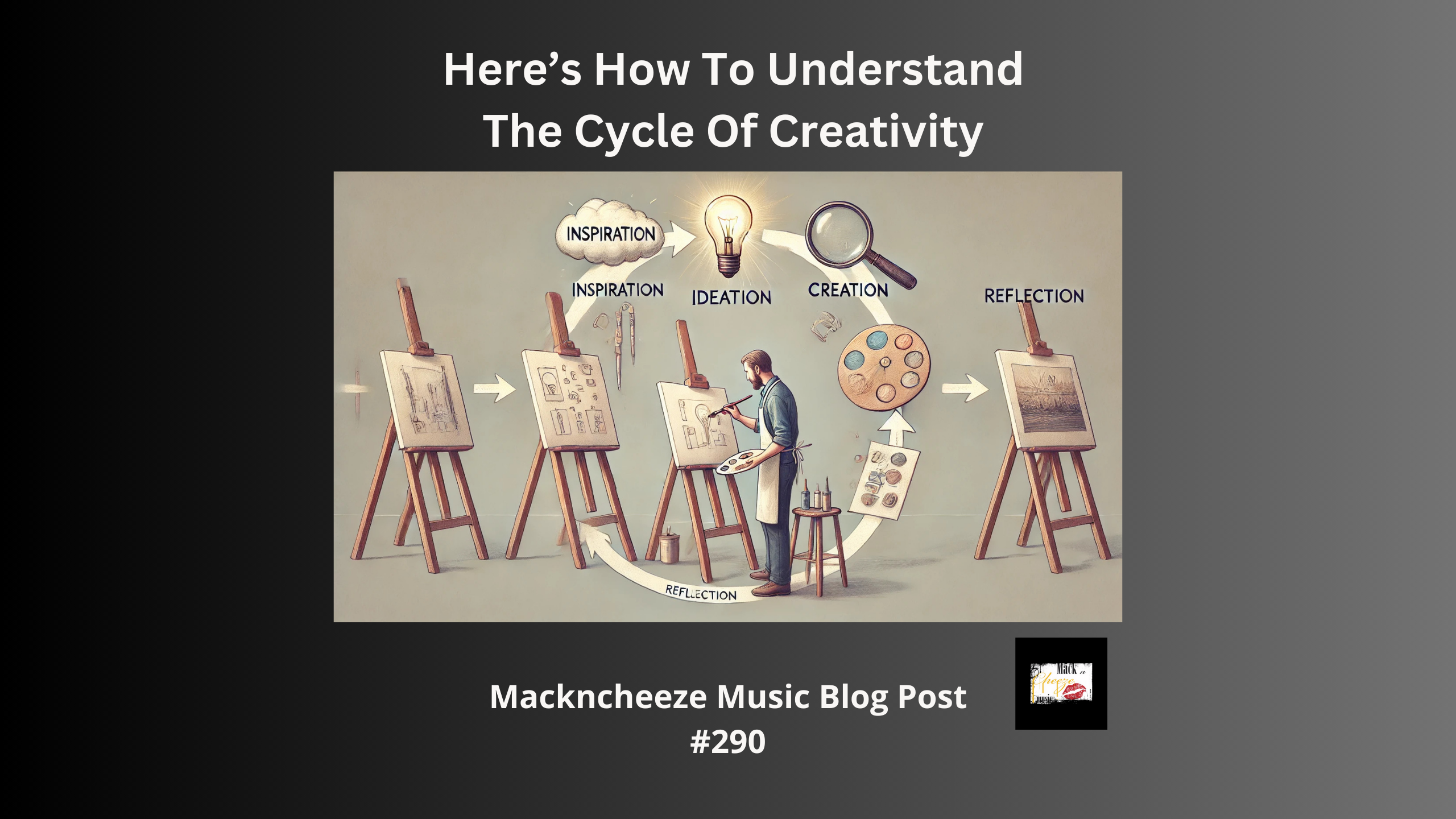
The cycle of creativity is a journey we artists know well, even if we don’t always recognize it. We live and breathe this cycle, moving from inspiration to creation and back again. As artists, we practice the cycle of creativity and divergent thinking. It is important that we understand what we are already doing. We’ll explore the cycle of creativity first. Then we’ll delve into divergent thinking.

Estimated reading time: 17 minutes
Table Of Contents
The Cycle Of Creativity
Henri Poincaré, a brilliant mathematician, observed his own creative process and that of his peers. He noted patterns in how ideas formed and evolved. Through these observations, he identified four stages: Preparation, Incubation, Illumination, and Verification. Each critical stage turns raw thoughts into polished concepts. This understanding led to the formulation of the Cycle of Creativity. The Cycle of creativity has influenced countless artists, scientists, and thinkers. Examples include Karl Popper, Norbert Wiener, and Albert Einstein. Poincaré shaped the way we understand and harness the creative process.
The Stages
Understanding the cycle of creativity is crucial for artists. It begins with preparation, the gathering of tools and knowledge. Picture yourself in a cluttered studio, sketching ideas and or working out new songs. The influences of the world absorbing into you. This is where the journey starts.
Then comes incubation. You step away, leaving the canvas untouched. Ideas simmer in the background while you attend to life, listen to music, or sit silently. The subconscious mind is at work, stitching together fragments of thoughts and inspiration.
Illumination strikes suddenly. A clear vision, a new perspective, or an unexpected solution appears. You are seized by a burst of clarity. Urgency pushes you to rush back to the canvas or your keyboards. You have to capture capturing the newfound insight with passion and precision.
Finally, verification. You evaluate the work, tweaking and refining until it aligns with your vision. You step back, scrutinizing each stroke and note, ensuring the piece holds up to your standards and the message is clear. It’s a moment of accomplishment. You take pride in your creation.
By understanding this cycle, artists can recognize each phase in their process. They learn patience during incubation, embrace the chaos of illumination, and find discipline in verification. It brings clarity and direction, helping them confidently navigate the tumultuous waters of creativity. This understanding transforms uncertainty into a structured journey, making the creative process less daunting and more fulfilling.
The Henri Poincaré Story

Henri Poincaré, born on April 29, 1854, in Nancy, France, was a French mathematician, theoretical physicist, and philosopher of science. His family was well-educated, with his father a professor of medicine. Poincaré showed exceptional mathematical talent early on. He attended the Lycée in Nancy, the École Polytechnique in Paris, and later the École des Mines.
Poincaré is considered one of the founders of topology, a branch of mathematics dealing with properties preserved under continuous deformations. He introduced concepts such as homology and the fundamental group. His work laid the foundation for the modern theory of dynamical systems, studying the qualitative behavior of differential equations, which led to the development of chaos theory. He made significant contributions to the three-body problem and the stability of the solar system, earning the first prize in King Oscar II of Sweden’s mathematical competition in 1889. He made pioneering contributions to the study of algebraic curves and surfaces and worked extensively on the theory of analytic functions of several complex variables.
In physics, Poincaré contributed to the development of special relativity, independently of Albert Einstein. He introduced the idea of the relativity of space and time and worked on the Lorentz transformations. He made important contributions to the field of electromagnetism, exploring the implications of Maxwell’s equations. His work on the three-body problem also had profound implications for mathematical physics.
Poincaré was a proponent of the philosophy of conventionalism, which posits that scientific theories are conventions or agreements rather than absolute truths. He argued that the axioms of geometry are not empirical truths but conventions. He explored the nature of mathematical reasoning and scientific knowledge, emphasizing intuition and the role of creativity in scientific discovery.
Books Of Influence
Poincaré authored several influential books, including “Science and Hypothesis” (1902), “The Value of Science” (1905), and “Science and Method” (1908), which delve into the philosophy and methodology of science. He published numerous papers on a wide range of mathematical and physical topics.
He held prominent academic positions, including a professorship at the University of Paris. Poincaré received numerous awards and honors, including membership in the Académie des Sciences and the Royal Society of London. His work has had a lasting impact on mathematics, physics, and the philosophy of science. Concepts such as Poincaré maps, Poincaré conjecture, and Poincaré recurrence theorem are named after him.
Known for his extraordinary intellectual versatility, Poincaré was a true polymath who excelled in multiple scientific disciplines. His work was characterized by deep intuition and insight, often finding connections between seemingly disparate areas of mathematics and science. Henri Poincaré’s contributions have left an indelible mark on many scientific fields, and his work continues to influence and inspire.
Understanding Poincaré’s Cycle of Creativity
Preparation: Getting Your Mind Right

Preparation is the act of making or being ready for use or consideration. It involves gathering necessary information, materials, and resources. Successful execution depends on how you set the stage. Preparation is a critical foundation for achieving goals and ensuring quality outcomes.
By being well-prepared, you can approach tasks with confidence. You want to reduce the likelihood of errors and increase efficiency. It also allows for a more focused and purposeful effort. With resources in place, you can take the necessary steps.
In creative fields, preparation can mean many things. You research themes, gather inspiration, or create a workspace to foster productivity.
In business, it involves planning, market research, and organizing resources.
In education, it means understanding the curriculum and preparing lesson plans.
Across all areas, preparation enhances readiness and resilience. Potential obstacles turn into manageable tasks. The goal is to make the path to success clear and attainable.
Incubation
The incubation stage of the Cycle is a period of subconscious processing. After immersing oneself in preparation, we step away from active problem-solving. This is not idle time; it’s a critical phase where the mind continues to work behind the scenes.
During incubation, we might engage in unrelated activities or work on a different project. This break from focused thought is valuable as it allows the subconscious to sift through the information in a different context. An example could be a practice session. You are having difficulty learning a passage. Stepping away from countless repetitions allows making connections and exploring new pathways. Your mind, free from the constraints of effort, roams through ideas and inspirations. Things that were not evident become so.
The incubation stage is pivotal because of its ability to foster unexpected insights. In the moments of diversion, profound ideas and solutions emerge. Unhindered by active thinking, the mind combines elements in unique ways. Breakthroughs materialize would not occur through sheer willpower alone.
Incubation helps artists embrace the necessity of breaks and trust the process. Downtime is no longer wasted time. It is an integral part of the creative process. Understanding and utilizing the incubation stage enhances creative output. This allows the subconscious mind to play a crucial role in the creative journey.
Illumination
Illumination is the sudden realization or breakthrough moment in the Cycle of Creativity. Our subconscious minds process information during the incubation stage. Clear ideas and solutions materialize. Described as the ‘eureka’ moment, answers become clear, things click into place. We visualize the perfect composition or the moment a plot twist unfolds. The complex problem resolves into simplicity.
The illumination stage is vital in the creative process. It represents the culmination of subconscious effort. It is where abstract thoughts and ideas coalesce into a coherent vision. This sudden clarity can propel a project forward with renewed energy and direction.
The significance of illumination lies in its transformative power. Vague notions become concrete plans, igniting a burst of creativity and motivation. This stage often provides the most exciting part of the creative journey. Enthusiasm propels us; we have confidence in bringing our vision to life.
Understanding the importance of illumination helps us recognize and value these breakthrough moments. We learn to trust our subconscious. Our minds will deliver the needed insights to enhance our art. Illumination allows us to look forward these moments of clarity. We navigate the creative process with greater assurance and effectiveness.
Verification
Verification is the final stage in the Cycle of Creativity. This is where ideas and solutions are evaluated, refined, and tested. Feasibility and effectiveness are the goals. At this point, we review and assess our work, making sure it aligns with our vision and standards. For the writer, this means editing and polishing a manuscript. A recording engineer will review the recording with great scrutiny. An artist will revisit and tweak the painting.
The verification stage is indispensable in the creative process. We step back and dissect quality and coherence. Raw outcomes become polished and viable. Our goal is to ensure that the creative process is inspired and well executed.
The importance of verification lies in its role as a quality control measure. It helps us maintain high standards and prevents the release of half-baked ideas. Through careful evaluation and refinement, creators can identify and rectify flaws. We desire to strengthen weak points and produce work that stands up.
Understanding verification empowers us to embrace this vital part of the process. Leveraging patience and careful attention ensures the final work truly reflects our vision. Thorough verification allows us greater satisfaction in the creation of our art.
J.P. Guilfords Divergent Thinking
J.P. Guilford, a pioneering psychologist, reshaped our understanding of human intelligence. His groundbreaking research inspired the concept of divergent thinking.
Divergent thinking, a form of creative thinking, is a powerful tool in problem-solving. It involves generating many unique solutions to a problem. This empowers us to tackle challenges from multiple angles. It is the cornerstone of creativity, emphasizing fluency, flexibility, originality, and elaboration.
Guilford’s insights have profoundly influenced education, psychology, and creative development. His work highlights the importance of nurturing our ability to think outside the box. It encourages us to explore diverse possibilities.
The J.P. Guilford Story

J.P. Guilford was an American psychologist born on March 7, 1897, in Marquette, Nebraska. He earned his undergraduate degree from the University of Nebraska and later got his Ph.D. in psychology from Cornell University in 1927.
Guilford held various academic positions, most notably at the University of Southern California. During World War II, he worked for the U.S. Army Air Forces, developing tests to select and train pilots and navigators.
He is best known for his Structure of Intellect (SOI) model, which proposed that intelligence is a combination of many different abilities. He identified three dimensions: Operations, Content, and Products. Operations are cognitive processes used in thinking. Content is the type of information being processed. Products are the form in which information is represented.
Guilford introduced the concept of divergent thinking, which is the ability to generate many different ideas for a single problem. He identified four key characteristics: fluency, flexibility, originality, and elaboration. Guilfgord used factor analysis to study intelligence and developed various psychological tests to measure different aspects of intelligence and creativity.
He also conducted research on personality traits and attitudes and their relationship to creativity. He was president of the American Psychological Association in 1950 and wrote influential books, including “The Nature of Human Intelligence” and “Way Beyond the IQ.”
Guilford died on November 26, 1987, in Los Angeles. His work has had a lasting impact on psychology, education, and creativity research, challenging traditional views and offering a more comprehensive understanding of human cognitive abilities.
Embracing Guilford’s Divergent Thinking

Guilford’s divergent thinking involves generating multiple, unique solutions to a problem. It includes four key elements: Fluency, Flexibility, Originality, and Elaboration.
This approach enhances creativity and innovation by encouraging expansive and varied thinking.
Fluency
Fluency in Guilford’s Divergent Thinking is the ability to produce a large number of ideas. It’s about quantity. The more ideas you generate, the better. Each idea is a spark, a possibility waiting to ignite.
Fluency is crucial. It’s the bedrock of creativity. When you have many ideas, you have more chances to find that one brilliant spark. It’s like casting a wide net into the ocean; the more you cast, the more likely you are to catch something valuable. Artists with high fluency don’t wait for inspiration; they create it by sheer force of numbers. They understand that in the pile of many, there lies a gem. Fluency drives the creative process forward, turning a trickle of ideas into a roaring river.
Flexibility
Flexibility in Guilford’s Divergent Thinking refers to the ability to produce a variety of ideas across different categories or perspectives. It’s about shifting gears, seeing problems from multiple angles, and adapting your thinking to explore diverse solutions.
Flexibility is crucial in the creative process because it prevents stagnation and encourages innovation. When you’re flexible, you don’t get stuck on one approach. Instead, you can pivot, explore alternative paths, and combine different elements to create something unique.
Artists with high flexibility can switch between different styles, mediums, or techniques effortlessly. This adaptability allows them to overcome creative blocks and find new inspiration. It also broadens their skill set, making them more versatile and capable of tackling various challenges.
Flexibility fosters resilience in the face of failure. When one idea doesn’t work, flexible thinkers can quickly adjust their approach and try something new. This quality is essential for continuous growth and improvement in any artistic endeavor.
By cultivating flexibility, artists can expand their creative horizons. We experiment with new ideas, and ultimately produce more innovative and original work.
Originality
Originality in Guilford’s Divergent Thinking refers to the ability to produce ideas that are unique, novel, and uncommon. It’s about thinking differently, breaking away from conventional patterns, and coming up with concepts that stand out for their uniqueness.
Originality is the lifeblood of true creativity. It is what sets great artists apart from the rest. When your ideas are original, they capture attention, provoke thought, and inspire others. Originality pushes the boundaries of what is known and accepted, leading to breakthroughs and innovations.
In the artistic process, originality is vital because it drives the creation of distinctive work. Original ideas have the power to resonate deeply with audiences, creating a lasting impact. They breathe fresh life into familiar themes and subjects, making them feel new and exciting.
Artists who embrace originality are not afraid to take risks. They venture into uncharted territory, exploring concepts that have not been tried before. This willingness to innovate often leads to significant advancements in their field, influencing others and shaping trends.
Cultivating originality involves nurturing your unique perspective and voice. It requires a commitment to authenticity and a refusal to simply follow the crowd. By valuing and seeking out originality, artists can create work that is truly their own, leaving a distinctive mark on the world.
In essence, originality transforms ordinary ideas into extraordinary creations. It is the spark that ignites the fire of innovation. We drive the creative process forward and ensuring our work has impact.
Elaboration
Elaboration in Guilford’s Divergent Thinking refers to the ability to expand. We expand ideas by adding details, depth, and complexity. It’s about taking a basic concept and developing it further. Nuances and intricacies are vital. They enhance overall value and impact.
Elaboration is crucial because it transforms simple ideas into fully realized creations. Fluency, flexibility, and originality generate the raw material for creativity. Elaboration shapes these ideas into polished and sophisticated works of art. It is the process of refining and enhancing an idea to make it more complete and compelling.
In the artistic process, elaboration ensures that an idea is thoroughly explored and developed. This depth of detail can make a significant difference in the quality and effectiveness of the final product.
For instance, a musician might add layers of harmony and texture to a simple melody. A writer might flesh out characters and settings to bring a story to life. A painter might add intricate details and subtle shades to a basic sketch.
Elaboration also plays a vital role in communicating the artist’s vision clearly and effectively. Detailed and well-developed ideas are more likely to resonate with audiences and leave a lasting impression. This process of adding detail and complexity helps to convey the full richness of the artist’s creativity.
Furthermore, elaboration encourages critical thinking and problem – solving. As artists delve deeper into their ideas, they often encounter challenges that require innovative solutions. This process of working through difficulties and refining their work helps to improve their skills and foster growth.
By cultivating the ability to elaborate, we can enhance our creative output, Let us ensuring that their work is not only original but also rich in detail and meaning. Elaboration turns fleeting inspirations into enduring masterpieces, making it an essential component of the creative process.
Combining Poincaré’s Cycle And Guilford’s Divergent Thinking

My point of this article is how we combine the Cycle of Creativity and Divergent Thinking. It is a natural part of our creative thought process. This integrated approach merges the structured stages of art. These dynamic elements of creativity offer focused frameworks for creators.
Poincaré’s stages provide a roadmap for navigating the creative process.
Guilford’s elements of Divergent Thinking enhance this journey.
The goal is to generate a wealth of ideas. We want to explore various perspectives, and develop unique, detailed concepts.
The Preparation stage aligns with Fluency. We gather information and generate a broad range of ideas. Herein lies a rich foundation for creativity.
Incubation corresponds with Flexibility. We often need to step away from active problem-solving. The goal is to allow our minds to explore different perspectives. We want our subconscious to make the connections.
Illumination ties in with Originality. It is the sudden insight where unique and novel ideas emerge.
Verification parallels Elaboration, where artists critically refine and develop their ideas. Depth is added, creating polished and impactful works.
These principles underscore that creativity thrives on both structure and freedom. We follow Poincaré’s Cycle and embrace the elements of Guilford’s Divergent Thinking. Through these concepts we unlock our our full creative potential.
This is a world where multitude of ideas exist. Diverse possibilities and unique insights allow us meticulously refine our work. This integrated approach enhances the quality and originality of our creations. The goal is continuous growth and innovation in our artistic journey.
Can We Help You?
Thank you for taking the time to read our exploration of Poincaré’s Cycle of Creativity and Guilford’s Divergent Thinking. We hope you found valuable insights that can help you harness your creative potential.
We would love to hear your thoughts! Please leave a comment below and share your experiences with the creative process. Do you recognize these stages and elements in your own work? How do you cultivate fluency, flexibility, originality, and elaboration in your art?
If you found this post helpful, please share it with your fellow artists and creatives. Your support helps us reach more people who are passionate about creativity and innovation.
Don’t forget to subscribe to our blog for more articles, tips, and insights on unleashing your artistic potential. We are incredibly grateful for your readership and support. Together, we can build a community where every artist thrives.
Thank you again for being a part of our journey. Keep creating, keep exploring, and keep pushing the boundaries of your imagination.

Want More Mack-n-Cheeze?
Videos - Bryan At Mackncheeze on YouTube
Podcasts – Bryan At Mackncheeze Apple Podcasts, Fountain, Spotify
Leave a Reply