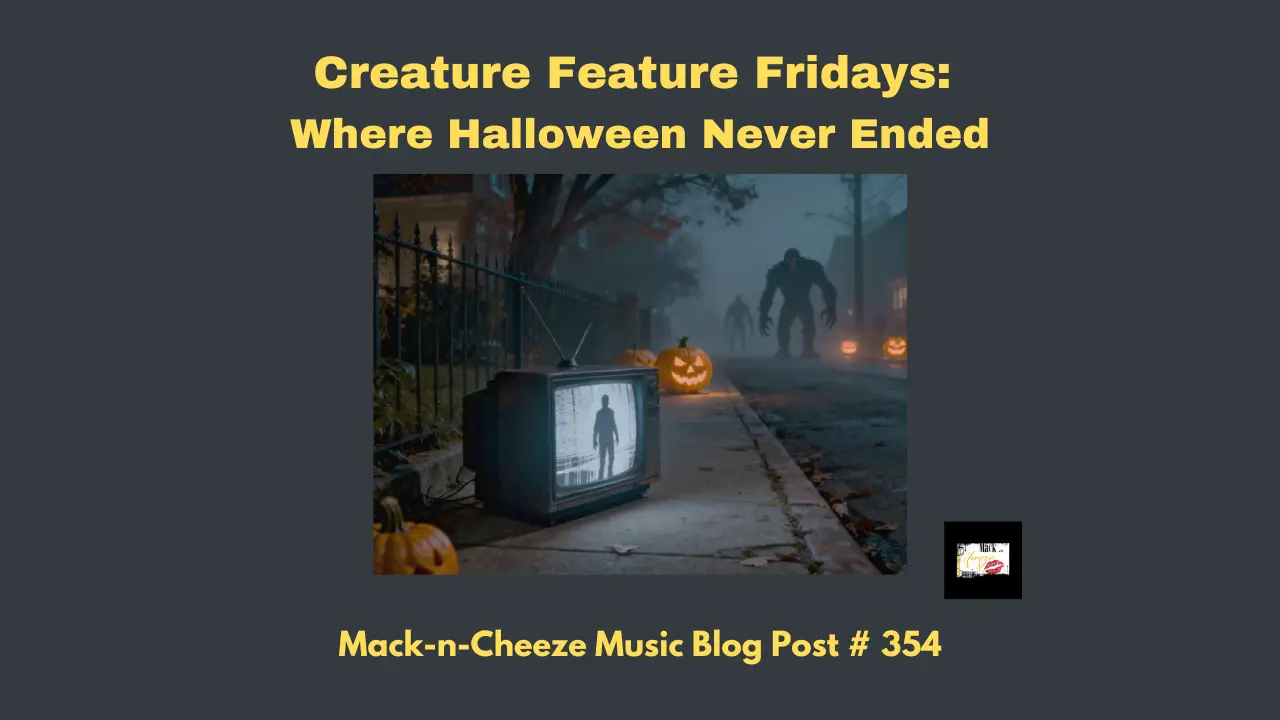
As a kid, yep, I’m dating myself, Friday nights, Midnight to be precise, Creature Feature. I loved it.
Estimated reading time: 10 minutes

Image generated by GeniGPT
Table Of Contents
Creature Feature Origins: The Day the Ants Got Angry
That’s the first time I encountered ‘Them.’ Produced in 1945, the movie suggested that we lit up the New Mexico desert with atomic tests and woke something up. Out of that scorched earth crawled a swarm of giant ants, pissed off and radioactive. Now it’s up to a handful of scientists, one overworked cop, and the military to keep those monsters from overrunning the country and turning humanity into lunch.
Perfect cinematic fodder for an 11-year-old with a Pepsi and a bag of chips.
Those old ’50s sci-fi and horror B-movies weren’t just about rubber monsters and screaming blondes. They built a whole subculture of paranoia, wild imagination, and quiet rebellion that still buzzes under everything from punk rock to modern film.
Godzilla

Image generated by Dalle
So speaking of atomic fire, let’s talk about Godzilla.
This wasn’t your average guy in a rubber suit wrecking model cities. Okay, it was, but there was more going on. Godzilla was born straight out of the radioactive nightmares of the ’50s. Japan wasn’t guessing what nuclear devastation looked like; they’d lived it. Out of that pain crawled a creature that was part terror, part revenge, and somehow… noble.
While American B-movies gave us ants the size of Buicks and flying saucers made out of hubcaps, Japan handed us a full-blown myth. Godzilla wasn’t the invader; he was the aftermath. A walking mushroom cloud with anger management issues and a message humanity still hasn’t quite digested: You built this.
And here’s the kicker – Godzilla outlived the fear that spawned him. The monster went from horror to hero, from nightmare fuel to box-office royalty. He became a global icon, the kind of crossover act no pop star could touch.
As a kid, I despised Godzilla. The rubber monster suit was too much. I thought it was just plain stupid.
But now, looking back, that first roar hits in a completely different fashion. Now I hear the deep, raw aching. It wasn’t just a sound effect; it was history screaming through the smoke. You can feel the weight of everything that came before it. As an adult, decades later and, hopefully, wiser, Godzilla is not campy sci-fi/horror. It is a wonder. Pure, spine-tingling magic.
Vincent Price
Vincent Price is my favorite creepy actor. That guy was something else. The second his face showed up on the screen, you knew things were about to get spooky. ‘The Pit and the Pendulum,’ boy, I loved that movie. It was the atmosphere and madness. Topped with psychological decay, it was like the nightmare you couldn’t wake up from.
Price didn’t need blood or sudden jump scares. That voice of his? Smooth and eerie, like honey dripping over a gravestone. He could frighten you and make you grin at the same time.
All he had to do was tilt his head, raise an eyebrow, say a line, and you were hooked. He wasn’t your chainsaw-waving maniac; he was the calm guy who’d already dug the hole. Think about it.
Price made horror feel cool before anyone else did. You could tell he loved every minute of it, too. There was always that little smirk, like he was saying, “Yeah, I know this is ridiculous, but isn’t it fun?”
For me, Vincent Price was pure midnight magic, the reason you stayed up way too late, blanket pulled to your chin, pretending you weren’t scared. But you were. And that was the best part.
Peter Cushing
If Vincent Price was the smooth talker who lured you in, Peter Cushing was the one who made you believe the monster was real. He had that sharp British calm, the kind that said, “I’ve seen worse before breakfast.”
Whether he was staking vampires or chasing Frankenstein’s latest mistake, or being Dr. Frankenstein, you always felt like the world was in steady hands, until it wasn’t.
Cushing had this way of standing perfectly still that was somehow scarier than a monster charging at you. Those eyes, cold and focused, made you think he knew more than he was letting on. Half the time, he looked like he was solving a moral equation in his head while holding a crossbow.
Is it any wonder they honored Peter Cushing’s legacy in ‘Rogue One?’ I loved that so much. It was so cool.
Cushing wasn’t the same sort of showman as Price, but oh boy, he commanded his space on the screen. Even when the script went off the rails or the budget ran out somewhere around the fake blood department, Cushing made it believable. That’s a kind of magic all its own.
He and Christopher Lee together, forget about it. That was the dream team of doom. One glare from Cushing, one raised eyebrow from Lee, and I was toast.
For me, Peter Cushing was the definition of cool under pressure, the monster hunter with manners. He didn’t just fight evil; he stared it down with perfect posture and said, “Not today.”
The Whole Point

Image generated by GeniGPT
Here’s the deal: this isn’t just me wandering down memory lane with a flashlight and a bowl of popcorn. This post is about connection. These old movies built a bridge between that kid glued to Creature Feature at Midnight and the man still chasing the same spark in the studio today.
All this talk about Godzilla, Vincent Price, and Peter Cushing is not nostalgia.
It’s my DNA. Part of the stuff that wired my brain for rhythm, tension, story, and sound. Those late-night movies didn’t just scare me; they taught me how to feel, imagine, and create.
The glowing black and white screen, every monster roar, every echo of a swinging pendulum, it all fed the same fire that still burns now. That’s the truth of it.
So yeah, these aren’t just stories about the past. They’re the breadcrumbs that lead straight to who I became, and maybe, if I’m lucky, they’ll help you remember where your own story started, too.
War of The Worlds
Now, War of The Worlds. What was that, 1953?
My parents replaced that Black and White Zenith with a Sears and Roebuck Silvertone, which they probably paid for with the forever Sears credit plan.
War of the Worlds, amazing. And watching it in color, the way it was supposed to be. Even 17 years after its production, the special effects stood the test of time.
I loved the heat ray, the Martians’ calling card. The special effect was genius for its time, green and orange rays drawn directly onto the film, giving it that otherworldly glow. And that sound, a pulsing electronic hiss that felt alive, sticking in your spine long after the credits rolled.
The heat ray wasn’t just a weapon; it was a metaphor. It was atomic fear wrapped in science fiction: one button, one beam, and it could erase a city.
How about that Martian camera? It was a snake-like probe sliding out from the ship, moving with slow, deliberate curiosity, like it already knew where you were hiding. The end of it had that glassy, tri-colored “eye” that swept the room, searching, studying, hunting. It wasn’t roaring or charging, only quietly looking. And somehow, that made it even worse.
The Farmhouse
Then Gene Barry and Ann Robinson are holed up in that busted-up farmhouse. Dead quiet except for the creak of the floorboards and that weird green light sneaking through the cracks.
Then it happens – three long, slick fingers, the color of something dredged from a swamp, moving slow and curious, like it’s feeling its way through a bad dream. When it touched Ann Robinson’s shoulder, you could almost feel it on your own. Yep, I jumped, and not only once. I would watch that movie over and over.
Yeah, the effects are dated now, but the memory of the emotions I felt is amazing. I relish this stuff.
Dark Shadows
Enter Barnabus Collins, vampire extraordinaire. Every day, after fifth-grade classes, my friends and I would gather around the TV and watch Dark Shadows, a Horror Soap Opera.
We didn’t care the nation was in chaos; we were too busy watching Fright Night. My buddies and I were clueless.
Reality Check

Image generated by GeniGPT
The ’60s were almost dystopian. Chaos. Fear. Disillusionment. The dream of progress was constantly colliding with the nightmare of reality.
The decade was in tumult. Cities burned. Harlem, Watts, Newark, Detroit. Tanks on American streets, smoke curling over rooftops. At the same time, televisions hummed in living rooms, feeding the chaos back to the people who caused it. The country wasn’t only embroiled in Vietnam, it was tearing itself apart right at home.
And the assassinations. Medgar Evers was gunned down in his own driveway in Jackson, Mississippi, in 1963. JFK was shot that same year in Dallas; hope and promise sprawled in a motorcade.
Malcolm X in Harlem, Martin Luther King Jr. in Memphis, Robert Kennedy in Los Angeles. It felt like every time someone tried to point toward daylight, a bullet shut the blinds.
And then came Chicago, 1968, the Democratic National Convention. The streets outside looked like a war zone. Protesters were chanting “The whole world is watching!” while police answered with batons and tear gas. They were right. The whole world was watching, America watching itself break down in real time, broadcast coast to coast.
Meanwhile, the future was quietly being built in the background. Rockets clawed into the sky. Computers the size of closets started to think. Satellites began whispering around the planet. Color TVs flickered with grainy hope while the country burned in black and white. The Space Age was here, but it was orbiting a world on fire.
Progress and violence, hand in hand, like old friends who couldn’t quit each other. Every night, the news tried to convince us the end was near. Maybe it was. But somehow the lights stayed on. The world didn’t end; it just learned how to look like it was ending every single night on every channel.
Check In, Baby
You think it’s bad now? Really? If you do, you have no perspective. Learn your history.
As I watched Creature Feature, I had no idea I was escaping from reality. Maybe I was too young to understand.
But come Friday night, everything changed. Midnight meant Creature Feature. That was our escape hatch. While the world outside went mad, we huddled close to the glow of that old black and white Zenith.
Giant ants, rampaging lizards, mad scientists, those were the kind of horrors you could turn off when the credits rolled.
It sounds strange now, but those movies were a kind of therapy. They gave shape to the chaos, turned our ignorance into something we could name, laugh at, even root for. In a decade where society really seemed to be engulfed in flames, the fake monsters almost felt like friends.
We were kids watching shadows flicker across the walls, not knowing one day we could learn a way to live with the dark and make something out of it.
Can We Help You?

How do we keep our humanity when the world feels like a horror movie?
If this one stirred a few memories, don’t keep them buried.
Share it with someone who remembers staying up too late with the TV humming in the dark.
Drop a comment below—tell me what your first Creature Feature was, or what still gives you that Halloween chill.
Want More Mack-n-Cheeze?
Videos - Bryan At Mackncheeze on YouTube
Podcasts – Bryan At Mackncheeze Apple Podcasts, Fountain, Spotify