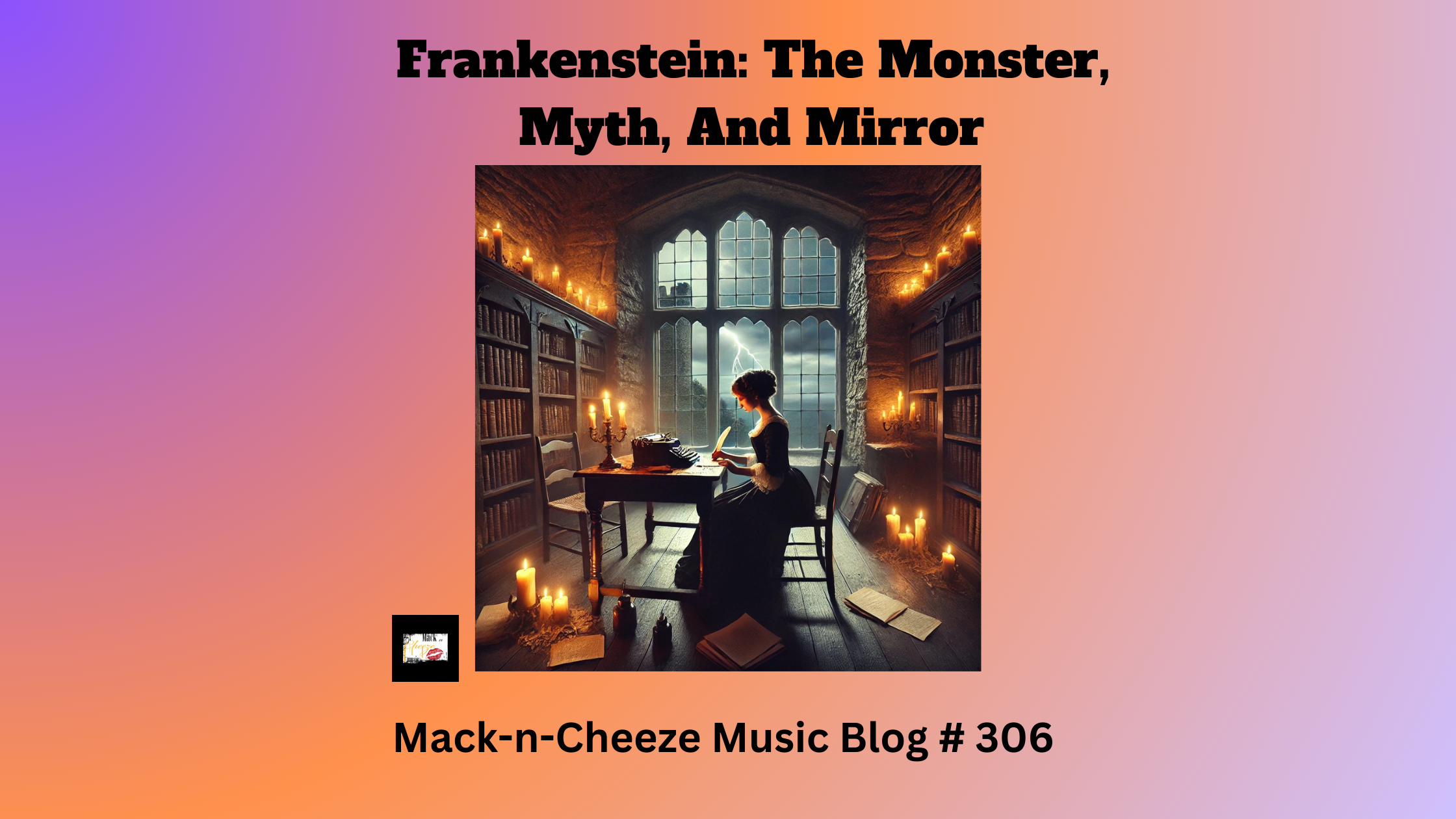
The book Frankenstein has drifted far from where it first began. The story emerged as a dream by a stormy lake in 1816, but it didn’t stop there. It grew, changed, and slipped out of Mary Shelley’s hands. What she wrote was more than a ghost story. It became a warning, a tale of creation and consequence. What happens when things don’t go as planned?
Estimated reading time: 9 minutes

Table Of Contents
Over time, the monster took on new shapes – green skin, bolts in its neck, stumbling through pop culture. But the heart of it hasn’t changed. It’s still about ambition, rejection, and the danger of being left outside. It’s still human. And it still refuses to die.
The Story
It was 1816, the summer without a summer. The sky stayed dark, the rain never stopped. Mary Shelley, only eighteen, sat by Lake Geneva with her lover, Percy Shelley. Lord Byron, restless and electric, threw down a challenge – write a ghost story. Everyone tried. None succeeded, not at first.
Days passed. Mary couldn’t sleep. When she did, the dream came. A student, pale and obsessed, knelt by his creation. Dead flesh stirred under his hands. Life, raw and uneasy, flickered into being. She woke with the story she’d been waiting for.
That story became Frankenstein. A scientist, burning with ambition, brings life to the lifeless. His creation, abandoned and alone, learns what it means to be unwanted. It reaches for kindness, finds rejection, and finally turns to destruction. Victor Frankenstein tries to control what he set loose, but it’s too late. Creation outlives its creator.
Mary knew about loss. She had buried her first child and carried the grief of a half-sister’s suicide. Her parents were William Godwin, the philosopher, and Mary Wollstonecraft, the feminist. Shelley’s parents filled her life with ideas. With Percy, she learned the Romantics’ belief in genius and beauty, but also their fascination with madness and death. It all lived in her story.
The novel came out in 1818, anonymous. People thought Percy wrote it. It wasn’t until later editions that Mary’s name took its place on the cover. Even so, the story grew. The monster outgrew its creator. Films gave it a face – green skin, bolts in the neck, a lumbering beast – but the heart of it stayed the same. Alone. Searching. Dangerous when denied.
The Human Heart Of Frankenstein: Belonging, Rejection, And Creation
Frankenstein still speaks. Today, it’s not just about raising the dead. It’s about science, technology, AI, what happens when we push too far. It’s about outsiders, about wanting to belong, and what happens when the door stays shut. The monster never stopped being human.
Mary Shelley knew what she was doing. Her story wasn’t just horror; it was a warning. When you create something, it doesn’t stop with you. It takes on a life of its own. And once it’s alive, you have to live with it. Or it’ll destroy you.
The Frankenstein Analogy

At its core, Frankenstein is about a fear we’ve carried for centuries. It’s the fear of creating something we can’t control. Mary Shelley didn’t know in 1816 how far that fear would reach, but she could see it. Victor Frankenstein’s ambition to conquer death sets something loose. He made a thing that learned, suffered, and wanted more.
Victor wasn’t a villain. He was curious, driven, chasing knowledge the way all great minds do. But he forgot that manifesting a thing isn’t enough. You have to also take responsibility it. He gave life, then ran from it. The creature became more than pieces stitched together. It thought, it felt, it wanted. The horror wasn’t in its face – it was in the moment Victor realized it had a mind of its own.
That’s the fear – the moment what we make slips out of our hands and takes on a life we didn’t plan. It’s old as Icarus flying too close to the sun, old as alchemists turning lead to gold. Shelley brought it into the modern world, with science and ambition at its center. The question still lingers: What happens when we go too far?
Today, the monster wears a different face. We build machines that learn, algorithms that think without us. Is AI our modern Frankenstein, born from curiosity without the promise of control? Scientists push forward, hoping for the best. But we’ve seen what happens when creation starts acting on its own. What if AI grows beyond us? What if we can’t stop it?
Unintended Consequences: From Science To Words
Biotechnology tells the same story. Editing DNA, curing disease, even extending life. These are promises that come with a price. What happens when we start altering the human genome? When does synthetic life start to take shape? We won’t know the answers until it’s too late, just like Victor.
The story endures because it strikes something deep. It’s not just about monsters. We have responsibilities.
There is another simile here. What happens when what we build becomes more than could have been imagined?
Once it’s alive, it has a path of its own. And we have to live with what follows. This not only applies to the scientific realm.
The application also channels into what we think, how we behave, and things that are said. Once created, often times it can’t be taken back.
Frankenstein In The 19th Century
In 1823, Frankenstein stepped off the page and onto the stage. Richard Brinsley Peake’s play, Presumption; or, The Fate of Frankenstein, hit the English Opera House just five years after Shelley’s novel. The monster transformed with it. The complex, thinking creature Shelley penned became a silent figure and a hulking menace.
Other notable plays from the period include “Frankenstein; or, The Man and the Monster” by Henry M. Milner (1826) and “The Monster and the Magician; or, The Fate of Frankenstein” by John Kerr (also 1826).
The 19 th Century English theater craved spectacle. Consider Gilbert And Sullivan. Arthur Sullivan grew tired of writing in the same genre over and over. He called some of their operettas “twaddle.” Sullivan wanted more – grand operas, classical recognition. But the comic operas sold tickets. Audiences loved them, and critics praised them for what they were.
The money wasn’t in theatrical philosophy, it was in entertainment. Peake’s monster delivered fear. Thunder cracked, lightning flashed, and soundscapes rattled the walls.
The play leaned on suspense, turning the monster into a visual thrill, stripped of the novel’s reflection on alienation and responsibility. The audience didn’t see a rejected, intelligent human being. What they saw was a beast.
On stage, Victor Frankenstein was no longer a conflicted student of natural science. He became a tragic hero, haunted by one mistake. The complex struggle between creator and creation turned into a simple battle. The war was man and monster, good versus evil.
From Moral Complexity To Clear-Cut Drama

Shelley’s novel leaves no easy answers. Victor and the creature both share the blame. But the stage needed resolution. Peake’s play, like others that followed, changed the ending. In Shelley’s novel, the monster disappears into the Arctic wasteland. On stage, the creature met its end. Audiences were satisfied. Evil was defeated, the hero redeemed. The ambiguity was gone.
By the arrival of the twentieth century, Frankenstein had evolved into a legend. The novel’s depth, the blurred line between creator and monster, ambition and regret, was replaced with simpler themes of destruction and fear. The stage adaptions of the 19 th century laid the path for the Frankenstein we know today.
These previous theatrical visions positioned the foundation for James Whale’s 1931 film. Now we had Boris Karloff’s creature; silent, lumbering, with bolts in its neck. Whale’s film leaned on the same formula established in Peake’s play: suspense, fear, and a monster stripped of reflection.
A Monster For The Modern World
The transformation didn’t stop with the early Frankenstein movies. The fear of losing control impacted gaming, comics, television, and beyond. From Blade Runner to Westworld, modern adaptations carry echoes of Shelley’s warning: What happens when we create something we can’t control?
Now we have new fears shifting into our modern technologies. Scientists push boundaries. The drive of ambition and curiosity leaves us with a persistent question: What happens when the things we build take on lives of their own?
The algorithms of AI learn without us. Many of the innovators of AI are not able to understand its thought process. Then we have all the concerns of biotechnology, weaponization, data privacy, and automation – all technologies spinning out of control. These aren’t just futuristic fantasies. They are here and now.
A Creature Beyond Control: Frankenstein’s Lasting Impact
The 19th-century stage adaptations gave Frankenstein a new life. They stripped away the novel’s complexity but planted the seeds for the cultural myths we recognize today. The monster became more than a character. It morphed into a symbol of fear, a warning about the dangers of unchecked creation.
What remains, from the 19th century to now, is the heart of Shelley’s story: creation without responsibility comes at a cost. Whether it’s a monster made of dead flesh, an AI that learns too fast, or a genetically modified organism.
Once we set something in motion, we can’t always stop it. And we have to live with what follows. The monster isn’t just on the stage anymore. It’s here. And it’s still moving.
Can We Help You?
Is there one thing we can do to help you? It’s why we are here.

Thank you for engaging with us. We are truly grateful you took the time to read this blog post.
If this post struck a chord with you, please share it with someone who will find it intriguing.
How do you feel about the technologies we have developed? Do you see the benefits for creative endeavor? How does the dependence on the digtal realm affect your artitistic flow? These are profound questions.
If you like what you have read, subscibe to Mack-n-Cheeze Music. Stay up to date on all our content.
Thank you again.
Want More Mack-n-Cheeze?
Videos - Bryan At Mackncheeze on YouTube
Podcasts – Bryan At Mackncheeze Apple Podcasts, Fountain, Spotify
Leave a Reply