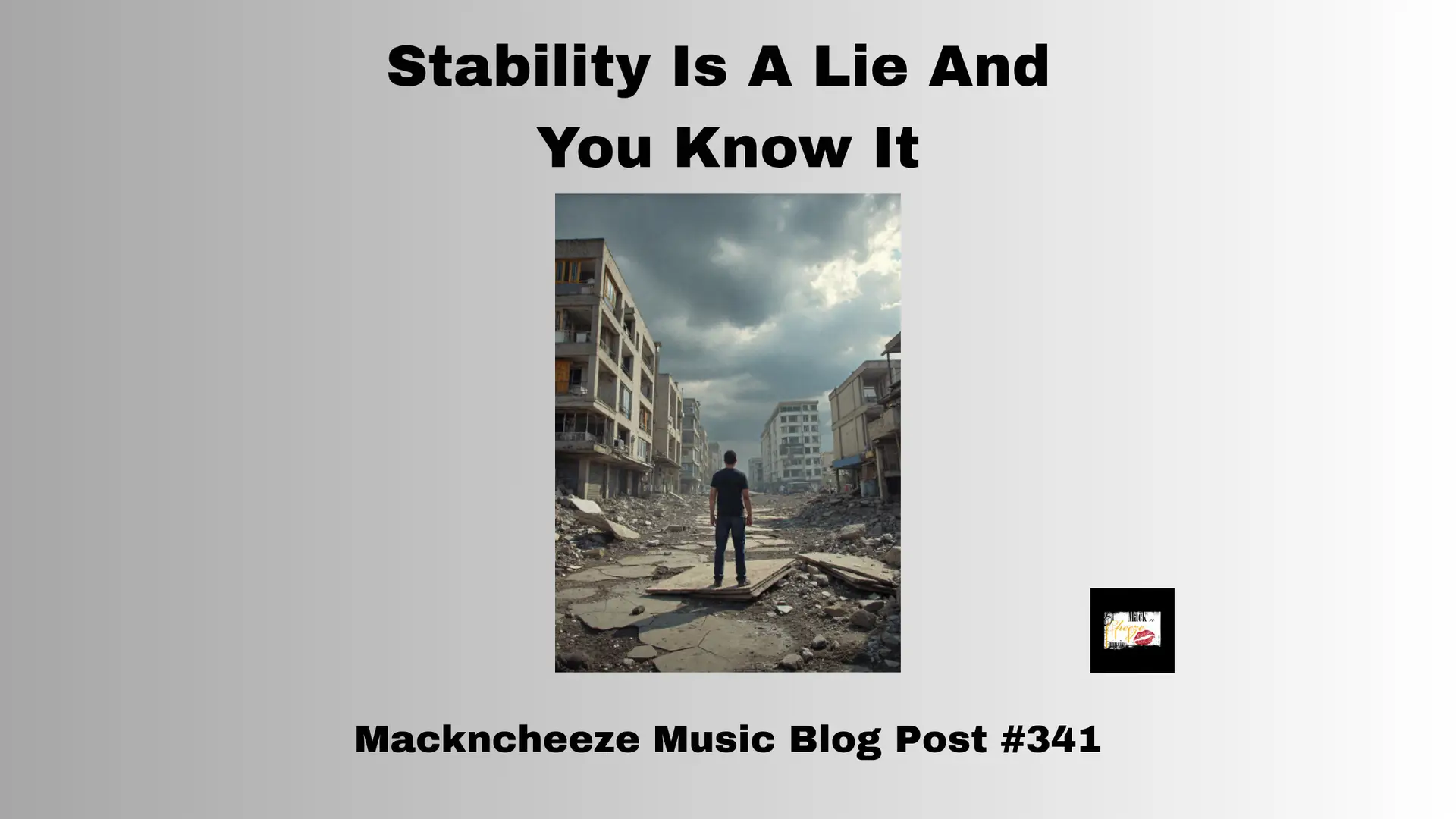
Stability is a lie. You crave it. So do I. We are wired to want it. The stage we’re on doesn’t care what we burn for. This is about nothing less than discovering who we are.
Estimated reading time: 10 minutes

Image generated by Dalle
Table Of Contents
- Life Lies To Us
- The Trap Of Stability: We Wait To Be Chosen
- Htein Lin: A Living Refutation Of The Stability Lie
- What Replaces The Lie: Six Real Foundations
- Maisara Baroud: Creation Amid Collapse
- Slava Leontyev & Anya Stasenko – Porcelain War : Beauty As Resistance
- When The Ground Gives Way
- Can We Help You?
When you think you’ve built something solid, often, the rules change, or the floor disappears.
It is only natural that we tell ourselves that being stable is necessary for creativity, progress, or peace of mind. We aspire to stability as if it were our salvation. Eventually, the thing we seek will be fleeting. Look around; it is not the way of the natural world.
Stability is the exception, not the rule. If you’re waiting for the right moment, when things settle, when the timing’s perfect, you’re already falling behind.
Face it: stability can be a lie. But there are better things to build your life on.
Life Lies To Us
Life shows us patterns. The sun climbs and falls, the pulse of the seasons beating like it will never stop; you get rewarded for your efforts. There is promise in the cycles.
And for a while, the illusions soothe you.
The paycheck is steady, and your relationships feel solid. Life hums along in a rhythm you start to trust. You dare to exhale.
Then, bam, the job vanishes, your body breaks, and the people you love disappear.
Overnight, the rules change.
What felt like bedrock was only temporary; a fragile alignment mistaken for a promise.
This is the illusion: life looks stable just long enough to make you believe it should be that way. It sells you on control, you buy into it, but you may be perilously close to having the rug pulled out from underneath you.
Stability whispers, “This is how things are now.”
Reality answers, “Not for long.”
The world isn’t built to stay still. It tilts, shifts, and spins. And if you’re not shifting with it, you’re already sliding.
The Trap Of Stability: We Wait To Be Chosen

Image generated by Dalle
We say we’re waiting for the right time. What we really mean is: we’re afraid to move.
The lie of stability doesn’t just exist in our systems, society, and in shifting markets.
It nests inside us, masquerading as caution and dressing itself up as wisdom. We often attribute our embrace of stability to maturity. But call it what it is, fear of being wrong and the risk of exposure.
We crave certainty like oxygen. We want the guarantee of success and also to be bulletproof before we leap. It would also be convenient if failure was off the table before we even show up.
So we stall.
What are we waiting for? To be chosen, seen, and told we are ready. We crave permission to succeed without failure.
We confuse stillness with strategy and baptize hesitation as patience.
But it isn’t patience. It’s paralysis with a better PR image.
If we believe it’s not our turn, or that we’re not good enough, we’ll make that story real, not by failing, but by waiting.
Delay is consent, and the longer we wait, the more convincing the illusion becomes. It starts to feel like wisdom. Like safety and truth. Instead, it is the cost of not taking a risk.
Sextus Empiricus And The Myth Of Certainty

Image generated by Dalle
Pyrrhonian Skepticism holds that for every conviction, there’s an opposing claim just as fierce, just as persuasive. So rather than clutching at certainty like a lifeline, you let go.
Sextus wasn’t cynical, but he believed chasing certainty is a trap. What if that’s the root of our paralysis? Not instability, but our refusal to act without guarantees. If certainty is not forthcoming, then we need something else to build upon.
Htein Lin: A Living Refutation Of The Stability Lie
If anyone had an excuse to stop creating, it was Htein Lin.
Imprisoned for nearly seven years by Myanmar’s military regime, first under dictatorship, then again decades later under the current junta, he was stripped of freedom, tools, space, and safety. Yet inside that cell, he painted. Over 1,000 works, created in secret, using prison uniforms, syringes, broken glass, bowls, and soap.
“Making art made me feel free.”
Before prison, Htein Lin was already creating under pressure.
He pioneered performance art in Myanmar, a bold, public, and often satirical form of expression. He studied under exiled artists, exhibited in Yangon, and made prints for rebel publications while living in border refugee camps. His art wasn’t a luxury; it was a weapon.
He wasn’t waiting for stability then, either.
When the regime locked him up, it didn’t change him. It just proved him right. The canvas shifted. The mission didn’t.
While the regime tried to erase him, he rebuilt with whatever composites he had at hand. Htein Lin wasn’t looking for approval; he was answering a purpose through creative adaptation.
Htein Lin didn’t survive because of safety, but followed his artistic passion in its absence. He didn’t wait for peace, but forged meaning through chaos.
He proved that purpose, not stability, is what endures.
What Replaces The Lie: Six Real Foundations
Adaptability – Flow over the promise of stability
Stability tells you to hold your ground. Adaptability teaches you to shift, bend, and respond. Being able to transform is not a weakness, but rather a trait that enhances survival and adaptation. You don’t get to control the terrain, but you can control how you move through it. Evolution and reinvigoration are how artists outlast the storm, not by resisting change, but by becoming fluent in it.
Flow is your advantage. Stability is your cage.
Discipline – Creating Without the Right Conditions
If you wait for the perfect setup, you’ll die waiting. Discipline means making something anyway. It’s standing in the wreckage and still creating.
No time, energy, or support? Make it anyway. Create your own opportunities. That’s not hustle culture, it’s creative survival. Discipline isn’t about force. Discipline is about refusing to let conditions dictate whether or not you matter today.
Iteration – Forward Motion, Not Perfection
Stability whispers that you need to get it right. Iteration answers: Get it moving. Progress isn’t elegant, it’s messy, repetitive, and uncomfortable.
But each draft, take, and attempt is a hammer hit against stagnation. You don’t leap to brilliance. You grind there. Iteration isn’t the enemy of excellence but, instead, the road to it. And you unfold your pilgrimage, not romanticizing about it.
Renewal – Emotional and Creative Resurrection
When the lie of stability collapses, what’s left? Burnout or rebirth? Renewal is the art of returning to your source again and again. It’s not a retreat. It’s reconstruction. Artists who endure aren’t constantly inspired, but they are continually reconnecting to memory, purpose, and the rhythm of their life source.
Renewal means you don’t rely on the world to reset you. You learn to reset yourself.
Purpose – The Only Compass That Survives Collapse
When everything else falls apart, purpose is what you steer by. It’s not a slogan or a brand. It’s your internal “why,” burning even in blackout. Purpose doesn’t make the work easier. It makes it non-negotiable. It’s the one thing that doesn’t need external validation. You don’t chase purpose. You anchor to it. And when you do, you keep moving.
Creative Process As A Compass Even When Nothing Makes Sense
The process is your shelter. When the system breaks, when the noise is too loud, when nothing fits, making something is how you reclaim clarity. The creative act grounds you. It’s not about outcome. It’s about engagement. About being present in the making. When you don’t know what to believe or who to trust, keep creating. Let the work become your gravity.
Maisara Baroud: Creation Amid Collapse

Image generated by Dalle
Gaza-based artist Maisara Baroud lost nearly everything in October 2023. His home, studio, tools, even his books. When the airstrikes leveled his neighborhood, that was it. Amidst famine, displacement, and a relentless siege, Baroud chose to document life daily in sharp, black-and-white ink drawings under the title “I’m Still Alive.” Each piece is a visual testament: survival inked on paper.
He draws to tell the world that he endures. The stark imagery is both testimony and a scream. His figures twist into lines that convey destruction, resilience, grief, hunger, displacement, and an unbroken human spirit.
Baroud may be physically displaced, his family having moved more than a dozen times within a year. But he remains emotionally and creatively grounded.
His artistry showcases:
Discipline: He draws every single day, even when paper and ink are scarce.
Renewal: Each sketch is a declaration that life continues, even if nothing else does.
Creative Process as an Anchor: With no studio, no safety, he chooses to create anyhow, turning survival into purpose.
“I draw to tell my friends that I am still alive.”
Baroud’s art is not narrative, but rather, a form of resistance. When life tried to stall his life, he moved forward. When stability evaporated, he reaffirmed his existence with ink. Every drawing is a pulse.
Yeah, stability is a lie, but creativity doesn’t have to die with it.
Slava Leontyev & Anya Stasenko – Porcelain War: Beauty As Resistance
Slava, a former special forces instructor turned porcelain sculptor, and Anya, a painter who brings those fragile figures to life. They continued working in their studio, even as the city crumbled. Slava trained civilians in self-defense during the day and crafted porcelain dragons and owls by night. Anya painted each piece with painstaking detail, often using a magnifying glass to achieve precision. Their creations became poems carved into the ruin of war.
Together with artist-filmmaker Andrey Stefanov, they co-directed Porcelain War. This intimate documentary doesn’t revel in violence, but in the beauty that war seeks to erase. The film won Sundance’s Grand Jury Prize in 2024 and earned an Oscar nomination in 2025.
“Ukraine is like porcelain—easy to break, but impossible to destroy.” – Slava Leontyev
Why Does this Speak To Us?
Purpose over comfort: Anya and Slava didn’t flee. They created.
Creative process as an anchor: The creation of porcelain figures became an act of cultural preservation.
Adaptability: From battlefield instruction to fragile sculpture, they navigated war without abandoning the work.
Their art and film aren’t a means of survival; they’re standards planted in dust. They tell us: if you still have breath, you still have work to do.
Slava and Anya are artists in defiance. Still in Kharkiv and actively creating. Not waving a flag of safety, but shaping beauty inside the firestorm.
Their art is not post-crisis reflection. It’s active resistance in real time.
They continue creating despite the conflict, not after the battle is over.
Their work embodies adaptability, discipline, and the creative process as a guiding light even while under fire.
When The Ground Gives Way
Eventually, the ground gives way. You might see it coming or you may be ambushed, and it won’t be part of your game plan.
However you deal with it, it comes down to how you keep moving while the world shifts around you.
To move forward, you will have to stand when it’s not safe, because it’s your place to do so.
Stability is a myth. Adaptation is the truth. And purpose is your spine.
That’s what we’ve got. That’s how we keep going.
Can We Help You?
What do you hold onto when everything you trusted breaks?

Thanks for reading.
If this hit home, drop a comment below, I want to hear your take.
If it stirred something in you, share it with someone else who’s in the fight.
And if you’re not already subscribed, what are you waiting for?
Let’s keep building this thing. Together.
Want More Mack-n-Cheeze?
Videos - Bryan At Mackncheeze on YouTube
Podcasts – Bryan At Mackncheeze Apple Podcasts, Fountain, Spotify