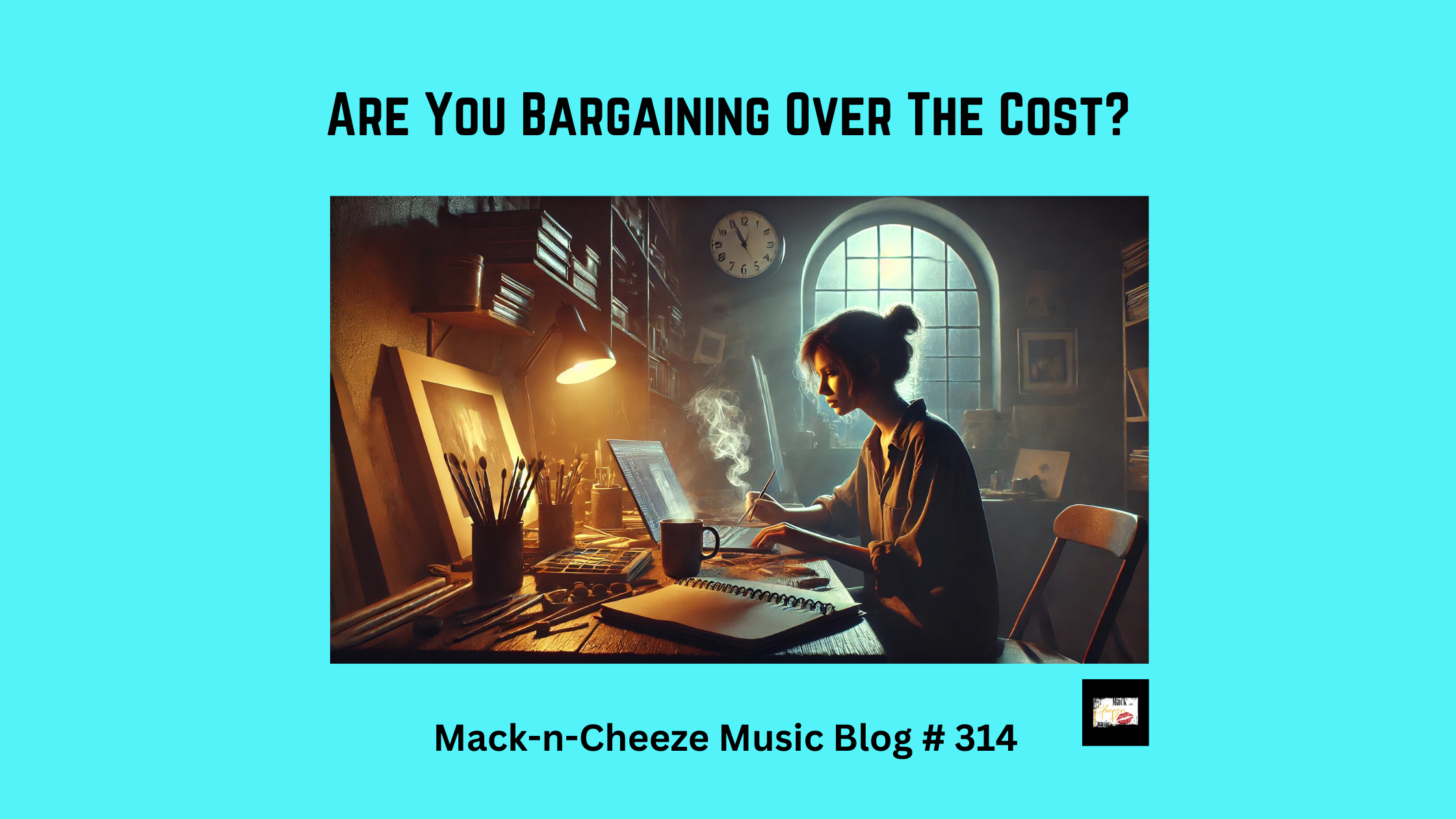
Are you aware of what you’re bargaining for?
We are constantly in the middle of negotiation. Every choice we make comes with a price.
Estimated reading time: 10 minutes

Every decision we make has a price. Whether it’s time, effort, relationships, or even peace of mind, there’s always a cost, sometimes hidden, sometimes glaring. As creatives, the stakes feel even higher. Do you stay up late working on your art, or do you rest and risk leaving your ideas unexplored? Do you choose authenticity, knowing it may alienate others, or do you conform and dilute your voice?
Ralph Waldo Emerson understood this balancing act. In Self-Reliance and Compensation, he wrote about the natural laws of sacrifice and reward. There is a corresponding loss for every gain, and for every choice, there is a consequence. His words challenge us to examine the bargains we strike daily, consciously or not, and ask: Are you negotiating wisely? Or are you bargaining away the things that matter most?
Table Of Contents
“For everything you have missed, you have gained something else; and for everything you gain, you lose something.” Ralph Waldo Emerson
This aligns with the idea of bargaining – acknowledging that every gain comes with its own price, tangible or intangible. Henry David Thoreau said, “The cost of a thing is the amount of what I will call life which is required to be exchanged for it, immediately or in the long run.” Every act of generosity, bravery, or creativity involves giving something up, but these sacrifices ultimately lead to personal growth. Emerson often refers to a universal justice system where every action has a reaction, every choice has its consequence, and it echoes a moral and practical form of “bargaining with the cost.
The Trade-Offs Of Ambition
There are simple truths in life. In creativity, you can’t move forward in one area without giving up something in another. In my world, it is social obligation. Only my most intimate musical collaborators understand this challenge. Everyone else seems to think that if I am not at my job, I have free time. The fact of the matter is that I don’t have free time. If I am not earning income, I am busy living my dream.
There is no significant other in my life, and most of the females I know don’t understand. I’m sorry, but I haven’t got time for someone else in my world. There was a time when I would have felt lonely, but not anymore. There is no time; the clock is ticking.
Friends and acquaintances wonder when we are going to hook up. I have flat-out told folks I am busy and am not available. It is a direct and straightforward answer. Besides, who is going to accomplish my goals?
Life has a simple truth: everything has a cost. You can’t gain without giving. The world runs on this balance. Every blessing carries a burden. Every loss hides a lesson. Life is a series of trade-offs. Moving forward means leaving something behind. It’s not a punishment; it’s a guide. Think about what you’re willing to sacrifice. Make sure the trade is worth it. Choose wisely. Aim for what matters most.
Friedrich Nietzsche

Friedrich Nietzsche, a 19th-century German philosopher, was born in 1844 in Röcken, Prussia. By his mid-20s, he became a professor of philology at the University of Basel, one of the youngest in history. A scholar of Greek tragedy and philosophy, he later abandoned academia to write full-time.
Nietzsche’s works, such as Thus Spoke Zarathustra and The Birth of Tragedy, challenged conventional morality, religion, and culture. His idea of the Übermensch introduced the concept of transcending human limitations through personal strength and creativity. He famously proclaimed, “God is dead,” not as a literal statement but to highlight the waning influence of traditional values in modern society.
Plagued by illness, Nietzsche endured physical pain and declining mental health, eventually spending the last decade of his life incapacitated. Regardless, his ideas on individualism, power, and the will to overcome resonate today, influencing countless thinkers, artists, and movements.
What Did Nietzsche Say About The Bargain?
Nietzsche proclaimed every step forward has a price. Moving forward, we leave behind what no longer fits, breaking our old tethers and putting aside the comfortable. He called this ‘Übermensch.’ We are refined and tempered by a spirit of sacrifice. There is the need to let go and become more in our struggles.
Greatness is not easy. It demands pain. The path is lonely and hard. Time slips away and its weight presses down. Nietzsche saw this clearly; the struggle is the price we pay for meaning. We who endure find strength in perseverance shall triumph.
Comfort is a trap. It keeps you safe but stops you from climbing. Growth asks for more and pulls you into the unknown. Nietzsche knew this. You must leave safety behind to rise because the reward is nobler than fear. The question is simple: will you pay the price?
Dreams carry weight, and each step has a cost. What will you keep? What will you leave? Nietzsche asks the brutal question: would you live this life again, with all its adversities?
Greatness comes at a cost. It demands more than effort. It tears apart what you know. Nietzsche called it transformation. It hurts to change and grow; we creatives feel this daily. We trade hours and peace for something bigger. In those trades, a life worth living is made.
Emerson’s Universal Justice: Work And Reward
Ralph Waldo Emerson believed every action has its reaction and every choice has its cost. The world pays back effort and punishes shortcuts. It rewards work and exposes emptiness.
He called it justice. The kind that holds you accountable. Do you trade today’s comfort for tomorrow’s growth? Or do you chase ease and lose something greater? The question isn’t abstract. It’s what shapes your life.
For the artist, this truth cuts deeper. Success doesn’t come by luck. It comes by hours of work, by staying focused when it’s easier to quit.
Distractions are always there; comfort whispers and fear waits. Our work is not brought to fruition without sacrifice; the artist’s craft demands it.
Every failure, rejection, and late night spent chasing an idea is part of the cost. They’re not losses. They’re the price of something better. Emerson saw this. He called it a fair exchange. You trade what’s easy for what matters.
In the end, the question is simple: What are you willing to give? What are you hoping to gain? Is the bargain worth it? Emerson would say it is the only question that matters.
Ayn Rand

Image Courtesy Of Shutterstock
Ayn Rand was born Alisa Zinovyevna Rosenbaum in St. Petersburg, Russia, in 1905. The Bolshevik Revolution shaped the way she percieved communism. Her family suffered through poverty when the soviet authorities confiscated her father’s pharmacy. Seeing what collectivism meant, Rand fled to the United States and pursued a wrting career in Hollywood.
In 1926, she came to America. Pursuing a writing career in Hollywood, she worked odd jobs and junior screenwriter positions, even as an extra. She kept writing, crafting stories that caught her attention.
In 1943, she published The Fountainhead. It told of individuals who stood alone, driven by purpose. Her ideas of rational self-interest and individualism took shape. The book’s success gave her a platform. In 1957, she released Atlas Shrugged. Innovators walked away from a crumbling world. It was her warning and her vision.
Rand wrote essays and gave speeches. She built the Objectivist movement. Some called her a hero, and others called her dangerous.
Ayn Rand died in 1982 in New York City. Her name still sparks debate, and her works live on, shaping and challenging our minds.
Bargaining The Price Of Purpose
Ayn Rand believed life is a series of choices. Every action has a price. To live purposefully, you must weigh the cost and decide what matters most. For her, the trade had to serve your values and your future. To Rand, this was how to live, sacrificing what is small for what is essential. She believed life was an exchange. Nothing should be given unless it brings back something of equal or superior value.
Living authentically had its cost; Rand knew this. She faced criticism and rejection for her ideas but never changed them. Her works were her proof. She believed greatness came only when you stayed true to yourself, no matter the opposition.
The purpose was everything. Without it, life had no direction. Rand’s characters lived by this rule. Rand believed only the individual could decide what was worth giving up. To her, freedom was owning your choices and living with their consequences.
For Rand, every choice had to align with a higher purpose. The price was worth paying only if it led to something greater. To bargain wisely was to live with integrity, honor one’s values, and pursue happiness without compromise.
The Long Game: Sacrifice, Effort, And Creation

Ralph Waldo Emerson lived the practice of sacrifice for reward and effort for growth. Today’s technology offers us quick results, but his words are more piercing and visceral. He tells us to play the long game, to trade comfort for something real.
We walk a fine line between creating and juggling bills and expectations. Social media whispers promise quick validation and instant gratification with likes and shares.
Emerson’s truth lingers. Real work happens in silence, late nights spent perfecting a craft, rejection letters, and starting over because the first try wasn’t enough. These are not losses. They are steps toward something lasting.
Stephen Covey also spoke of this. He believes that delayed gratification is indispensable. You have to clearly understand your goals before giving up things that seem good now for something better later.
“The key is not to prioritize what’s on your schedule, but to schedule your priorities.”
“I am not a product of my circumstances. I am a product of my decisions.”
Patience. Discipline. Let the novel take years. Spend months on one song. Resist the urge to rush. Trade fast wins for work that matters. The reward isn’t in the applause but in the creation itself.
Emerson asked, what is essential? Artists must answer. Cut distractions. Endure doubt. Accept the strain. It’s not easy, but nothing worthwhile ever is. This truth stretches beyond art. Athletes. Inventors. Anyone chasing something bigger than themselves. They all pay the same price.
In an age of shortcuts, Emerson offers a challenge: Earn your success, sacrifice for it, and build work that stands the test of time. The reward is not just in the creation but in who you become while creating it.
Can We Help You?
Is there one thing we can do help? Let us know. It’s why were here.

Thank you for taking the time to examine the road to balancing creativity with its costs. We all pay the price, one way or another. Please share your thoughts. We would love to hear about your challenges and successes in walking the tightrope of artistic endeavor. If we hit a chord here, please share the post with someone who can relate. If you haven’t, please subscribe; there is a lot more in the pipeline.
Thank You Again!!!
And if you’d like to stay connected for more posts like this, please consider subscribing. Thanks again for reading. Want More Mack-n-Cheeze?
Videos - Bryan At Mackncheeze on YouTube
Podcasts – Bryan At Mackncheeze Apple Podcasts, Fountain, Spotify
Leave a Reply