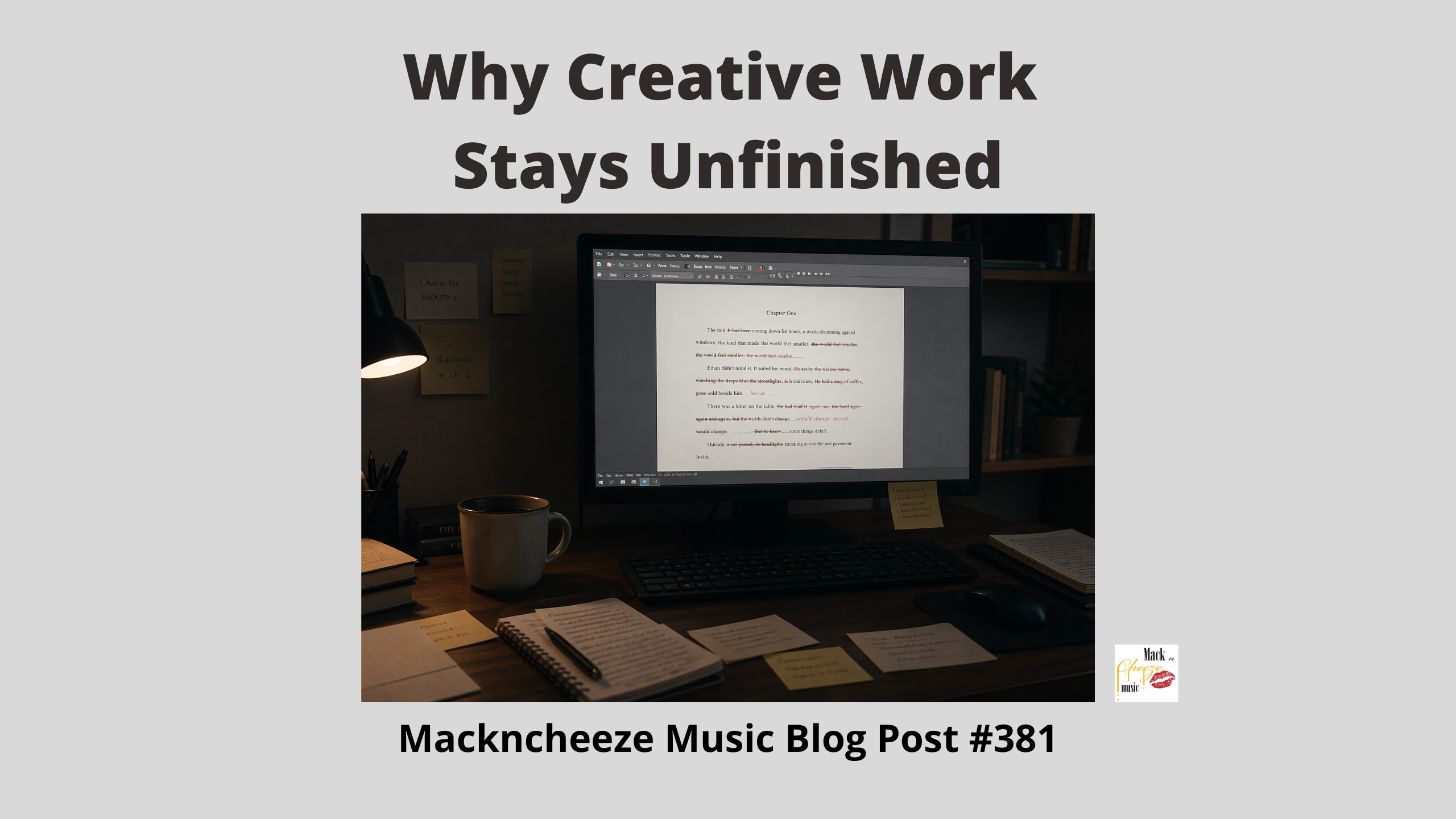
Why is it so hard to finish what you start?
Estimated reading time: 6 minutes

You sit down with something that made sense when it hit you. When inspiration came calling, you felt it, knew it would work. But moving forward, it’s just not coming together.
Your first impulse is still there. Not gone. Not moving. You adjust a line. Rework a section. Shift something that doesn’t connect. You dig in, but the piece doesn’t support any substance that matters. It just sits there.
It’s easy to blame a lack of discipline. Or time. Or the fact that life pulls you in too many directions. Those reasons hold up just enough to keep you from looking closer.
But those reasons don’t explain why your creastive work keeps piling up unfinished.
Look at what’s behind you: work undone, partial ideas, projects that never made it past a certain point. Not all of it is bad. Some of it still has oomph. But it stalled. It just sits there, waiting for a version of you that doesn’t show up.
That pattern doesn’t come from a lack of ideas. It doesn’t even come from a lack of effort. It comes from something else that appears when the work starts to come into fruition.
It’s why the work keeps stopping before it has to stand on its own.
Wasted Time
Time isn’t open-ended. It just feels that way when you leave things unfinished.
You tell yourself you’ll come back to it. Clean it up. Take another run when you’re fresh. That “later” keeps the piece alive longer than it should.
Only finished work counts. Everything else sits in the same place it was left.
Every project takes time. Doesn’t matter if it goes somewhere or not.
You can spend an hour pushing it forward, or spend it adjusting things that don’t change anything. Either way, the hour is gone.
That’s the part that gets missed. It’s not the work. It’s the time you gave it. And what you got back.
Reality Check
Open your last ten projects.
Not the ones you like or talk about, but documents, canvases, or sessions, whatever you’ve been working on.
Line them up. Which ones are finished? Not close. Not “almost there.” Finished.
Those unfinished projects lie somewhere in the middle. Started, worked on, then left.
That’s your output.
Seneca

“It is not that we have a short time to live, but that we waste a lot of it.” —Seneca, On The Shortness Of Life
This isn’t new. Seneca was saying the same thing centuries ago. You don’t run out of time, you use it poorly.
Finishing forces a decision. You stop adjusting. You let it stand as it is. That’s the moment the work loses its flexibility and becomes something fixed.
Leaving it unfinished keeps everything open.
As long as it’s not done, it can still improve. It can still become what you thought it might be. That’s the thought process, but none of that gets tested.
Here lies the challenge: You can finish it and find out what it actually is. Or you stop short of finding out what you made.
The Mechanism
There’s a point where the work stops matching what you imagined. It happens all the time.
That’s where most projects stall.
The idea doesn’t fall to pieces. It just doesn’t feel right anymore.
You move something. Change a line. Go back over what you already did. Anything to make the correction. And for a bit, it feels like progress is being made, but it isn’t getting there.
The original inspiration is still in your mind, but the piece in front of you won’t come together.
That’s usually where it slows down. You don’t quit. You just stop pushing it through.
Ira Glass
There’s a gap that shows up when you stop pushing through.
Ira Glass from, This American Life, talks about it. What you want the piece to be and what you’re actually able to make do not line up. You can feel the difference.
You keep working it, trying to close that distance. Sometimes it gets closer. Sometimes it doesn’t.
This is where people usually stall, or even give up.
You can spend an inordinate amount of time adjusting things that don’t change the outcome. It feels like you’re still working, but your projects aren’t getting any closer to the original vision.
Exploration or Avoidance
Not all unfinished work is wasted.
I’ve got plenty sitting unfinished. Some of it had to be left that way.
You try something, it doesn’t seem right, you move on. That’s part of finding where the work actually wants to go.
But that only matters if something gets finished.
If all your work stays open, nothing gets tested. Nothing stands; it all just sits there, waiting to be better later.
At that point, it’s not exploration anymore. It’s just avoiding the moment when it has to deliver. It is important to remember: Good enough is good enough.
You’re not running out of ideas. You’re running out of things you actually finish.
Every unfinished piece is a decision, whether you call it that or not. You leave it where it is. You move on. It stays behind you.
Do that often enough and it becomes the pattern.
Not a lack of ideas.
A lack of finished work.
Can We Help You?
What are you going to finish before you start anything else?

Pick one piece. Finish it. Then come back and tell us what changed—comment, share, subscribe.
Thank you for taking the time to read this and stay with it.
Want More Mack-n-Cheeze?
Videos - Bryan At Mackncheeze on YouTube
Podcasts – Bryan At Mackncheeze Apple Podcasts, Fountain, Spotify