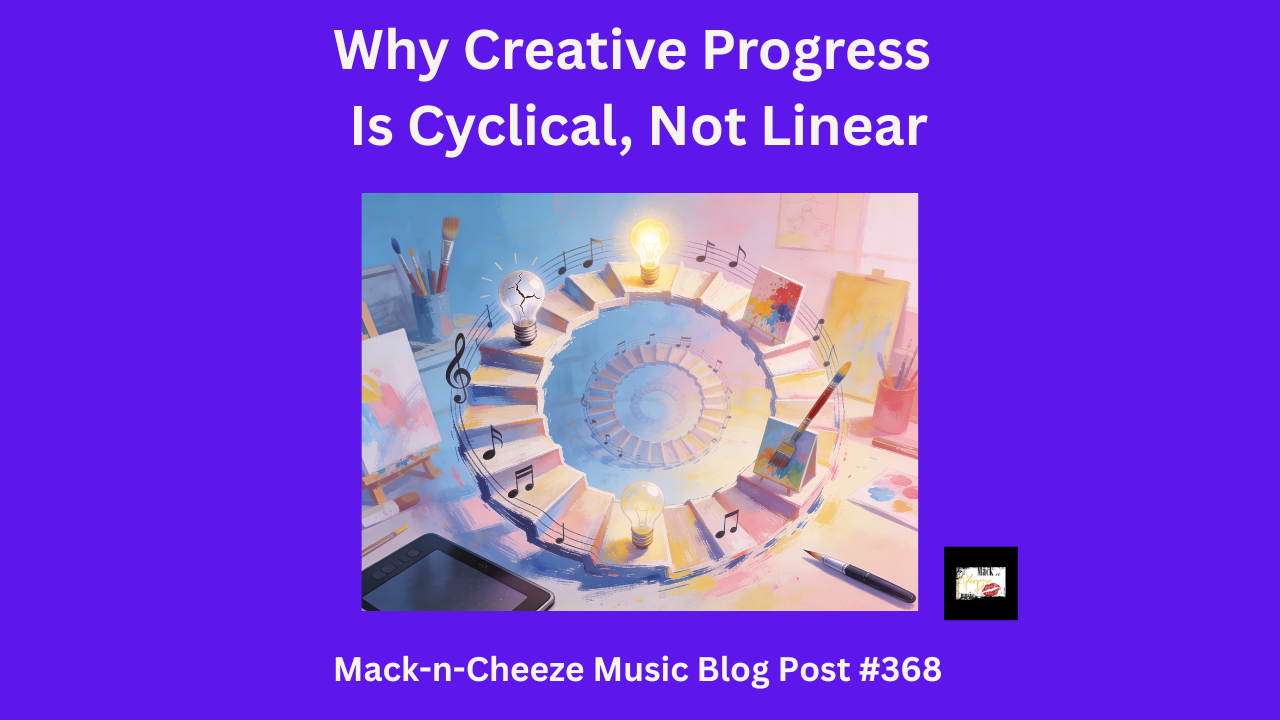
Talent? Motivation? Momentum? Creative cycles can manifest long before those attributes mature and bear fruit.
Estimated reading time: 7 minutes

Table Of Contents
Creative cycles mark the shift from the growth of options to the pursuit of control in the life of creative work.
The culture of creativity tends to assume progress must always move forward.
Slowing down gets labeled as a loss of drive. Reduction gets mistaken for retreat. Returning to earlier forms is treated as a lack of ideas.
Why Circling Back Is A Normal Creative Move
Returning to earlier work is not a step backward. It’s a continuation.

Igor Stravinsky did not keep moving forward by endlessly inventing new language. After breaking form, he returned to it. Not to retreat, but to work with intention again. Structure gave the music somewhere to stand. Limits made decisions clearer.
This was Stravinsky’s discipline.
The work didn’t wait for inspiration to strike again. It continued by narrowing its frame. That move wasn’t a failure. It was how his work stayed alive.
The familiar forms we work with don’t have to wear out the way trends do. A form, or style, can hold many options. It can stand on its own over and over.
New ideas come and go. But the belief that creativity must always invent something fresh mistakes novelty for movement.
Forward motion doesn’t depend on new ideas arriving on schedule. It depends on attention. On care. On the willingness to stay with something long enough to see it clearly. Much of the work advances through revision, restraint, and return.
Nothing is lost in that movement. Control replaces excess. Clarity replaces noise. The work remains alive because it is allowed to repeat itself without apology.
Familiar forms do not wear out the way trends do. A form can hold more than one answer. It can be used again without losing force.
Writers return to the same sentences. Musicians return to the same progressions. Painters return to the same shapes.
The Cultural Pressure Toward Novelty

The culture of creativity rewards what looks like forward motion.
However, returning to the same terrain can produce serious work without apology, justification, or consequence.
Edith Wharton wrote from inside the world she knew. Her work returned again and again to elite social life because that was her lived terrain.
Wharton drew on insider knowledge of New York’s upper-class society in her fiction. She returned to that world across multiple books, using it as a stable setting to show how rules, status, and consequences shape lives.
Nothing in her modus-operendi needed defense. It didn’t signal decline or lack of invention. Her writing reflected continuity between experience and subject.
Creative culture tends to treat novelty as proof of life because it’s easy to recognize. What looks new can be identified quickly as movement, even before it’s understood.
Because novelty signals change at a glance, it often gets mistaken for progress. Work that returns to familiar ground doesn’t offer that signal. It moves more quietly. As a result, it’s judged as stalled or spent.
Those judgments often miss the point in how someone’s craft develops.
Reworking, Revisiting, Refining

Pablo Picasso was purported to have said it took him years to learn how to paint like Raphael, and a lifetime to learn how to paint like a child.
Picasso’s process was to keep returning, stripping away what he had learned, reducing form instead of expanding it.
He was prolific, not because he was endlessly reinventing.
Towards the end of Picasso’s life, he worked with the same figures, faces, and shapes until they became more refined, speaking what he wanted spoken.
Reworking concepts is how craft tightens. Revisiting is how judgment improves. Refining is where the work decides what it actually is.
If this methodology worked for Picasso, isn’t there something here that can be utilized? It is a tool that can turn effort into shape.
Cycles Of Attention, Not Inspiration
Inspiration is not a gatekeeper. It is a companion, not a checkpoint.
Some days it shows up loud. Other days it doesn’t show at all. Regardless, our work is till waiting.
Paying attention to what we are doing is key. Sitting with the work. Touching it again. Making one small decision, then another.
Emotions change. The work doesn’t stop.
When inspiration is there, it helps. When it isn’t, the work doesn’t lose its right to exist. You don’t need permission from a mood to keep going.
If inspiration isn’t driving us, what is?

Edgar Degas kept returning to dancers because they were never finished. Rehearsals, not performances. Bodies tired, stretching, waiting, adjusting. He drew them again and again—legs at the barre, backs bent, balance just off. The truth was in the repetition.
Degas didn’t work from bursts of inspiration. He worked from watching. From staying with the same human effort long enough for it to give up its detail. The singers, the nudes, the women at work, all of it came from the same discipline: looking without needing a spark to justify it. The work moved because of the focus of the subject matter.
Form As A Creative Anchor
Form gives our creativity something to hold onto. Without it, effort can become scattered. With it, our output can be sustained.
Structure doesn’t restrict motion; it steadies it. Over time, that steadiness is what allows the process to continue.
Utilizing form preserves momentum. Our frame work sharpens. The work moves forward without having to reinvent itself each time. Control enters not as restraint, but as support. The work goes on because it isn’t carrying more than it needs to.
Can We Help You?

Do you think revisiting your work means you’re stuck?
If this helped put words to something you’ve been living with, share it with someone who’s still circling their work in silence.
If it pushed back on how you’ve been measuring your own progress, leave a comment. Say where it landed, or where it didn’t.
If this kind of thinking is useful to you, subscribe. The work continues here, without chasing novelty for its own sake.
Food for thought:
Want More Mack-n-Cheeze?
Videos - Bryan At Mackncheeze on YouTube
Podcasts – Bryan At Mackncheeze Apple Podcasts, Fountain, Spotify