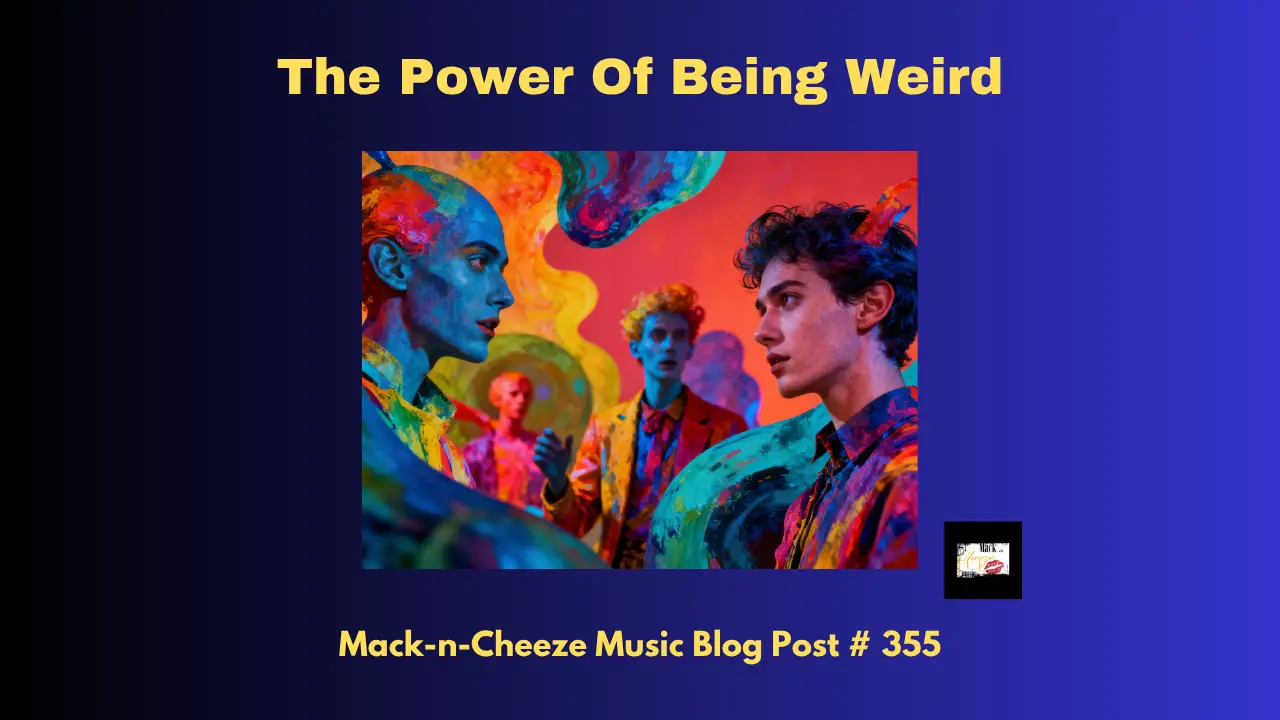
Is being weird the key? Is there any such thing as usual? Or normal? Society is made up of a kaleidoscope of individual personalities. One size does not fit all. It is just like music and art. There is no right or wrong place on the dial, just different frequencies, like the spaces between notes.
Estimated reading time: 10 minutes

Image generated by GeniGPT
Table Of Contents
The Myth of Normal
Some of us breathe differently than others, more or less noisy, more or less alive, each inhale our own rhythm, each exhale our own kind of prayer.
The idea that there is an objectively usual way to live is a lie perpetrated by businesses, religions, and political parties. The goal is control.
There is no authentic way to live. To believe that is a lie. Noam Chomsky, take him or leave him, talks about how organizations operate to preserve their own power and to shape public perception in ways that maintain the existing hierarchy.
Business, politics, religion. Part of the individual dialogue each of us carries is as to what, and how much, we buy into these power structures. What we decide, what, and how much, we are going to believe. This, too, is part of our individual personalities.
I am not advocating Noam Chomsky. I don’t agree with everything he says. But he has his points. He is just another Weirdo who thinks outside the box.
If you want to go deep, start here – https://chomsky.info/commongood01
What is normal for me is most likely not normal for you. And when we chase what others presume to be normal, we lose the naturalness of our being.
Culture And The Risk Of Being Weird
In high school, being different wasn’t brave; it was social suicide. I can’t imagine teenage culture has changed much in the 90 years.
One wrong word, a bad haircut, or misplaced opinion, and you could vanish from the lunchroom hierarchy like you never existed.
I wasn’t swimming in normal; I was clinging to it for dear life. Like every teenager, I just did not want to screw up and get branded as that person, the weirdo. I carried all sorts of angst with the social pressure.
Then came my year at the alternative high school, Eugene, Oregon, mid-1970s, ground zero for progressive weird. The teachers wore tie-dye, read Be Here Now, and lit up in the faculty lounge. I’m not kidding, I literally smoked pot with my teachers. Great role models, right? But in their own backwards way, they were.
They didn’t care about fitting in, not with the school board or with society. It was chaos with a pulse. They never talked about individuality; they just lived it. Wild, unfiltered, half-crazy, and somehow completely free, children of the sixties, only a decade older but a lifetime less rigid.
The hierarchy of the school district had no idea of what they unleashed.
And that’s when I started noticing the kids who didn’t fit the mold. The Thespians. Loud, dramatic, unapologetic, half-crazy in the best way. They weren’t trying to survive high school; they were trying to live life.
They weren’t the jocks, cheerleaders, the debate team, or scholastic achievers. I remember watching them and thinking, “My people. These are my people.” It was the first time I realized that being weird wasn’t dangerous, it was living life in reality.
What Is Being Weird?
Weird isn’t a flaw. It is the spark that sees what others miss. The world runs on repetition; weird cuts new paths.
Those called strange are the ones who build, paint, and play what no one else can imagine. Weird doesn’t wait for permission. It breaks the pattern and keeps going.
When you stop hiding it, weird stops being the exile and becomes gravity. Your people are drawn to you. You begin to understand your tribe.
Don’t sand the edges. Hone them. The wrong note, the wild color, the offbeat rhythm, that is where the soul is revealed.
Weird lights the room. Always has.
Be Weird; Avoid The Status Quo

Image generated by GeniGPT
When we start shaping ourselves to someone else’s standard, something essential dulls. Not every rule kills the spark, but too much imitation drains it.
People don’t always crave shock or spectacle; they crave sincere originality. Sometimes that truth whispers, sometimes it roars. Either way, it has to come from you and who you are.
What stands out isn’t always the loudest or the wildest; it is often the most honest. The piece that only you could make, the line only you could write, or a song that only comes from your heart.
Everyone wants to stand out, but most are afraid to go first.
When you lead with your weird, you give others permission to drop their masks. They may never say it, but they’ll feel it, and maybe they may be grateful for it.
We humans are starved for what’s real. Always have been. Every great piece of art, every real movement, started with someone weird enough to stop pretending, for good or bad.
Nikola Tesla – The Unplugged Genius
Tesla had an intense attraction to the birds. He fed pigeons in the park and even nursed the injured ones in his hotel room.
Tesla swore he could feel electricity in his hands. He dreamed in light. The world called him mad. But his madness powered everything. We owe him for our modern lifestyle. Alternating current, radio, the pulse of contemporary life. The man who never fit in wired the rest of us together.
Sleep was another frontier for him. He often claimed to sleep extremely little, just two hours a night or less, though historians debate the consistency of those claims. How are you supposed to get REM on only two hours a night?
Whether the stories were exaggerations or real extremes, they underline how he challenged human limits.
Tesla’s strangeness was his method. He saw electricity not as a tool, but as a living force to be choreographed.
Sun Ra

Image generated by GeniGPT
Sun Ra was born Herman Poole Blount, but he didn’t stay tied to that name for long. He rechristened himself Le Sony’r Ra, then simply Sun Ra, claiming origins on Saturn. He led his Arkestra not just as a band but as a musical collective, spiritual movement, and performance art experiment all rolled into one.
Sun ra portrayed himself as a cosmic prophet, dressing in Egyptian regalia and space-age robes, turning jazz concerts into rituals, myth-making, and visions in motion.
Musically, Ra moved without fear. He bridged swing, bebop, free jazz, electronics, and sometimes did it all in one piece.He was among the first jazz leaders to integrate synthesizers, electric pianos, and exotic percussion into the fold. His band was fluid, expansive, and always ready to push into uncharted sound.
Sun Ra wasn’t just crafting music; he was building a belief system. His stage was a spaceship; his songs, a manifesto. The manifestation of intentional weird. He saw jazz as a vehicle for liberation, for cosmic identity beyond race and Earthbound constraints. So funny, yet oddly liberating, that’s how I saw him.
He left behind hundreds of albums, thousands of performances, and a legacy that refuses to be embalmed in history. His weirdness may have been a gimmick. But it was fun. It was the warp drive foreshadowing the future.
Frank Zappa
Frank Vincent Zappa was born in Baltimore in 1940, but he never stayed comfortable in any place or label. Largely self-taught, he became a musical alchemist, pulling from doo-wop, avant-garde classical, jazz, and rock to forge sounds no one had heard before.
In 1963, then totally unknown, Zappa appeared on The Steve Allen Show. He introduced himself as a “composer of modern music” and proceeded to “play the bicycle.” He makes Allen join in. It is a complete foretelling of what the world would experience with his identity.
Zappa organized his first groups in L.A., and in 1964 merged into what would become The Mothers of Invention, a team built not for safety but for sonic provocation.
Zappa’s work was never about pleasing everyone. He twisted composition into satire and built musical jokes into political critique. His albums ranged from blistering guitar solos to orchestral experiments, always refusing to sit in a neat genre box. By the time he released Joe’s Garage, I was done with his lyrics. If high school profanity is your game, he exemplified it. I just wasn’t interested, needing no help in the matter.
And when you name your children Dweezle and Moon Unit, that pretty much defines out-of-the-box.
Zappa stood up against censorship, famously testifying before Congress in 1985 to defend the freedom of musical expression.
He left this world in 1993, but not without sending the signal that weirdness is valid and necessary. Zappa challenged complacency. He provoked, disrupted, disgusted, and made music that demanded your attention.
Zappa was an example. He drew the map for anyone who’s ever felt too loud, too strange, or too different, showing that those very edges can carry you farther than any conformity ever could.
Own Your Weird
Every real breakthrough in art, science, or revolution starts the same way. Someone refuses to stay inside the lines. Weirdness is the spark that flips the light on, the thing that turns imitation into invention.
The status quo doesn’t create; it protects itself. Progress always comes from the outliers. It belongs to the ones willing to look foolish long enough to see differently.
When you hide your weird, you dim your signal. When you use it, you shine. The energy you spend pretending is the fuel you could be burning toward the truth that is you. Your authentic self.
The fear is always in loneliness. But it is sameness that really isolates us, not difference. When you live honestly, your people find you. That’s the law of resonance. You light up, and others with the same frequency light up too. Weirdness is the invitation that builds a tribe.
So own it. Stand outside the frame. See yourself as capable, and the world starts to agree. It won’t happen all at once, but the moment you stop chasing approval and start broadcasting who you are, everything begins to bend toward that signal. That’s not your ego. That’s gravity.
Weirdness is not rebellion; it is your alignment, the pulse of everything new.
Can We Help You?
What part of yourself are you still hiding to seem normal?

If you’ve spent your life trying to fit in, maybe it’s time to stop shrinking and start shining.
The world doesn’t need another copy. It needs your version, your sound, your brand of weird.
Drop a comment, share your story, and let’s hear how your weird shows up in your art, your work, your life.
And if this hit home, pass it along. Someone out there’s hiding their spark, waiting for a sign that it’s okay to stand out. Be that sign.
Thanks for reading. Stay weird. Stay real.
Want More Mack-n-Cheeze?
Videos - Bryan At Mackncheeze on YouTube
Podcasts – Bryan At Mackncheeze Apple Podcasts, Fountain, Spotify