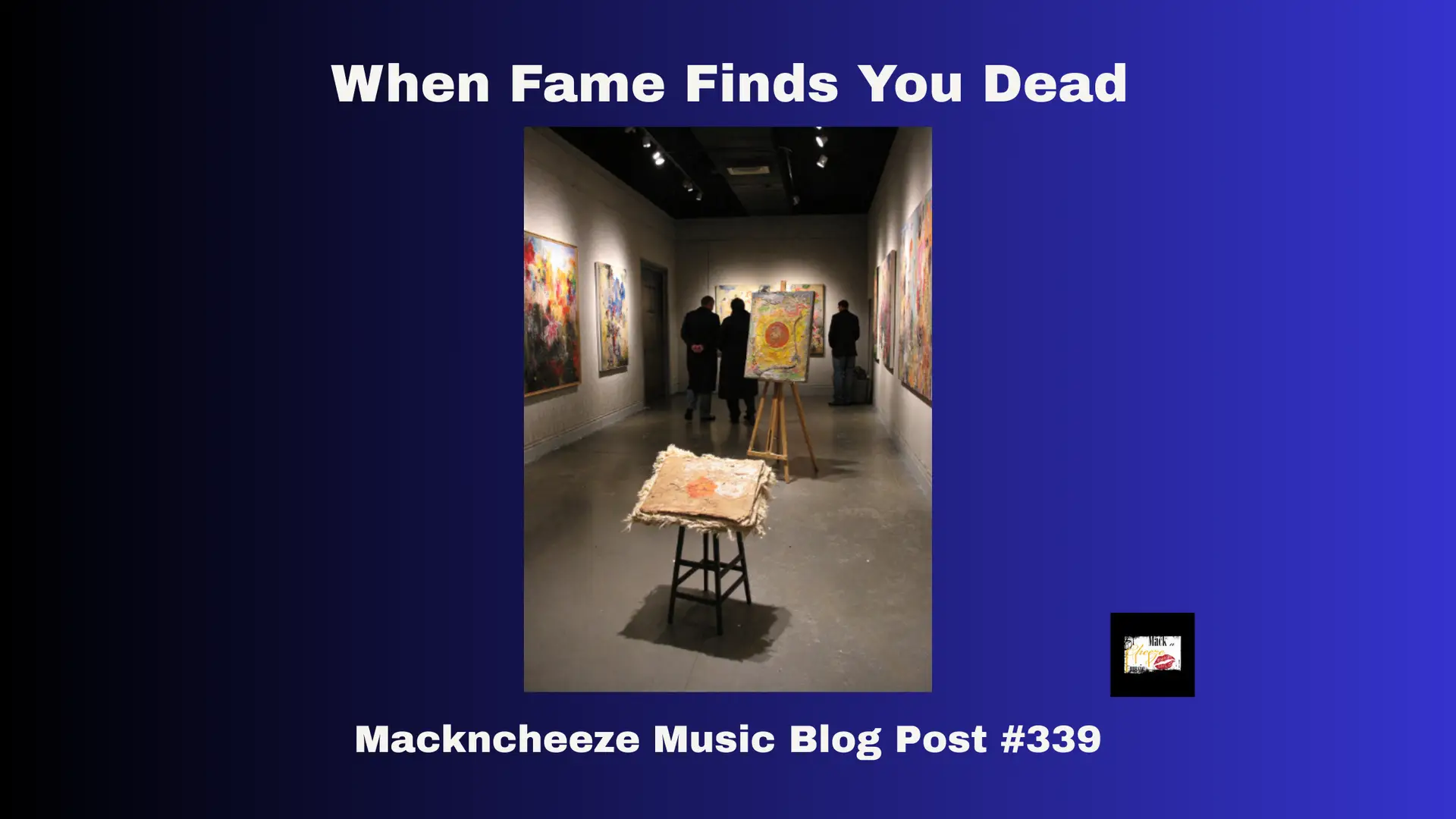
When fame finds you dead, who cashes the check?
Estimated reading time: 10 minutes

Image generated by genigpt
Estimated reading time: 10 minutes
We parade your work through museums, paste your face on coffee mugs, and plagiarize your best work on Pinterest.
But where were we when your hands shook from unpaid bills and the ravages of disease began to claim you? Where were we when your art gathered dust, and you wondered if the silence meant your work was worthless?
If your grand strategy was to hide in glorious obscurity, mission accomplished. Now, we can call it “mystique” instead of what it really was: empty rooms, unpaid rent, and concerned relatives who worried about your priorities.
Is it our macabre instinct to crown the unrecognized only once they’re decaying nicely?
History is full of names we missed while they yet lived, a recurring theme in the history of art. Van Gogh. Dickinson. Keats. Darger. We celebrate them now, absolving ourselves by crowning the dead.
Should we stop asking what their stories reveal about them and start asking what they reveal about us?
Who Cashes The Check When Fame Finds You Dead?

Image generated by GeniGPT
He sold one painting, maybe two, while he was alive, that’s it. When he successfully died from an attempted suicide, his brother Theo took up the cause.
But Theo died soon thereafter, leaving it to his widow, Johanna van Gogh-Bonger. She spent years getting Vincent’s work seen. It finally paid off, just not for Vincent. Decades later, collectors and auction houses started swapping his canvases for tens of millions. Vincent barely saw a dime.
Emily Dickinson spent most of her life writing poems in near seclusion.
When she died, her family found hundreds of her works stuffed away in drawers. They decided to publish them, often editing the lines to fit their taste or the market’s. The result? Publishers made money, and Dickinson became an American literary icon.
John Keats was a young English poet who barely made enough to live.
He died at 25, sick and in debt, thinking he’d failed completely. Only later did the critics and universities turn him into an essential study. Good news for publishers and professors, but not so much for Keats.
Then There’s Henry Darger
He spent his life as a hospital janitor, holed up in a rented Chicago room, quietly creating a sprawling fantasy world on thousands of pages and vivid watercolors. After he died, his landlords discovered the treasure trove and turned it into an outsider art phenomenon. Darger’s work began appearing in major galleries, and one of his pieces even sold for $750,000.
Meanwhile, his actual estate? Still tied up in court. As of 2024, distant relatives and his landlords are locked in a legal battle over who truly owns the rights and who stands to benefit financially.
Who wins? Not you, the deceased, obviously. That’d be too tidy. Nope, it’s the auction houses flipping your work for seven figures, the biographers squeezing your life into paperbacks, and the merch guys plastering your face on tote bags. The entire ecosystem thrives; everyone gets paid, like blood-sucking lawyers, except the one person who actually made the art.
Who Paid Attention Before You Croaked?
Pull back from the glossy museum walls and look at the life actually lived.
It’s not hard to picture: stacks of canvases nobody asked for, half-finished pages curling on a dusty desk, and bills shoved in a drawer because facing them means admitting there’s no money to pay.
Friends drift off, polite invitations stop, and every time you bring up your work you see that flicker, the half-second glance that says, ‘Maybe you should grow up and do something else.’
And alone in the quiet, you start asking yourself the question nobody wants to hear out loud:
“Is my work worthless?”
Because it sure feels that way when the only thing arriving in your email are rejections when one actually shows up.
Not My Circus, Not My Monkeys

Image generated by GeniGPT
Let’s look at the general cultural autopsy.
This isn’t some rare, star-crossed tragedy, but rather, the punchline.
Are you laughing yet?
There’s a gob of content, too many creators, and more disparate voices than you can shake a stick at. Welcome to the big tent.
The sheer volume means that most of us will remain invisible, no matter how hard we work or how legitimate our art.
Then, throw in the algorithms. They aren’t designed to surface raw, struggling talent. They’re engineered to keep feeding the winners. The gallery sweethearts get more eyeballs, clicks, and cash because they’re a proven bet. That’s the risk-free metric: reward the familiar and throttle the unknown.
That’s the racket.
So when your work gets overlooked, it’s not because there’s some sinister cabal plotting to crush your dreams. The machine hums along on its own favoring what’s safe, proven, and what’s already bankable.
That’s why so many of us keep grinding in obscurity while the big names double-dip on every feed.
It’s not personal.
It’s just how the circus runs.
Not my circus, not my monkeys, except it is. We’re all in the same ring, juggling our work, hoping it lands some place where someone gives a rats ass.
Is Obscurity Really What You Signed Up For?
Look, if you truly find peace in the quiet, far from the noise and judgment, more power to you. Some people honestly want that. We respect it.
Is being unrecognized somehow noble? Is slaving away in silence, unpaid, and unseen the ultimate badge of artistic purity?
People love to romanticize the unknown genius, waxing poetic about starving in your attic, scribbling away by candlelight, untainted by filthy commerce. Do unpaid bills and complete invisibility make your art more authentic? Would your landlord like to be paid with artistic integrity instead of Doe Rae Me?
Some genuinely don’t care if anyone ever sees their work. But most of us? We don’t pour our guts into this because we crave obscurity. We didn’t set out to be a private museum that only the dust appreciates.
Obscurity isn’t some deliberate, higher calling. It’s just where most of us land when the sheer flood of content, algorithms, and market realities do what they do.
If being ignored was your big strategy, congrats again. For the rest of us, we’re here because we wanted to share something real, maybe even get paid enough to keep doing it without losing the lights. Turns out that’s a taller order than the myth-makers ever admit.
Nothing Sells Like Tragedy, Just Ask Shakespeare

Image generated by Image Generator Pro
What is it with us? I mean the collective “us.”
Why do we often wait until someone’s demise before we break out the tributes, documentaries, and the $50 t-shirts with their faces silk-screened across the chest?
It’s like we can’t fully celebrate artists until they’re safely six feet under. Once they’re gone, they can’t get messy, contradict us, or call us out for ignoring them when they need it most. Dead artists are easier to manage. We can cherry-pick the songs, paintings, and tragic headlines and build them into neat little altars. No surprises, no inconvenient truths, nothing to ruin the narrative.
Look at Kurt Cobain. The world swarmed to crown him the voice of a generation after he put a shotgun to his head. Amy Winehouse? Same circus: “What a raw, tortured genius.” Sure. Meanwhile, we all watched the train wreck in real time; tabloids sold millions off her addiction, and nobody exactly stormed the stage to save her.
Funny how death makes someone suddenly worth listening to.
And why would this ever stop? Nassim Nicholas Taleb, in Antifragile (Chapter 3, “The Cat and the Washing Machine”), calls it the Lindy effect: the longer something’s been around, the more likely it is to keep going.
We’ve been paying to watch tragedies unfold since Sophocles had Oedipus tear his eyes out. Shakespeare made a fortune on blood-soaked betrayals and dead lovers piled on stage. So don’t expect humanity to suddenly lose its appetite for posthumous fame.
Just remember: the Lindy effect only favors what lasts. The art lives on because the artist is already dead. The perishable has already perished.
What Does Our Worship Actually Say About Us?
Death has a way of wrapping things up neatly.
Not for me. Mostly because I’m not dead yet. I’m still dealing with taxes and spam calls.
But for an artist’s work? Once they’re gone, what’s left feels more precious.
When heroes kick the bucket, their art often inflates into legend. It’s hard to screw up your reputation when you’re dead.
The 27 Club is the gold standard in this regard. Janis Joplin and Jim Morrison punched out at the top of their game, so there’s zero chance of a clumsy comeback tour or a cringe-worthy Christmas album to tarnish their myth.
Their stories stop right at the peak, freeze-framed forever.
It also helps that we humans love a tragic story almost as much as we love reality TV. Artists who check out young or under messy circumstances become instant folklore. Their biographies practically write themselves: tortured genius, blazing talent, snuffed out too soon. The 27 Club is a marketing phenomenon with a tragic twist.
Meanwhile, we project hopes, disappointments, and weird insecurities onto these artists. Our fantasy of who they were stays locked in, all glossy and untouchable.
It’s a total myth that an artist’s work only becomes valuable once they’re dead.
The Idolatry Of An Artist’s Death
We feel good doing it; dead artists are the safest gods to worship. They can’t contradict us, disappoint us, or release a questionable project that messes with their mythology. They’re embalmed right where we like them: tragic, flawless, eternal.
Meanwhile, the living version, the one who once stood in line at the pharmacy behind us, worrying about rent, we ignored. The real human was too messy, too needy, too alive.
But the corpse? We can project anything we want onto it without fear it’ll start talking back.
It’s a morbid comfort. Like we’re all part of some solemn cult, chanting, “If only they were still here…”
But when they were here, most of us couldn’t have picked them out of a crowd.
Maybe that’s the ugliest truth: we like our idols dead. That way, they stay pure, sealed in tragedy or inevitability, and we get to worship them without the burden of ever having to actually support them. The vast majority of the greatest are just that – Dead.
Why are you more successful than your heroes who have met their demise?
You’re reading this, right? There is still hope and fire in your bowels.
Your heroes are gone. Kapput.
You’re here. Breathing. Alive.
Congratulations. That is a success unto itself.
What are you going to do with that?
Can We Help You?

Thanks for reading.
If this lit a fire or poked a nerve, tell me; drop a comment below.
Share it if you think someone else needs the kick.
And if you want more insight, creative fuel, and the occasional friendly slap, subscribe.
Let’s keep pushing. Time’s short.
Want More Mack-n-Cheeze?
Videos - Bryan At Mackncheeze on YouTube
Podcasts – Bryan At Mackncheeze Apple Podcasts, Fountain, Spotify