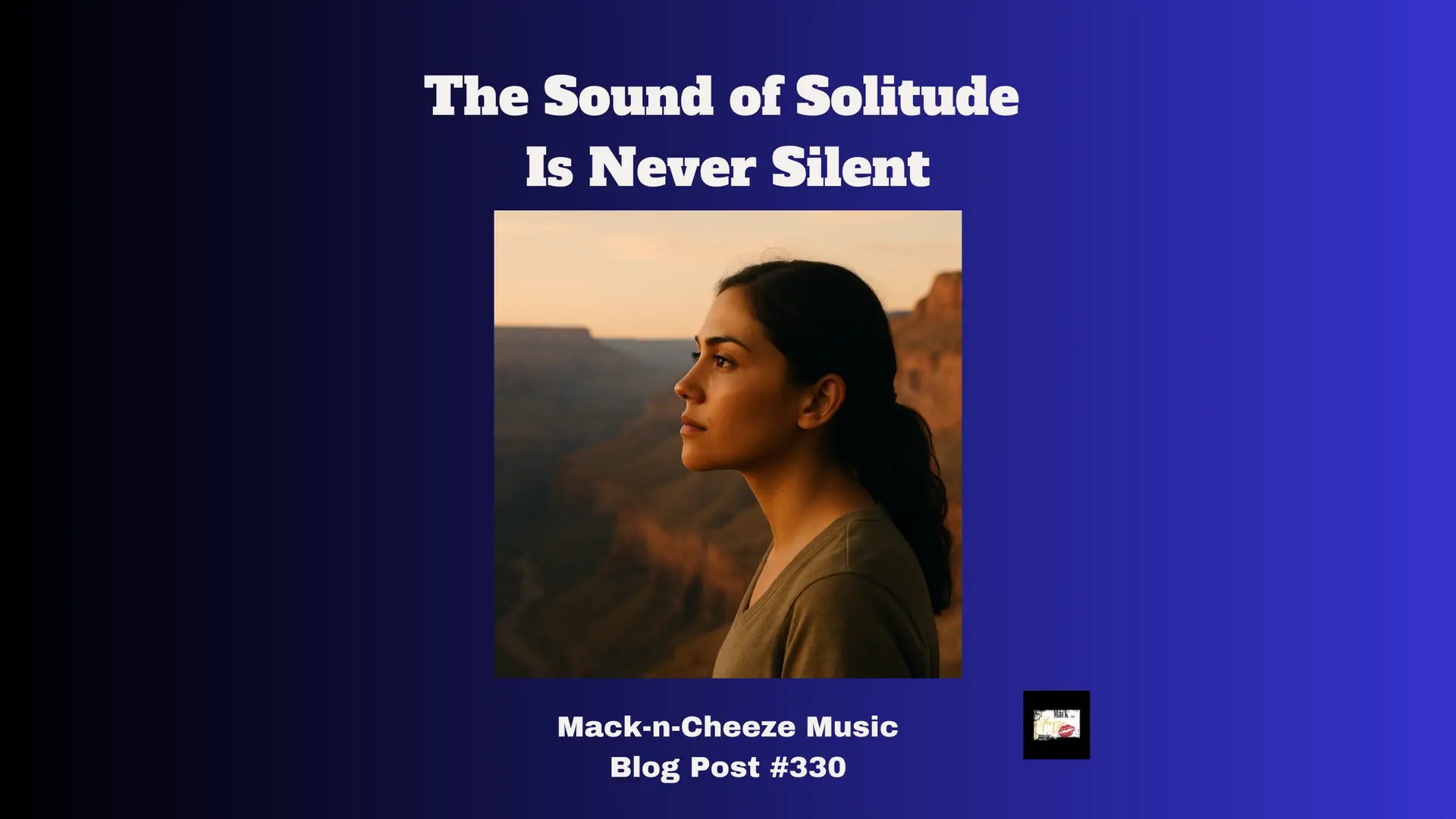
You don’t find solitude just by locking a door.
Estimated reading time: 9 minutes
You can shut off your phone, close the blinds, and kick everyone out of the room, and still be tangled in noise. The noise in your head, the world, and even the clamor that lingers in the quiet.

Image generated by Dalle
Table Of Contents
The word carries depth.
Not loneliness. Not isolation.
Solitude.
The deliberate, sometimes defiant, act of being alone.
The catch: solitude is not quiet. It hums and screams. The sound of solitude is never silent.
When you finally shut the world out, the real noise begins. The buzzing of doubt. The ticking clock of ambition. The ghosts of every unfinished idea pacing in your skull. And if you’re a creator, God help you, because the silence will start crying out.
You hear the music you haven’t written, the lines you’ve been avoiding, and, hopefully, the truth you have been searching for.
Solitude In Chaos
I’m on the train, returning to Seattle, after visiting my mother and family. The train: It is noisy and thrashes about, but I can sit down in the cafe car and immerse myself in my work.
There used to be many hours spent on the freeway, stopping at rest areas and grabbing lunch on the way down to see Mom. Dealing with the snarl of Southbound Portland traffic, getting frustrated, accomplishing nothing, except exasperation and boredom.
The train offers creative respite. I can have creative solitude in the midst of fellow passengers, their laughter and stories trying to trump Chopin, Haydn, or Buxtehude in my earbuds. And sometimes, there is a sniveling child clamoring for their parents’ attention through false tears and whining entreaties.
But I still create in solitude despite the ruckus.
Solitude is not only about getting away from people, but it is about getting away from the versions of yourself you perform for those around you.
Real solitude? That’s when the masks drop. And one of the oldest ways to get there is when I look up.
Go outside. No music, headphones, or script. I look at the stars.
It is humbling.
Those ancient lights don’t care how many followers I have, don’t flinch at my regrets, or argue with my pride.
They shine for eternity. I know my place.
I am small but part of something vast, ordered, and beautiful.
The heavens were made transparent for a reason. Maybe it’s so we never forget the difference between the eternal and the trivial.
Maybe it’s so we have something to return to when everything else feels loud and shallow.
Emerson And Solitude

Image courtesy of the NASA Spitzer Space Telescope
As Emerson suggested, if the stars only came out once every thousand years, people would lose their minds.
They’d weep and write symphonies. They’d gather their kids and say, “Remember this. It’s the closest thing to heaven you’ll ever see.“
But because it happens every night, I forget, buried under endless to-dos and the constancy of eternal daylight and dusk of city life.
We urbanites have forgotten the beauty, vastness, and eternity that the stars proclaim.
The stars don’t get less miraculous. We just stopped paying attention.
Everything in nature whispers like that, if we’re listening.
Trees, mountains, flowers. A quiet walk. A note that rings out and disappears into the air.
None of it is ordinary, and I grow numb trying to act like I have it figured out.
The Call
If your soul feels stretched thin, and the noise inside your head is louder than your music, and your creativity feels artificial or forced:
Go outside. Look up. Be still. Let wonder punch through the static.
Because the universe doesn’t shout. It doesn’t chase you. It waits.
And when you are ready to listen, it sings.
Be Like Those Who Knew And Know
They didn’t stumble into it, but sought it.
Not for peace, or quiet, or even for inspiration.
In the present, solitude is not a retreat; it is a test. We show up. If we want to be part of the elite, solitude is not an escape but a confrontation.
Like the masters of the past, the real work, our soul work, only happens when the mirrors aren’t polished and the lights aren’t flattering. This is when we are stripped of applause, validation, and distraction.
This is when the only voice left is our own, not whispering, but demanding.
Silence is not to be feared because it is not empty.
It is full, filled with the unsaid, undone, and unwritten; we begin to hear the truth that is shrouded when the world gets too loud.
This is not a place to wait for ideal conditions. Make the space, and in that space, face the static, the surge, the rising pulse of something authentic waiting to be born.
Solitude does not coddle us; it sculpts us.
When we return from isolation, we are transformed, if only a little. When we walk through the crucible of isolation, we listen until the silence speaks.
Caspar David Friedrich

Image generated by Dalle
Caspar David Friedrich (1774–1840) was a German Romantic painter best known for his haunting, contemplative landscapes. He often placed solitary figures in vast, moody natural settings of fog, cliffs, and forests, not to paint nature but to explore what it meant to be alone with yourself.
He wasn’t interested in realism. His goal was spiritual. Friedrich believed nature was a reflection of the divine, and solitude was how you accessed it. Critics didn’t always get him in his lifetime. Later generations recognized him as a master of silence, space, and inner vision.
He didn’t just paint solitude, he lived and understood it.
Friedrich articulated the necessity of solitude for artistic creation, stating, “I must stay alone and know that I am alone to contemplate and feel nature in full; I have to surrender myself to what encircles me.”
In his review of the Metropolitan Museum of Art’s Caspar David Friedrich retrospective, critic Jerry Saltz highlights the artist’s profound exploration of solitude:
“His pictures of graveyards, seashores, shipwrecks, and mountain vistas force us to ponder our place in the universe. Friedrich’s subjects appear disaffected, melancholy, and beset by torpor as they gaze on landscapes that awe and confuse in equal measure.”
Saltz emphasizes how Friedrich’s work invites viewers into a contemplative space, where solitary figures are immersed in vast natural settings, prompting reflections on isolation and introspection.
He worked and thought alone, and understood something most people never will: the deeper you go into solitude, the more you start to hear what matters.
It is said you can see it in his brushwork, that the observer can feel how stripped down everything is. He didn’t paint distractions; Friedrich painted what is left after the distractions are gone.
The Hero’s Journey: A Blueprint for Creative Solitude
Joseph Campbell mapped out a universal pattern in myths, stories, and lives across cultures. It is the Hero’s Journey. And while the myths are full of dragons, mentors, and trials, the heart of it is this:
You leave everything familiar, face yourself in the dark, and come back changed.
Sound familiar?
That middle stage, the Abyss, the Innermost Cave, the Ordeal, that is solitude. Think Luke Skywalker.
It is not comfort or clarity. It is the stripping away of noise, ego, distraction, and identity. The hero goes inward, and nobody can go with them.
“The cave you fear to enter holds the treasure you seek.” – Joseph Campbell
That cave? It’s never a physical place. It’s psychological. Emotional. Often spiritual. You’re alone in the silence. And that’s where the breakthrough happens.
So yes, Campbell wasn’t only talking about heroes with swords. He was talking about artists, thinkers, creators, people like us, people walking into creative solitude not to escape the world but to wrestle with truth, return with something real, and offer it back.
Solitude Versus Isolation: Know The Difference

Image generated by Dalle
Solitude is chosen.
Isolation happens to you.
Isolation is when the world turns its back and leaves you in the dark with nothing but static.
Solitude makes room.
Isolation empties it.
One sharpens you.
The other wears you down.
Solitude is the studio door closed, the phone off, the track looping until it breaks open into something real.
Isolation is when you’re surrounded by people but still starving for connection, when you post the song and the silence after feels like failure.
Solitude says:
“This is where you meet yourself.”
Isolation whispers:
“No one’s coming.”
The truth? Creators need solitude. That’s where the real work happens.
But you’ve got to protect it. Name it. Claim it. Or it slides into isolation, and that’s when doubt starts eating your edges.
So ask yourself:
Are you carving out silence? Or are you stuck in it, waiting for someone to notice?
Because only one of those leads somewhere worth going.
Daily Solitude
Mornings begin with ritual: oblations, gratitude, reflection, and intention. Then comes the work.
Networking is essential; collaboration is fuel. My latest video? Proof I can’t do this alone. I’ve got talented people in my corner.
After that, it’s on to the day’s projects. But the top priority always gets my best energy. No exceptions.
Every Wednesday, I release new content, which has to matter. It is not fluff or filler; it is real and deeply personal.
And of course, it takes at least two hours to work on the kit. Gotta stay sharp.
Speaking of the big stuff:
And my good friend; working with Darnell Scott has been my life’s most rewarding musical collaboration. We’ve had our battles, but we’re still in the ring, and I’m grateful for that.
Can We Help You?
What do you think your future self would tell you to start doing right now?

If this stirred something, if the silence you’ve been sitting in suddenly felt louder, it means you’re still in it. Good.
Leave a comment if this hit home.
Please share it if you know someone who needs to hear what solitude really sounds like.
And if you’re building something real in the quiet:
Subscribe. I’m right there with you every week, no noise, no filter.
Want More Mack-n-Cheeze?
Videos - Bryan At Mackncheeze on YouTube
Podcasts – Bryan At Mackncheeze Apple Podcasts, Fountain, Spotify
Leave a Reply