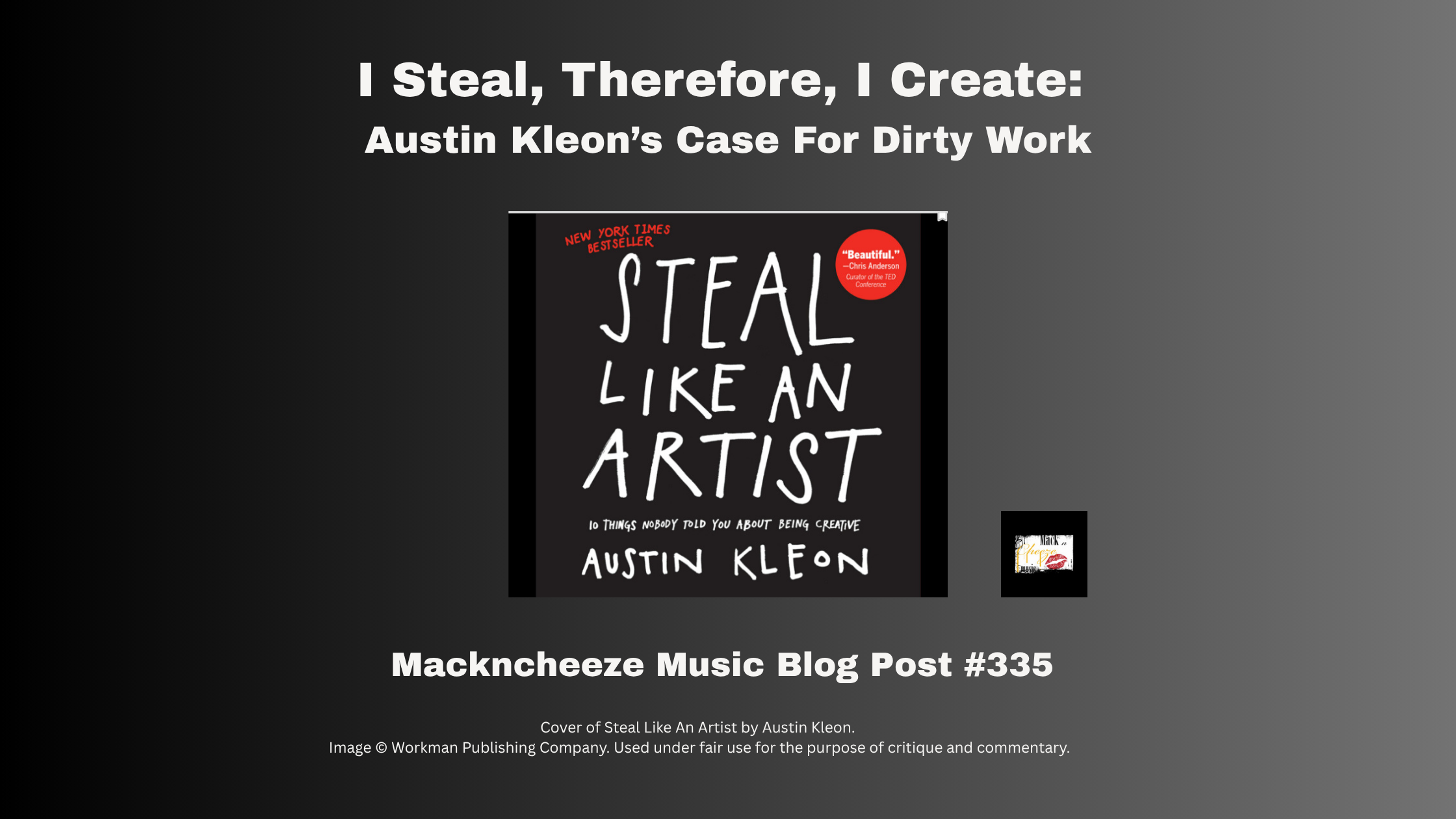
I steal; therefore, I create. Plain and simple.
I’m a thief by trade. To pretend otherwise would be two-faced.
Estimated reading time: 10 minutes

Table Of Contents
I’ve borrowed grooves, lifted phrasing, and copied the structure of blogs, videos, and tunes that worked, then dragged them through the mire of my wreckage until they emerged as something else.
You can call it stealing. I call it survival. This is a review, confession, and recommendation combined. Read on if you have ever stolen anything and called it art.
An artist with clean hands? Hah! An innocent creative whose influences are unblemished? Pure charade!
I’ve been a sommelier for over thirty years, reading people, navigating egos, and threading the needle between elegance and chaos. All the while, I have built music, blogs, podcasts, and a YouTube channel, and with the scraps of time most people waste scrolling.
This is my lifeblood. On a deadline.
Steal Like An Artist: The Book
When I picked up Steal Like An Artist by Austin Kleon, I didn’t need a roadmap. I was looking for confirmation, not proof that I was confiscating another artist’s vision.
I’m a drummer. I did not create Bembe, Mozambique, or the Half-Time Shuffle. I only reinterpret them the best I can, with my own voice.
And that’s precisely what the book offers. It’s not a guide for those convinced of the purity of their creative pursuits. It’s a mirror for those of us already deep in the work, dirty hands and all.
Kleon’s thesis is simple: originality is a myth. What matters is what you do with what you take. I did not need convincing or someone to say it out loud.
I’m biased; plainly and simply, that is my identity.
No Idea Is Original
“There is no such thing as a new idea. It is impossible. We simply take a lot of old ideas and put them into a sort of mental kaleidoscope… but they are the same old pieces of colored glass that have been in use through all the ages.”
— Mark Twain, Mark Twain’s Own Autobiography

Image generated by Dalle
Kleon opens with the provocation that gives the book its title: “Steal like an artist.” Do not plagiarize. Do not copy-paste. Steal with intent and discernment, transformation being the goal.
He argues that no idea is truly original; it is only authentic when passed through the filter of your lived experience. As someone who’s spent decades reshaping other people’s ideas, I didn’t need convincing. I’ve made an advocation out of creative theft.
“Everything is up for grabs. If you don’t find something worth stealing today, you might find it worth stealing tomorrow or a month or a year from now.”
Kleon, Austin. Steal Like an Artist: 10 Things Nobody Told You About Being Creative (Austin Kleon) (p. 6). (Function). Kindle Edition.
Here’s where my argument starts to fray.
Kleon leans hard on the comfort of the phrase ‘steal like an artist’ without fully confronting the mess underneath. What are those? The ethics, doubt, and the threat of imposter syndrome. When we actively steal, we may question the real fear that we are not innovating, just mimicking with flair.
How Do I Steal Well?
What does it mean to steal well? What’s the line between influence and dependency?
I once failed a Certified Sommelier exam for not using the proper adjectives in my olfactory approbations. Subjective? Absolutely. Terms like ‘a dense dark fruit nose’ or ‘bracing acidity laced with nuances of decaying limestone.’ Utter crap.
Did I invent those descriptions? You know the answer. But I needed someone else’s approval to ‘correctly’ analyze the wine to pass the test.
You get the analogy.
So Kleon gives permission but not much strategy. Why would you need it?
Plagiarizing one person is stealing, of course, no question. But, stealing from everyone is time-consuming because it is called research.
And if you’re already knee-deep in creative work, you don’t need permission. You need tools to differentiate your voice from the noise of your influences.
Kleon’s advice here is a great start. For the artist already crafting, the question isn’t ‘Can I steal?’ but rather, ‘Have I transformed what I took into something that reveals who I am?
I Steal With Intent
“The artist is a collector. Not a hoarder, mind you, there’s a difference: Hoarders collect indiscriminately, artists collect selectively. They only collect things that they really love.”
Kleon, Austin. Steal Like an Artist: 10 Things Nobody Told You About Being Creative (Austin Kleon) (p. 13). (Function). Kindle Edition.
Sounds poetic, the artist as a collector, Right? Who decides what’s worth collecting? You do. What happens when your taste outpaces your ability? Good question. That is a constant predicament. What about those who collect too well, mimicking perfectly but never innovating? God grant me the execution to be able to do that.
The line between hoarder and collector is blurry. For some of us, collecting can become another form of procrastination: scrolling, screenshotting, saving, and bookmarking without ever acting on any of it.
Guilty as charged. I come up with ten new ideas a day. Every day. That’s not an exaggeration, it’s a habit I’ve built over years. Hooks, headlines, grooves, blog titles, fragment phrases, project names. I write them down, sometimes.
Most of those ideas? Not mine. I participate in the practice of cut-and-paste, finding creativity and inspiration from things I have absorbed and twisted.
Prioritize Theft
But here’s the thing: A list isn’t a song. A title isn’t a post. A great idea doesn’t mean you’ve done anything.
Collecting feels like progress. But if I’m being honest, some of that collecting is cover for stalling.
When does collecting become avoidance? When does the love of influence become a mask for inertia? It could be said that Kleon doesn’t push hard enough to answer those questions.
Should you?
Collecting is seductive and feels like work. Take it from me. It looks like progress, but a folder full of saved genius is like my Monet and van Gogh prints, just decoration and not authentic.
I Steal From What I Read
“Always be reading. Go to the library. There’s magic in being surrounded by books. Get lost in the stacks. Read bibliographies. It’s not the book you start with, it’s the book that book leads you to.”
Kleon, Austin. Steal Like an Artist: 10 Things Nobody Told You About Being Creative (Austin Kleon) (p. 20). Workman Publishing Company. Kindle Edition.
I have been asked, ‘Where do you come up with your ideas for blogs?’
I read.
Yes, each idea for my blog posts is stolen from another writer. I do not plagiarize their work, but I let their concepts simmer in the cauldron of my brain. A lot is in there; most of it doesn’t spill out.
Why read and not listen to audiobooks? Audiobooks are usually consumed while multitasking. When we multitask, our attention is divided. We can not give one hundred percent of our concentration to two things at once. It just doesn’t happen.
Kleon is not recommending consumption for consumption’s sake but pushing for discovery through serendipity. He argues that real creative growth happens when you immerse yourself in diverse voices, let your attention wander between the shelves, and follow the breadcrumbs that reading offers. It’s less about finishing a book and more about letting each one open doors to new paths.
When Does Creativity Start?
The questions we need to ask ourselves:
When do you, as a creator, stop reading and start making?
When does exploration become procrastination?
Who really has the time to “get lost,” especially those holding down gigs and lives?
Kleon says, Always be reading… get lost in the stacks… it’s not the book you start with; it’s the book that that book leads you to.
He’s right. You know it , and I know it. Immersion is the creative fuel. But when every bibliographic rabbit hole becomes a distraction, reading edges out inertia. If you’re going to chase down those paths, chase them with purpose, not just to collect but to create.
Who Do I Steal From?
“First, you have to figure out who to copy. Second, you have to figure out what to copy. Who to copy is easy. You copy your heroes—the people you love, the people you’re inspired by, the people you want to be.”
Kleon, Austin. Steal Like an Artist: 10 Things Nobody Told You About Being Creative (Austin Kleon) (p. 35). Workman Publishing Company. Kindle Edition.

Image generated by Image Generator Pro
Ever played in a cover band? You actually hone your craft through imitation. If you played in a good cover band, you worked with multiple vocalists and skilled instrumentalists. It is a difficult skill to master because you must be able to move through various genres convincingly. If imitation is not a form of theft, I don’t know what is.
This is a case for intentional apprenticeship, not a formal mentor relationship, but through studying the work of those who shaped your taste. Copying your heroes is how we reverse-engineer their magic. Eventually we will find our voice.
Kleon goes on to say that once you really start copying your heroes, you realize you’re not copying them exactly. You’re copying what you see in them. And what you see is filtered through your own lens. That is where originality sneaks in.
This advice is at the intersection of humility and aspiration. And boy, is it humbling. Aspiring to take creative control of your art requires uncounted hours, days, weeks, months, and years.
Fact: creativity is lineage. No artist begins in a vacuum. Every sound, brushstroke, or sentence lives in a historical and personal context.
Kleon isn’t advocating for lazy mimicry. We become by copying, transformed by choosing what to keep. The process of filtering what resonates, discarding what doesn’t, and reshaping it through our limitations is what real art is all about.
Go Out And Steal
Well, you suffered through another pontification. Good job.
Steal Like An Artist is great book. I highly recommend it. It is a quick read, has a lot of affirmations of what the creative path is like. Despite having played The Devil’s Advocate in a few of my comments, what a killer book.
I like being told I am doing the right thing.
Keep on stealing. You’re already doing it anyway.
I’m going upstairs to work on my approbation of the half-Time shuffle, hopefully I’ll use the right adjectives.
Two Sides To Every Coin
If you disagree with me, perfect, I want hear about it. Iron sharpens iron, my friend. I can get pretty dull.
Hang out with people smarter than you. It works. Steal from them.
If this post resonated, share it.
If you haven’t subscribed, do so. My content is ripe for the picking, albeit, most is low hanging fruit. Have at it.
Can We Help You?
What would your ideal creative day look like—if money wasn’t an issue?

Want More Mack-n-Cheeze?
Videos - Bryan At Mackncheeze on YouTube
Podcasts – Bryan At Mackncheeze Apple Podcasts, Fountain, Spotify