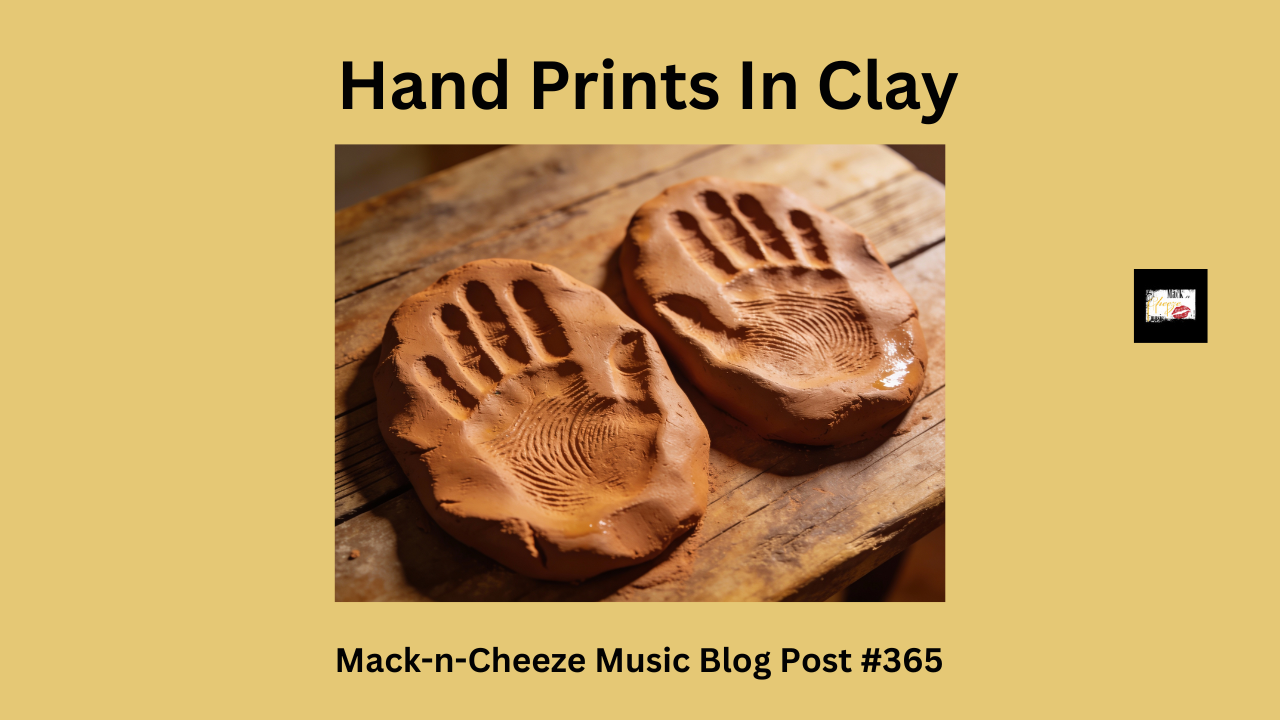
What do you believe your hand prints in clay are?
Estimated reading time: 1 minute

Table Of Contents
Are they proof you were there?
A record of who you are?
A sign that the work mattered because it came from you?
Most of us don’t arrive at those ideas through theory. We arrive at them early, without language.
Think back before art class, before kindergarten, before we understood what a mark was supposed to mean.
Play-Doh on the table. Soft enough to take a shape. We pressed our hands into it almost without thinking, sometimes while eating it, sometimes just to see what would happen. It was a fun. We laughed when the shape appeared.
That flattened imprint felt like confirmation, not in words, but in recognition. The surface gave way, and what remained corresponded to us. An indentation appeared where a hand had been.
Long before we had language for identity or expression, the pattern was set: contact leaves evidence. A visible trace reads as presence.
What The Hand Print Means
Our early encounters with a responsive surface hardened into expectations.
Most artists don’t articulate them, but they operate anyway—quietly, automatically. We assume the hand print has implicit meaning; a set of assumptions.
The first: the presence of a hand print is taken as evidence of effort, regardless of how lightly the surface was touched.
The second follows closely: the mark carries my identity.
Because the imprint corresponds to the hand, it’s assumed to carry the person with it. The deformation is read not just as contact, but as self. There is something personal embedded in the material by default.
The third represents durability: the mark means something because I created it.
We act as if meaning comes with the action of creation.
How Clay Actually Responds

Clay holds its shape only where pressure is applied. Inconsistent pressure produces shallow distortions that don’t hold. You can pass over the same spot again and again and still leave no lasting trace. From the hand, it feels like an activity. From the surface, it’s negligible.
This is where the artist gets confused. Effort is being spent, but pressure isn’t. The hand keeps moving. The same area gets revisited. Time passes. From the inside, it feels like work, but nothing is happening. Movement without force leaves no trace. The material doesn’t care how long it took to create the piece. It records only what altered its shape.
Understanding these differences matters. The work stops responding to what you meant and starts reacting only to what you actually did.
The Threshold Most Work Never Crosses
The threshold is the point at which work begins to exist independently of the person doing it.
Before that point, only effort matters. The work requires your presence for it to remain alive.
Most projects stay at this point.
Motion is not accumulation.
This is why work can feel alive internally and invisible externally at the same time. Attention creates activity, but activity alone doesn’t give the work durability. Without response, engagement, and continuation, the work collapses back into ongoing effort.
The artistic process makes this hard to notice.
Stagnation can show up here, not as emotion, but as mechanics. Work continues. Independence never arrives.
Crossing the threshold isn’t a moment of inspiration. It’s when the work no longer depends on your constant pressure to exist.
That’s the boundary most work never reaches.
Cave Hand Prints
At this point, some people think of cave hand prints. They always do. It’s an easy association. Hands on stone. Survival across time. Identity made permanent. We do not know what those people intended.

Humans have never been stupid. They understood environment, shelter, cycles, and return. It is entirely plausible that they knew those marks would last, especially if the caves were revisited seasonally.
People familiar with prehistoric art often think of the hand prints found in sites across the world. From the ancient stencils in El Castillo, Spain, to the panels in Chauvet Cave, France, and the hands of Cueva de las Manos in Argentina. These are examples of marks that have survived for tens of thousands of years.
Modern work exists under opposite conditions. Constant exposure. Endless handling. Repetition. Nothing is protected or sealed. What remains now isn’t what was placed carefully. It’s what holds up under pressure.
What Has to Survive
A post you publish once, or a draft you finish once, or the song you write and then set aside, none of those have to withstand interruption.
They don’t need a way back in or need structure. They don’t need to reappear. The moment the act is finished, the demand ends.
What matters now is what happens after the act. The next day. The gap. The interruption. Whether the work continues without requiring a fresh decision every time.
Modern work is handled constantly. It’s seen, skipped, returned to, ignored, surfaced again.
If returning to the work requires a new decision each time, it won’t survive.
Endurance here isn’t about effort. It’s about arrangement. Where the work lives. How it’s revisited. What makes the next step unavoidable instead of optional?
What lasts isn’t what was done once.
It’s what keeps getting done when nothing is pushing it.
That’s the pressure modern work has to withstand.
Hand Prints In The Clay: Firing The Clay

Firing isn’t a ceremony. It’s the point where adjustment stops.
You publish the post, release the record, or perform the piece in front of people who didn’t help make it. You don’t control the results.
This is where weak work shows itself. Firing removes the option to keep circling, revising, explaining, or preparing. Whatever wasn’t resolved in the making shows up immediately. Gaps harden. Thin areas crack. Avoidance becomes visible because there’s nowhere left to hide it.
Permanence comes at a cost. Like clay, once fired, the work can’t be softened again without damage. There’s no protection built in. No guarantee it will be received well, or received at all. Exposure replaces control.
This is why many people stop here. Not earlier. They can handle effort and the continued effort. Especially in a society where it seems everything operates in immediacy.
What they avoid is consequence without insulation. Firing the clay means accepting that the work will exist as it is, not as it was meant to be.
There’s nothing heroic about this stage. Just risk. And the refusal to pretend otherwise.
What the Metaphor Allows
In the end, pressing our hand prints into clay is not a strategy. Our hand prints are proof that we were here.
When we make something, we press ourselves into it. Not as an idea or a statement. Rather, as a contact. Whatever happens afterward is out of our control.
The measure is simpler. We were here. We touched something.
The people who left their hands on cave walls weren’t dependent on an audience to be real. Neither are we. Whatever their reasons, the marks still say the same thing ours do now, stripped of time and outcome: this was a human presence. This happened.
So whatever becomes of the work, whether it survives, circulates, or disappears, the hand print remains what it always was.
Proof of contact. Proof of being here.
Can We Help You?
When you pull your hand away, is anything left in the clay?

Make something that remains.
Put it out.
Then leave it alone.
If this post matters, share it.
Did it hit a nerve? Share it.
If you want to keep watching what survives, subscribe.
Thank you for sticking around. Can’t do it with out you.
Want More Mack-n-Cheeze?
Videos - Bryan At Mackncheeze on YouTube
Podcasts – Bryan At Mackncheeze Apple Podcasts, Fountain, Spotify