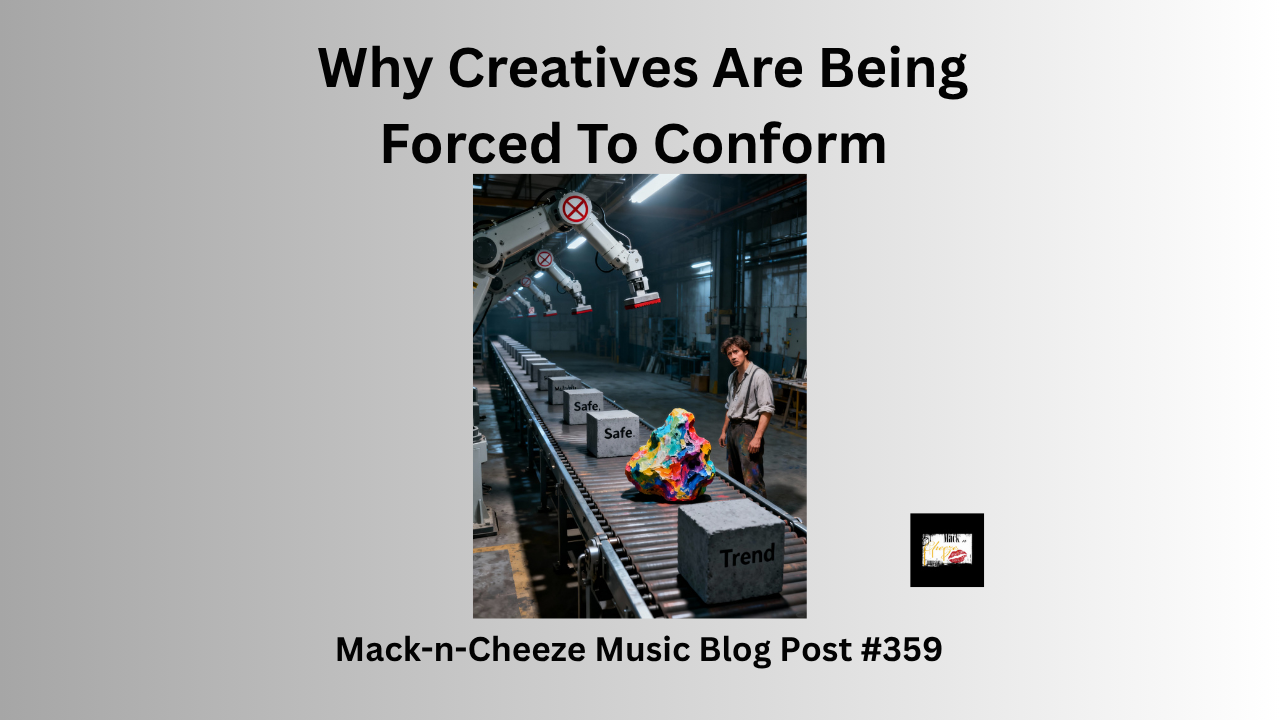
We creatives are being forced to conform. Not by overt governmental censorship. But by a culture that rewards speed, sameness, and safety (i.e., pre-approved ideas). The pressure is quiet, constant, and everywhere.
Estimated reading time: 11 minutes

Table Of Contents
Screenwriters are pushed into rigid formulas that guarantee predictability. Painters are encouraged to make work that photographs well for social media feeds. Graphic designers are asked to mimic whatever template is trending this week.
Filmmakers are advised to follow test-audience data rather than their instincts. Photographers adjust everything to fit the Instagram look.
Animators and illustrators are often bound by franchise-style guides. Musicians chase algorithms instead of exploration.
Across every discipline, the message is the same: don’t risk, deviate, or disrupt.
Audiences reward what feels familiar. And institutions filter out anything that might disrupt their equilibrium.
That’s the real box we’re being pushed into; one built not from rules, but from incentives.
The result isn’t just creative fatigue — it’s a system where the only acceptable artist is the one who stays inside the lines.
Forced To Conform: A Pattern Across Generations

But this pressure isn’t new. Every era has punished the people who refused to conform to the box it built.
Kara Walker took a polite Victorian silhouette and carved open America’s racial history, and the art world flinched. Stravinsky detonated the expectations of polite society with The Rite of Spring and was met with a near-riot. Artemisia Gentileschi painted women with power instead of compliance and paid for it with isolation and erasure.
Each one shows the same math: when you break accepted patterns, the world pushes back.
The Scale Of Change
What’s different now is scale. The box has never been wider, faster, or more normalized. Creatives face a choice every generation has confronted, but at a higher volume: blend in or face resistance. And if you care about truth, originality, or integrity, blending in is its own form of collapse.
This blog is about that pressure, the cost of refusing it, and a few creators who chose the more challenging path. They decided to go down that path because the systems around them demanded conformity. And they refused.
Kara Walker
Kara Walker didn’t enter a neutral art world. She stepped into a system that expected “acceptable” work about race, images that soothed, educated politely, or uplifted. Curators wanted dignity and healing. Collectors wanted symbolic reconciliation. Audiences wanted narratives that confirmed their existing beliefs. Walker refused all of it.
Instead, she revived the genteel Victorian silhouette and weaponized it. This technique turned a decorative, prim medium into a blade that cut straight into America’s buried history of violence, domination, and power. Her scenes were stark, explicit, and impossible to ignore. They forced viewers into discomfort rather than giving them a moral pat on the back.
The backlash came fast and from all sides. White critics accused her of being too graphic, too raw, too willing to show things they preferred to forget. Black critics argued she was exposing trauma for elite white institutions. Museums worried about how to display her work without igniting outrage. Some audiences walked out; others refused to look at all.
Kara Walker vs. the Rules of “Safe” Art
Kara Walker pushed back hard against the criticism. She made it clear that she wasn’t depicting literal reality, but rather the fictions and stereotypes that had been handed down through history.
She argued that avoiding these stereotypes was just another form of denial. Confronting them was necessary if their power was ever going to be understood or dismantled.
Walker also rejected the idea that Black artists must produce only uplifting images. She refused that burden of representation and insisted on using the full range of Black imagery, not just what felt safe.
The backlash revealed a generational divide. Older artists saw these images as untouchable; Walker saw them as unstable projections that needed to be challenged. For her, discomfort in art wasn’t a failure; it was the point.
Walker didn’t become controversial because she chased provocation. She became controversial because she broke the mold her era quietly expected her to fit: be palatable, careful, and affirming. She chose truth instead, paying for it with resistance, misunderstanding, and sustained cultural friction.
The Pattern Behind The Pressure

The pressure Kara Walker faced wasn’t unique. Every creative era builds systems that reward predictability and punish deviation.
The effect is always the same: stability is rewarded, disruption is discouraged.
When the work challenges familiar narratives, the risks are financial, cultural, and social. Systems respond to risk by pushing creators back into recognizable forms. That pattern doesn’t depend on time period, tools, or technology. It’s structural.
And it’s the same pattern that confronted artists long before Walker ever picked up a silhouette knife.
Igor Stravinsky
Igor Stravinsky didn’t grow up in artistic freedom. He grew up in late Imperial Russia. The expectations of Russian composers were to expand the classical lineage, honor the past, and keep music within familiar, respectable boundaries. That was the mold.
Stravinsky wasn’t even supposed to be a composer. His family pushed him toward law, a safer, more predictable profession.
But in 1909, everything changed.
Sergei Diaghilev, the director of the Ballets Russes, saw Stravinsky’s early work and invited him to Paris. The Parisian creative environment was exploding with experimentation, modernism, and artistic risk-taking.
France offered him what Russia could not: opportunity, freedom, and a platform for creative deviation.
Once he arrived, he was working immediately and composing for a company that wanted shock, not safety. That is precisely what he delivered with The Rite of Spring.
Instead of extending the elegant musical tradition he came from, Stravinsky unleashed pounding rhythms, violent harmonies, and choreography built around ritual sacrifice.
Paris audiences expected refinement; he gave them rupture. The performance triggered shouting, fighting, and one of the most infamous riots in music history. Some called the work barbaric. Others called it noise. Stravinsky fled the theater, certain he had torpedoed his career.
He hadn’t. He had simply refused to write within the expectations of his own background or the tastes of his new audience. However, the cost came first: public hostility, institutional rejection, and a complete break with what was considered “acceptable” music.
Stravinsky didn’t become a revolutionary because he sought chaos. He became one because he rejected the mold both Russia and France quietly expected him to fit and paid for it upfront, long before the culture finally caught up.
Forced To Conform
The pressure to conform hasn’t vanished; it’s just been outsourced to platforms. TikTok, Instagram, YouTube, and Spotify decide what rises and what disappears. The decisions aren’t based on originality. They make the call on what grows and what disappears through pattern recognition.
Creatives today are often pushed to optimize, rather than explore. I know it well.
On TikTok, if a sound trend is moving, you’re expected to follow it.
On Instagram, work that isn’t immediately visually striking or formatted as a Reel is buried. I gave up on Instagram a long time ago.
On YouTube, ideas that don’t fit a recognizable format get ignored by the recommendation engine. The algorithm significantly favors content that fits established, high-performing patterns.
Photographers maintain a consistent color palette because shifting aesthetics not only tanks engagement but also confuses their established client base.
Musicians often avoid surprising their audience with radical genre shifts because Spotify’s algorithm is optimized for consistency. Abrupt changes in style, sink engagement, and algorithmic favor.
More Conforming
Writers on Substack tend to stick to one angle, even when they outgrow it. Audience expectations, subscriber trust, and platform growth mechanics combine to enforce consistency. Substack acts more like a market force.
I post on Substack. I’m not sure how effective it is for me, but it rewards those who are established.
Short-form platforms like Mastodon Social reward output frequency, not development. Pausing to think, refine, or experiment costs reach. I post on Mastodon; the verdict is still out.
None of what I have addressed appears to be censorship, but rather it seems to be a matter of “best practice.”
However, the effect is the same across every discipline: the systems that distribute creative work tend to prefer what they already understand.
And long before social platforms existed, one Baroque painter confronted a version of this pressure with far higher personal stakes.
Artemisia Gentileschi

Artemisia Gentileschi grew up in her father, Orazio Gentileschi’s, studio. She was surrounded by instruction, commissioned work, and a strict hierarchy that defined everyone’s place.
Her brothers worked alongside her, but Artemisia advanced faster, technically stronger and more fluent in Baroque composition and light. In a period where sons inherited artistic legacy, Artemisia was the one with the real skill. That alone destabilized expectations.
The Baroque world had rigid boundaries for women. The scope was limited to small devotional scenes, quiet allegories, and anything that kept ambition contained. Large-scale history painting was reserved for men. Even in her father’s workshop, the assumption was that Artemisia would stay within those limits or eventually fade into domestic life.
She refused.
Her work, Judith Slaying Holofernes, is blunt and violent, not polite or symbolic. Artemisia wasn’t following the rules. She was exposing the stories her era tried to smooth over.
Before Artemisia Gentileschi was ever seen as a threat, she was a teenager working in her father Orazio’s studio. That’s when his colleague, Agostino Tassi, raped her.
The trial that followed didn’t treat her as a victim or even as a witness. It treated her as someone whose word had to be proven by force. The court ordered that she be subjected to the ‘sibille’, a torture device that tightened around fingers and crushed them. These were the same fingers she painted with, the tools of her craft.
Refusing To Conform
She held to her testimony. The message from the court was unmistakable: her truth mattered less than the reputations of the men around her.
The aftermath wasn’t gentler. Male painters dismissed her skill. Patrons backed away. Works she painted were credited to men or removed from attribution altogether. Artemisia’s talent upset the gender order of her time, disrupted the expectations inside her father’s studio, and challenged the male monopoly on history painting. The system’s response was predictable: contain her, diminish her, and make her disappear.
But the refusal stayed consistent in her work. Artemisia adopted the complete artistic vocabulary of the Baroque. She directed her talent towards female agency rather than male heroism. She chose narratives that forced confrontation rather than comfort.
Recognition eventually came. Not from the culture that punished her.
King Charles I of England invited her to his court, valuing the originality and force that her home institutions resisted. Her talent was undeniable. But acceptance came from elsewhere. Not from the structures that tried to keep her in place.
Artemisia’s career makes the pattern explicit: Break the hierarchy, and the system punishes you before it understands you.
The Ruthless Math of Being Forced to Conform
Across centuries, the pattern hasn’t changed. Systems reward what they already understand, and they punish the peoplewho refuse to fit inside that structure.
Kara Walker confronted the narratives her era sought to soften.
Igor Stravinsky broke the musical expectations his audience treated as law.
Artemisia Gentileschi defied the gender hierarchy that tried to erase her.
Different centuries, different tools, different risks, same mechanism.
The choice hasn’t changed either.
Conformity gives you predictable approval, reach, and rewards. But it erodes the work and eventually erodes the person making it.
Non-conformity can cost you resistance, misunderstanding, and lost opportunities. But it preserves the only thing you actually control. That is your creative integrity.
That’s the math.
You can break the mold, or you can let the mold break you.
Every creative has to choose which break they can live with.
Can We Help You?
If you stay inside the mold, what part of you disappears?

If this resonates with you, share it.
If you disagree, say so. Your pushback sharpens the conversation.
And if you want more work like this, subscribe.
Want More Mack-n-Cheeze?
Videos - Bryan At Mackncheeze on YouTube
Podcasts – Bryan At Mackncheeze Apple Podcasts, Fountain, Spotify