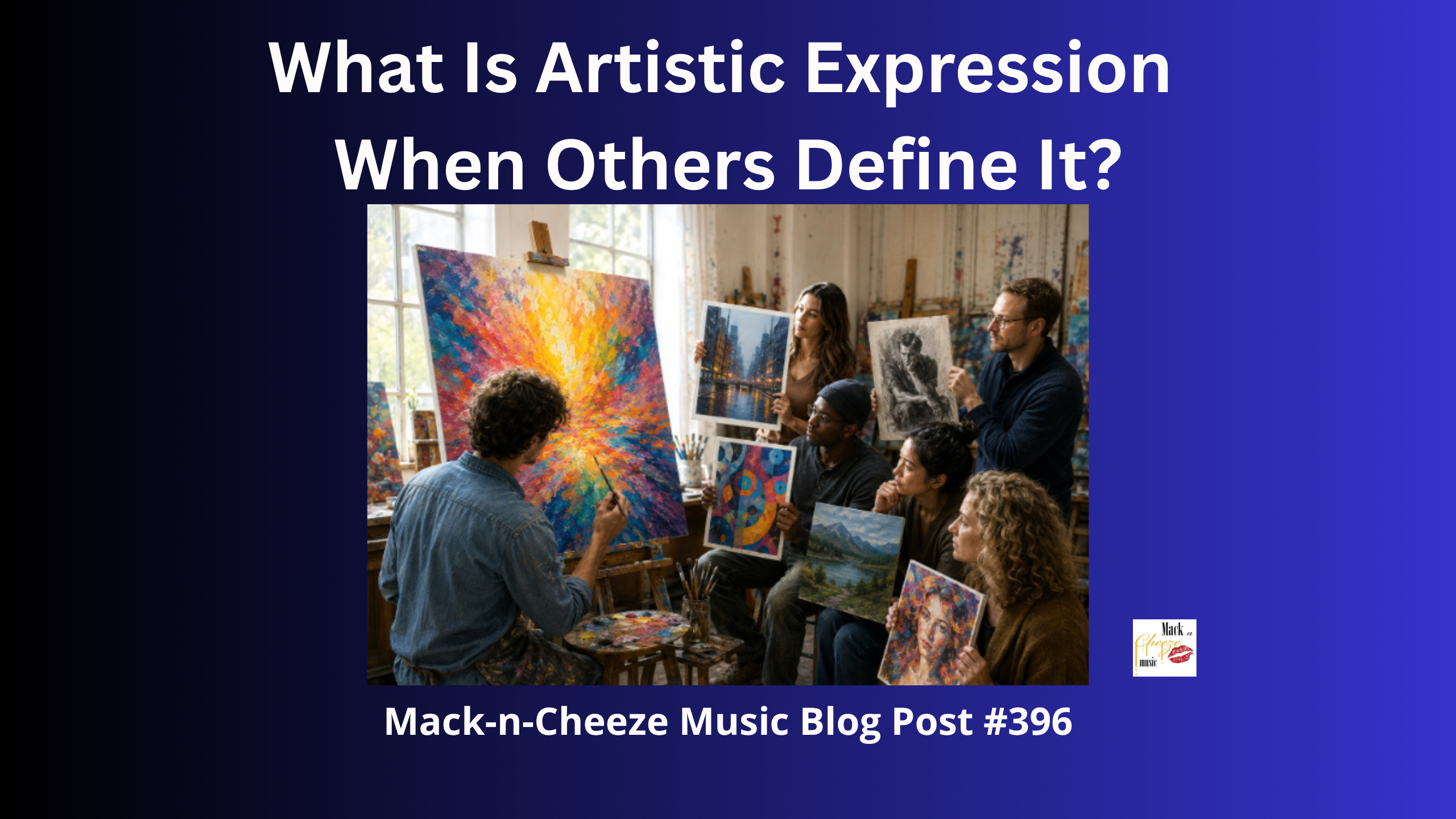
What is artistic expression if the meaning of what we create changes the moment it reaches someone else?
Estimated reading time: 7 minutes

Table Of Contents
A musician can shape every detail of a recording, but that control ends when someone else hears it. The listener has no obligation to hear what the musician intended.
A song about one subject may stir the memory of something completely different. The meaning the listener perceives can move beyond the artist’s intention.
Does artistic expression end with what the artist intended, or does the person receiving the work become part of it?
Music offers a clear example, but the question applies to every form of art.
After the Music Leaves the Room
Music reaches us through sound alone. What we hear reaches us through vibrations, yet enjoying music does not require any of the other senses. Those who hear it do not need to see the musicians, know what instrument made a sound, or understand how the recording was made.
On May 29, 1913, The Rite of Spring opened in Paris, and the audience did not sit politely through it. Stravinsky’s music was pounding, dissonant, and unfamiliar. Nijinsky’s choreography didn’t make matters any easier. People started shouting boos and catcalls. Before long, the premiere had become infamous for the uproar inside the theater.
Stravinsky had written the music. Nijinsky had choreographed the movement. Neither could dictate what happened when the work reached the audience. What had been carefully created became provocation in the theater.
That night also challenges the idea that artistic expression remains what the creator intended. The audience brought its expectations of what ballet and music were supposed to be, and The Rite of Spring shocked them.
The work did not change during the performance.
What changed was what happened when it reached someone else.
The Skill Factor

Technical skill matters. It gives an artist greater control over what reaches the audience, but control over the work is not control over its effect.
A flawless performance can leave someone untouched. Another, full of rough edges, can stay with someone for years. This does not make craft irrelevant. It means craft cannot guarantee connection.
The Ramones weren’t trying to impress anyone with harmonic complexity or instrumental virtuosity. They stripped the music down until almost nothing stood between the song and its impact. Blitzkrieg Bop is a prime example. Its simplicity didn’t prevent connection. It helped create it.
An artist can spend a lifetime developing technique and still have no authority over what another person feels.
If craft cannot guarantee connection, what exactly is craft accomplishing?
Whose Meaning Is It?
If the recipient brings meaning to the work that the artist never intended, is that meaning part of the artistic expression, or merely a reaction to it?
The artist’s intention still matters. A song was written for a reason. Choices were made to express something, and different interpretations don’t erase the purpose behind them.
But intention can only account for what the artist put into the work. Once someone else encounters it, their own experiences affect what the work means to them. Meaning can develop that the artist neither planned nor recognized.
Who determines that meaning?
The Audience Doesn’t Arrive Empty-Handed

No one encounters a piece of art without bringing a part of their life along with it. Memory, experience, and circumstance affect what we recognize and what stays with us. Those components become ingredients of how the work is understood.
This creates a problem for artistic intention. The artist knows what went into the work, but cannot know everything the audience will find there. Meaning can emerge from the encounter that belongs neither entirely to what was created nor entirely to the person experiencing it.
If meaning develops through both expression and interpretation, can either side determine it alone?
Expression or Reaction?

Artistic expression belongs to the creator. The work carries what the artist chose to put there, while everything that follows belongs to interpretation and reaction. If so, the boundary is clear.
In the Bronx during the 1970s, Kool Herc noticed what happened when a record reached its break. That’s where the dancers came alive. Instead of letting that moment disappear, he used two turntables to keep it going. A few seconds buried inside someone else’s record suddenly had another life. From those parties came something the musicians on the original records could never have planned for: their work had become raw material for somebody else’s art.
The musicians on those original funk, soul, and disco records had already finished their artistic expression. Yet pieces of their work were being heard differently, physically manipulated, and turned into the foundation for new expression.
Decades later, hip-hop had traveled far beyond the circumstances of its creation, adapted to other languages and cultures around the world. The Smithsonian describes its trajectory from the parks of the Bronx to worldwide influence.
That complicates the boundary. Art doesn’t remain confined to the circumstances of its creation. It enters lives, times, and cultures the artist may never have known.
Letting Go
When is a piece of art no longer yours alone?
The creator still owns the decisions that made it, the reason it exists, and whatever was meant to be expressed. Releasing it doesn’t rewrite any of that. But it does end the creator’s control over what happens next.
Other people will find things in the work that were never deliberately placed there. Some will understand the intention. Others won’t. Their response may give the work a significance the artist never imagined.
Artistic expression can begin as something deeply personal. The artist creates the work. Once released, the audience gets to make it theirs.
Can We Help You?
When your work reaches someone else, are you willing to let them make it theirs?

We’re grateful you spent some time with us.

Continue The Journey
The Fire of Inspiration: A Journey into Artistic Genius explores the philosophy of Mack-n-Cheeze Music in greater depth.
Because sometimes the wisest person in the studio has four paws.

Want More Mack-n-Cheeze?
Videos - Bryan At Mackncheeze on YouTube
Podcasts – Bryan At Mackncheeze Apple Podcasts, Fountain, Spotify