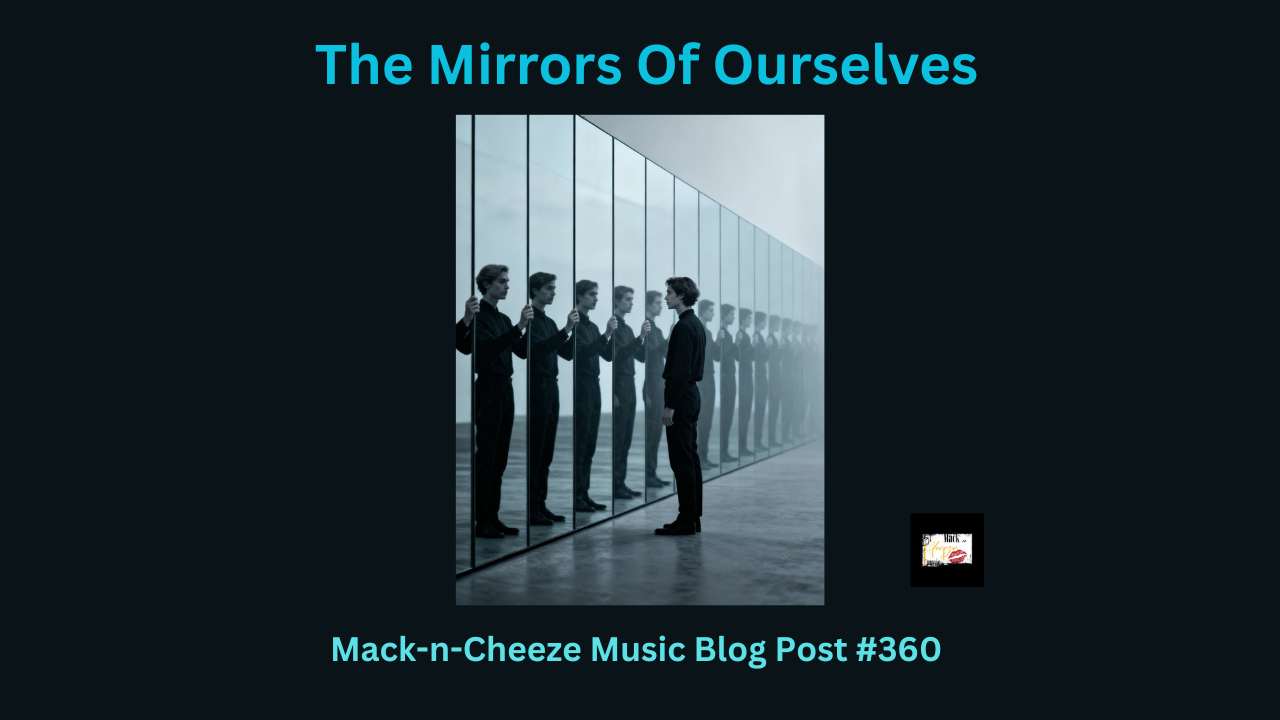
The mirror does not lie; and when we look into the mirrors of ourselves, what creative identity do we see?
Estimated reading time: 8 minutes

Table Of Contents
The Mirrors Of Ourselves
We create from identity. Rick Rubin, in The Creative Act, calls it one of the real sources of inspiration. How do you see yourself? It’s not the tricks or the gear. The question isn’t “What do you want to make?” It’s “Who’s holding the pen?”
If you’re honest, the work exposes you. It drags out the part you’ve been trying to sidestep.
When I started my first genuine attempt at a book, the mirror hit harder than I wanted. I needed direct quotes from people who help shape culture. That meant reaching out. Actual conversations. Actual risk. My self-image wasn’t having it.
“I’m scared. I have no credentials. I’d rather hide.”
Why would anyone listen?
That tiny shift cracked the old shell. My identity didn’t change because I believed a new story. My core self changed because the work forced the issue. The fearful version of me couldn’t survive repetition. Two names became four. Four became fifty. Before long, I had networks in places I used to be afraid to even email. I’d lived years in the grip of imposter syndrome; now I was staring at a contact list that made that story impossible to keep believing.
The work didn’t just shift my direction. It rewired how I operate.
That’s when I realized the real fight was never with the industry.
The fight was with the reflection.
Who do you see when you look in the mirror?
The Stories We Invent About Our Limits

Self-talk is like unfired clay. Soft enough to shape you, strong enough to hold you. Every word you repeat presses another fingerprint into the material.
A parent snapped once.
A teacher dismissed you.
A bandmate muttered something careless twenty years ago.
Those moments stay wet longer than we expect. They settle in, and over time the clay starts to remember their shape more than yours.
Say “I’m not good enough,” or “I’m behind,” or “I’m too old” often enough, and it stops sounding like insecurity. It starts sounding like identity.
That’s how the trap forms.
A thought becomes a pattern.
A pattern becomes a story.
A story becomes a room you learn to live inside—even when it shrinks around you.
Fear knows how to sound reasonable. It doesn’t need to yell. It can speak in a calm, mentor tone:
“Be realistic.”
“Take your time.”
“You’re not ready.”
“Who do you think you are?”
It sounds mature. Protective. Wise. But it isn’t. It’s the past trying to keep its grip.
Hesitation isn’t a stop sign. Hesitating is the friction you feel when stepping into unfamiliar territory.
Action is the only thing that weakens the story.
Movement exposes it. Repetition of new behavior breaks the old mold.
Fear can’t keep its authority when you’re in motion.
The voice doesn’t disappear, but its credibility is shaken. It stops sounding like truth and starts sounding like an outdated echo from a life you’ve already outgrown.
Tolstoy and His War With the Mirror

Leo Tolstoy knew this battle better than most. The man who wrote War and Peace spent decades at war with himself. This wasn’t a lightning-strike awakening or some tidy moment of clarity, just years of grinding contradiction.
He preached simplicity while living as a Russian count.
He praised humility while demanding obedience from his wife and children.
Tolstoy spoke of moral purity while wrestling impulses he couldn’t control.
The identity he claimed and the identity he lived never lined up.
He admitted it in his journals:
“I preach what I do not live.”
“My life contradicts my beliefs.”
“I am a sinner speaking of purity.”
These weren’t dramatic flourishes. They were the words of a man who couldn’t stomach the gap between his ideals and his behavior.
And that gap tore through his home.
He pushed his family to adopt his radical ideals, poverty, chastity, the renunciation of property. When they refused, he threatened to cut them out of his inheritance, convinced virtue could be forced into place.
To be fair, the crisis wasn’t simple. Faith, shame, health, and fame, these things were pulling at him. His struggle was bigger than any clean metaphor. It deserves that acknowledgment.
The Mirror Still Broke Him
At eighty-two, after years of internal strain, he walked away from his estate in peasant clothes. Not because he’d become the person he preached about, but because he couldn’t bear living as the person he actually was.
He hoped a new identity would meet him somewhere down the line.
It didn’t.
Tolstoy didn’t die in quiet solitude. He died in one of the first global media frenzies. Pneumonia stopped him at the Astapovo railway station, and within hours reporters, photographers, a Pathé news crew, government spies, disciples, and local peasants packed the stationmaster’s house. The man who longed for silence and anonymity left the world surrounded by the noise he spent years trying to escape.
A chaotic, public ending. Nothing like the serene death he imagined.
When identity and truth collide, something gives.
Sometimes the old identity dies.
Sometimes the life built around the identity collapses.
Tolstoy proves the mirror doesn’t care about brilliance, intention, or legacy.
It only reflects the person you are today.
If the reflection becomes unbearable, you either change or you run until the version you can’t live with finally breaks.
Circumstances Do Not Make the Artist

External conditions don’t create the work. They never have.
Comfort doesn’t define the artist. It exposes the truth underneath.
I am facing losing my recording space. The landlord is ending the lease, and the studio I’ve built piece by piece might be gone in a few weeks. It is really difficult to face, but it doesn’t touch the source that built the studio in the first place. The foundation came long before the room. The room just made things easier.
A great space can help momentum. It can speed up the workflow. It can feel good.
But it can’t generate the work.
I’ve watched people with flawless setups fail to finish a single track, and I’ve watched creators with barely functioning rigs turn out killer music. That tells you everything you need to know.
Circumstances are scaffolding.
Identity is the engine.
If the room goes away, the work doesn’t disappear. The path might bend, but the drive stays the same. The creative signal comes from the internal wiring, not the square footage around it.
Tolstoy stands as the reminder: his crisis wasn’t external. He had space, wealth, time, everything creators fantasize about, and none of it could resolve the division inside him. Comfort didn’t fix him. It only made the fracture louder.
The Same Principle Applies To Us
Circumstances can support the work, but they don’t define the creator.
If they did, talent would only exist in perfect rooms.
What actually drives the work is your internal architecture.
It’s how clearly you can transmit, not how fancy the gear is.
Rick Rubin comes back into focus here. He keeps pointing at the real issue:
the creative signal is only as clean as the mind sending it.
Scrambled inside, scrambled out.
Doesn’t matter how polished the environment is.
The possibility of losing the studio forces me to live what I talk about.
It pushes me from comfortable to uncomfortable, exactly where growth happens.
A clear mind doesn’t guarantee great work.
But a cluttered mind guarantees compromised work.
The source determines the signal. The signal determines the art.
Creative Portability
Here’s the part that’s easy to ignore until life forces the issue: your creative life has to be portable. If it only works in one room, under one set of conditions, that’s not a creative life. That is dependency.
Circumstances change. Leases end. Gear breaks. Spaces disappear. If the work collapses every time the environment shifts, the environment was doing the heavy lifting, not you.
The creators who keep producing when everything gets disrupted aren’t superhuman. They just built something they can carry. Their practice isn’t tied to a building. It’s tied to a way of operating.
That’s the real divide between people who create consistently and people who create occasionally. One group waits for perfect conditions. The other figures out how to continue when everything gets rearranged.
Your surroundings matter. They help. They boost momentum. But they can’t be the source. The source is the part you can walk out the door with.
Can We Help You?
Who are you when the mirrors are gone?

Thank you for taking the time to read this post!!!
If the mirror exposed something today, don’t walk away from it.
Drop your thoughts in the comments, share this with someone who needs a jolt, and subscribe so you don’t drift back into the same old reflection.
Want More Mack-n-Cheeze?
Videos - Bryan At Mackncheeze on YouTube
Podcasts – Bryan At Mackncheeze Apple Podcasts, Fountain, Spotify