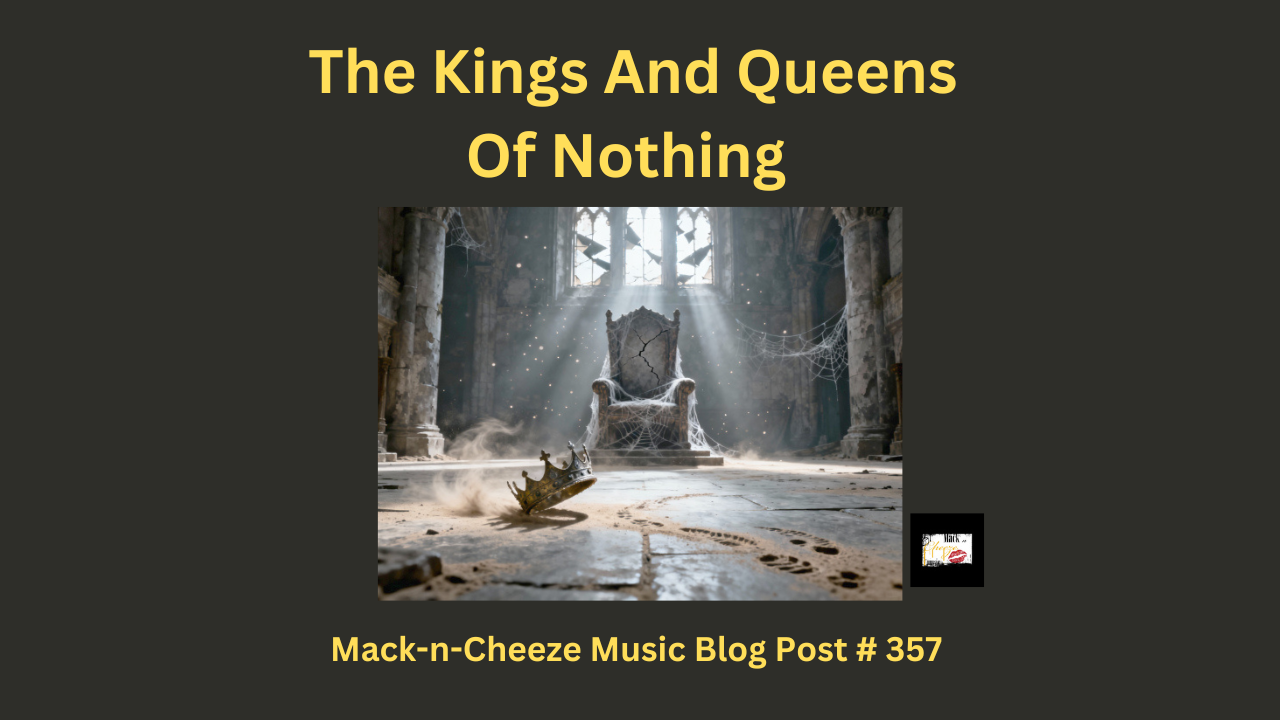
In the end, we all end up as The Kings and Queens of Nothing. That is life and the future of your demise.
Estimated reading time: 9 minutes
While you are still here on this planet, you want a crown. Don’t pretend otherwise, not on this blog.
You tell yourself it’s about purpose. Truth. Contribution. Art.
But beneath the brushstrokes, the riffs, the drafts, and the endless takes, there is a hunger you don’t admit out loud, because you tell yourself you’re humble.
You want to matter and your name spoken in rooms you’ll never walk into.
You yearn for the crown.
And if you’re not careful, it can eat you alive.
Like it did the ones before you.

Image generated by Dalle
Table Of Contents
Edie Sedgwick
Edie Sedgwick, I bet you haven’t heard of her. Andy Warhol called her his muse, and she appeared in at least ten of his movies.
She stepped into the New York art scene in the mid-1960s with money, beauty, and a desire to be seen. Born into privilege and familial instability, she carried both glamour and fracture in equal measure, a girl raised in comfort but chased by demons.
When she met Andy Warhol, she found a doorway to purpose. His world was kinetic: cameras, painters, filmmakers, musicians, all orbiting an uncharted idea of celebrity and creation. In that world, Edie wasn’t ignored or dismissed; she was noticed. Admired. Filmed and talked about. She became a face of the Factory, a symbol of Warhol’s vision that fame itself could be art.
Edie wasn’t forced there or fooled. She wanted the attention, and perhaps she needed it. Warhol’s Factory offered a kind of crown she believed she could wear.
And for a time, she floated on it.
Front-row parties. Magazine spreads. Everyone wants her name.
Attention lifts you for a moment, then drops you when the wind changes.
And when the winds shifted, there was nothing for her to lean against. No body of work or foundation of craft. She had only hunger and the willingness to be used that had brought her there.
A short reign and a silent ending. She was no villain, just someone who mistook recognition for permanence, and found herself holding smoke when the lights went out.
Not everyone collapses.
Not every crown destroys.
But wanting one can take you places from which you don’t recover.
The Crowns of Art, Money, and Culture
“Uneasy lies the head that wears a crown.”
— William Shakespeare, Henry IV, Part II (Act 3, Scene 1)
In the history of art, a recurring pattern. An artist rises to fame from their vision and prowess, yet is responsible for their own destruction.
I have this tendency; I’m sure we all do to some degree.
Kurt Cobain is not only a symbol but the poster child for having it all and refusing to accept his crowns. He had many.
Cobain wanted impact, not worship, and sought authenticity over sainthood.
But his fans crowned him king, and kings don’t get to be fragile.
The crown fit, but the cost devoured him.
What contributed to the collapse of a person with Cobain’s fame?
His body turned on him. He was afflicted with chronic stomach pain, constant nausea, and sleeplessness. His mind wasn’t a refuge either. He fought depression, anxiety, and relentless internal noise.
Drugs weren’t rebellion; they were relief.
Heroin, alcohol, not to chase a high, but to quiet the pain long enough to function, then long enough to exist.
It was self-medication that became self-destruction.
Most people imagine fame ruins you from the outside in.
Cobain’s tragedy ran in the opposite direction. His demise was from his mental state first, and the spotlight only poured on the accelerant.
In the end, nothing. He still retains the crown of his legacy. But it seems it was never important to him.
The hunger for cultural royalty isn’t something new. The crown of being seen existed long before social media, paparazzi, and streaming content.
Time is the ultimate arbiter of truth and erases most crowns.
This Game Has Been Played Before

Image generated by GeniGPT
Adah Isaacs Menken lit the 19th century on fire for a moment. She was an Actress, poet, and cultural sensation.
A crown built not on craft alone, but on persona, spectacle, rumor, and reinvention.
Menken engineered her persona. In the mid-1800s, before Hollywood, before tabloids, before anyone even had a word for celebrity, she turned scandal into currency.
Her breakthrough? A stage act called Mazeppa. She appeared nearly nude, strapped to a live horse, riding across the stage as “the Naked Lady.”
Crowds flooded the theaters. Moral outrage doubled her ticket sales.
She became the highest-paid actress in America.
Menken surrounded herself with giants. Walt Whitman, Alexandre Dumas, and Swinburne.
She published poetry and cultivated mystery about her origins, her religion, and her marriages.
She didn’t chase a role but rather visibility. Curating scandal like it was oxygen, she became the talk of cities she barely stayed in.
And then it ended. And then her body failed first: tuberculosis, exhaustion, and collapse. Dead at 33.
The crowds moved on without a pause.
A woman who commanded headlines on two continents now survives mainly in footnotes and theater history seminars.
The crown she fought for evaporated the moment she was gone.
The crown of attention has no memory.
It only shines while someone is looking.
No worship, no pity. Just the shape of the crown and how quickly it evaporates when the gaze turns elsewhere.
Is there a TikTok analogy here?
Carvaggio: The Crown of Entitlement

Image generated by GeniGPT
Michelangelo Merisi da Caravaggio was a prodigy who painted truth with a brutality that no one had seen before. Sacred figures pulled down to earth, light carved out of blackness, bodies not divine, just people, flawed, alive; his art as dark and violent as his nature.
He reinvented painting and believed that gave him the license to live above everyone else.
Carvaggio’s genius was matched only by his rage. Street fights, arrests, and the enemies he created everywhere.
He killed a man in Rome. A blade in the street, ego and temper ending a life, and he shattered his own freedom.
From rising star to fugitive overnight. Running from city to city, begging powerful patrons for pardon, painting masterpieces while being hunted.
Every city got the same man: brilliant, volatile, impossible to contain.
He painted masterpieces in exile. The Beheading of Saint John and David with the Head of Goliath. Works soaked in blood, shadow, and repentance, Carvaggio would never admit aloud.
A man too talented to ignore, and too dangerous to embrace. He died like he lived; exiled, fevered, desperate, trying to claw his way back to the stage he believed belonged to him.
Caravaggio’s crown wasn’t one of fame or adoration. His crown was about being right, feared, and untouchable. Even brilliance rots if the ego carrying it decides it’s owed the world.
A Papal pardon was finally within reach for the murder he had committed. The Vatican doors cracked open, and then he died on the road, sick and spent, before the grace he yearned for arrived.
The Crown of Moral Certainty
Some of us who fight tyranny become tyrants ourselves. A dangerous lesson when all that you hold dear comes back to devour you.
Here I diverge from art to politics, with the grandest King of Nothing.
If Caravaggio wielded a sword, Robespierre wielded principles.
The Crown of Moral Authority

Image generated by GeniGPT
The French Revolution came about as a revolt against the corruption, monarchy, and privilege that had hollowed out France. Robespierre was a man of virtue, without mistresses, adverse to bribery, and not wealthy. And he wielded principles, a morality if you will.
The pace of the Revolution radicalized faster than anyone had predicted. The king fell, factions splintered, paranoia spread. Robespierre positioned himself as the moral spine of the movement.
When politics became violent, he argued that violence was a duty. The logic was lethal and straightforward: if the people are sovereign and you oppose the people, you oppose virtue itself. Opposition became treason. Dissent became immorality.
The Reign of Terror operated as policy. Committees. Accusations. Lists. Daily executions. A new civic religion of purity, built on fear and moral absolutism.
Robespierre believed he was protecting the Revolution. From corruption and moderates who would “betray liberty.” Instead, he created a machine no one could question. When he expanded the category of enemies to include those insufficiently enthusiastic, he quietly signed his own death order.
By 1794, the same National Convention that once applauded him now feared him. If no one is pure enough, sooner or later, you become the impure one. Robespierre was arrested and executed by guillotine without trial, as he had permitted others to be.
He died at 36. All that remained were his papers, speeches, and a legacy trapped between heroism and fanaticism.
Robespierre did not fall because he wanted power. He fell because he believed power belonged only to the righteous. The righteousness he defined as righteous was his.
The moment purity became power, it fed on its own. The Revolution followed the logic he had built. His crown was moral certainty, and the crown was lost when the world refused to match the ideal.
Can We Help You?
If you’re chasing the crown, do it with your eyes open.
Don’t build on applause and worship your own myth. And do not mistake attention for depth or purity for purpose.
Create because the work deserves to exist, not because you need to be crowned for doing it.

What are you really after? And what price are you willing to pay?
Drop your answer in the comments.
Share this with someone who’s grinding in the dark.
Subscribe if you want more truth than comfort.
Want More Mack-n-Cheeze?
Videos - Bryan At Mackncheeze on YouTube
Podcasts – Bryan At Mackncheeze Apple Podcasts, Fountain, Spotify