Why would you want to use Flow State in your creative Process?
You know the feeling of staring at a blank page, an empty canvas, or a half-finished project, waiting for inspiration to strike. But it doesn’t. The harder you push, the more stuck you feel. Creativity isn’t just about talent; it’s about momentum. And when that momentum stalls, frustration takes over.
Estimated reading time: 11 minutes

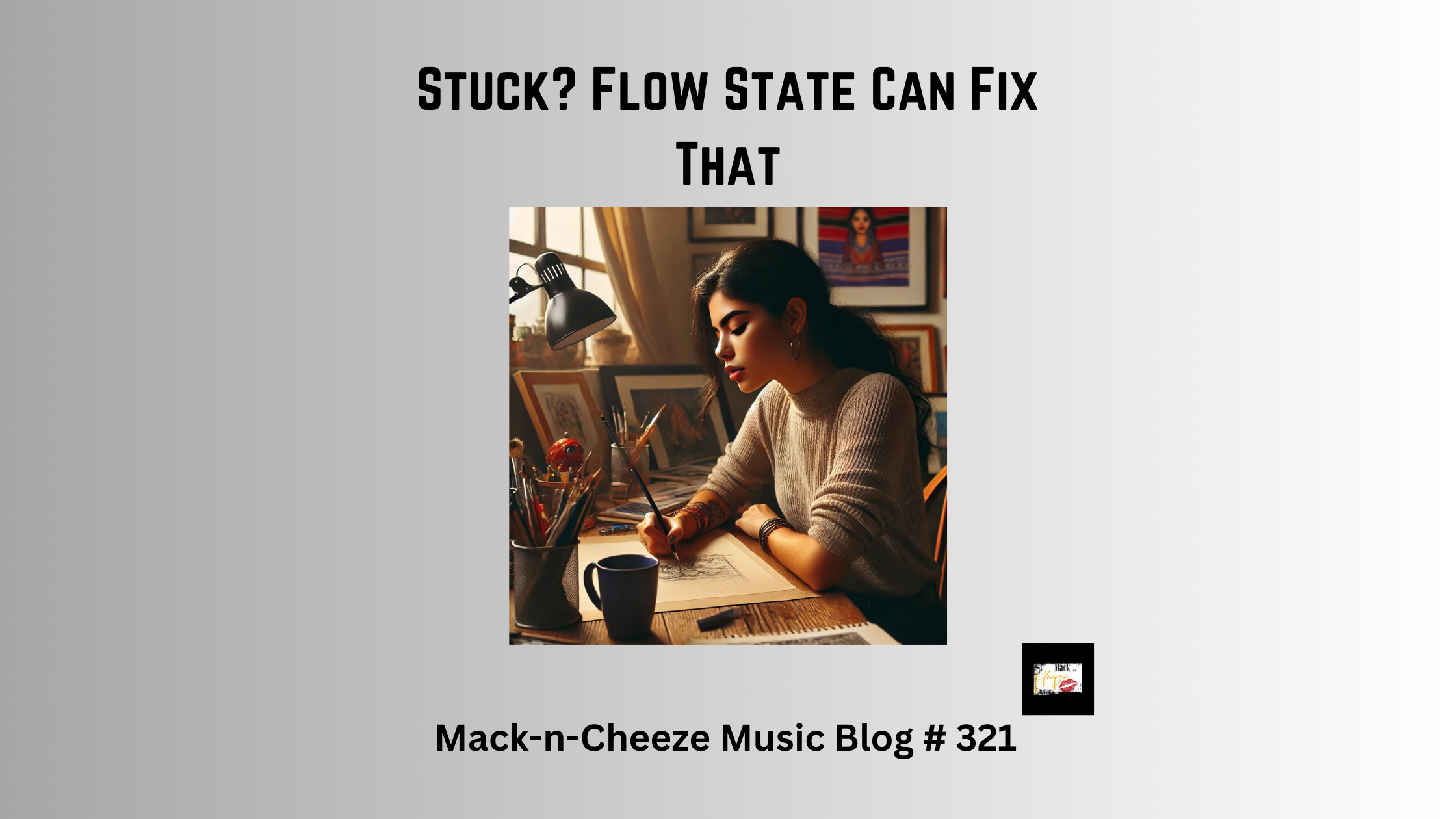
Image Created by naif X
Table Of Contents
Enter Flow State: it’s not a shortcut but a tool. I’m not advocating a something-for-nothing approach. In my world, it takes effort to accomplish my projects.
I often use Flow when writing, reading, rehearsing, mixing, and editing. Flow is a state of deep, focused work where skills and challenges meet head-on.
If you’ve ever wondered why some creatives produce at a level that feels out of reach, the answer isn’t luck or born virtuosity. It might be their ability to tap into Flow. And while it won’t do the work for you, mastering it can transform how you create.
Flow State: What It Really Means
I first read about Mihály Csíkszentmihályi in Angela Duckworth’s Grit: The Power of Passion and Perseverance. My first impression was the difficulty of Mihaly’s last name. Mostly, a blank stare was all I could give it. Chat GPT has its uses. Csíkszentmihályi pronounced roughly as Cheek-sent-mee-high-ee, helped to unconfuse my brain.
Mihály Csíkszentmihályi was a Hungarian-American psychologist widely recognized for developing the concept of Flow State. Through extensive studies, he discovered that people across various disciplines, from artists to surgeons, athletes to everyday workers, experienced profound satisfaction when fully immersed in challenging tasks matching their skill levels. He termed this advantageous state “Flow.”
Have you ever entered Flow or the flow state? It is an immersive mental state in which a person is completely absorbed in an activity and enjoys the intrinsic rewards of the task itself.
I have been there many times, often daily.
The flow state is that moment in time when what you’re doing pushes you enough, not too easy or overwhelming, so you can lose yourself entirely into it, get genuinely creative, and finish feeling incredibly satisfied.
It happens when I’m deep into a mix, writing, or even riding my bike.
Flawed Assumptions

Image Created by naif X
Common misconceptions about Flow persist. One that Flow is effortless. Once you’re “in the zone,” creativity simply pours out without conscious input or effort. The truth is quite different. Flow demands purposeful, intentional effort; it’s a state that arises when you’re deeply challenged and fully engaged.
Another fallacy is the belief that Flow is a manifestation reserved for creative geniuses, elite athletes, or uniquely gifted people. I’m proof in point. I would like to be one of those people, but that’s hard to measure up to.
In reality, Flow is accessible to everyone. Csíkszentmihályi’s research emphasizes that Flow is universally available, regardless of innate talent. It emerges naturally whenever an individual’s skills and challenges reach equilibrium, and it’s something anyone can learn to cultivate with practice.
The key lies not in being extraordinarily talented but in consciously creating the right conditions, regularly practicing your craft, and being willing to consistently push yourself.
Why You’re Stuck (And How Flow Helps)
Creativity isn’t just about talent or inspiration; it’s about movement or Flow. When that motion stalls, frustration sets in. Feeling stuck is one of the most discouraging experiences for any creative. It often comes down to several internal obstacles, but external challenges can also bog us down.
Overthinking leads to paralysis, with ideas being analyzed and dissected before forming.
If you’re a perfectionist, you tend to assume nothing is good enough. However, every note, brushstroke, or sentence does not have to be flawless before you commit to it.
Fear of others’ opinions can loom over the process. Every creative decision feels like an opportunity for someone else to criticize.
The big one for many is distraction. The constant tug of notifications, obligations, and the endless stream of external noise fractures focus and steals the deep engagement needed for genuinely creative work.
Lose Yourself In The Work

Image Created by Dalle
This is where the Flow State changes everything. Flow doesn’t erase these obstacles. It renders them powerless by shifting the way the brain processes experience. In Flow, there’s no time to second-guess when you’re fully immersed in the moment. The inner critic goes silent, replaced by a deep trust in instinct and execution. Doubt, hesitation, and self-judgment can’t coexist with the intensity of Flow. The mind stops getting in its own way, and instead of being tangled in self-analysis, creativity is allowed to unfold naturally.
The balance of Flow is key. The moment the task pushes you beyond your current skill level, requiring full attention but remaining within reach, the mind clicks into place. Too boring, and the process becomes dull. Too complicated, concentration becomes focused on execution rather than the execution building up the focus.
Mastery is built inside Flow. The more creative people learn to work within that balance, the more often they find themselves where work feels deeply absorbing, progress feels tangible, and creating becomes its own reward.
Conditions Necessary For Flow
I know fellow creatives who can pop in and out of Flow on command. I can also do that when I’m on a roll and consistent in my daily routines, but it is sporadic.
It’s necessary to condition yourself to achieve flow-on-demand.
Flow doesn’t just happen; you build it.
My mind needs order because ideas slip away without it. Flow thrives on structure, both in the process and the environment. The goals, feedback, challenges, and focus draw me in.
Interestingly, I should mention my environment. In the mornings, I need the structure of my desk, some classical music, and solitude. That’s when I write.
In the afternoon and evenings, I thrive on chaos. I have entered deep Flow working in noisy coffee establishments and even more odd, busy bars and restaurants. I have entered a super-deep Flow for three to four hours in those establishments. Weird? I know. Everyone is different.
Isolation is paramount in the recording studio. These can turn into intensely heavy editing sessions. A six-hour stretch without breaks is not unusual. Flow isn’t a perfect process; it is time-out time when mistakes pile up.
The Road From Distraction To Focus

Image Created by Dalle
There are definite parameters. Setting clear goals and knowing what you are shooting for gives your brain direction. You don’t need the whole picture, just the next step. Without it, you drift.
There has to be feedback. Groups can enter Flow together, but you’ll likely be working alone. The feedback that keeps you moving is mostly how your emotions respond to what you are doing.
Feedback isn’t applause. It’s knowing something is working. The faster you see it, the more heightened the experience can become. It is almost an elevated high close to an exhilarated state. This is good news for those of us who thrive on endorphins.
You push, stretch, and focus; you get lost in it. The more you work at that edge, the more often Flow comes.
Distraction can kill Flow. As I said, it depends on the environment, time of day, and task.
One of my most amazing Flow states was riding my bike on a hot afternoon. It was intense euphoria coupled with Deja Vu. I came out of the state when startled by the feeling that I had been at that precise location only minutes before when I obviously had not. The feeling that aliens had grabbed me and taken me away was overwhelming. But such is intense Flow.
When all of this lines up, Flow isn’t luck. It’s not a gift. It’s something you can return to again and again. You don’t wait for it. You make it happen.
Triggering The Flow State
Flow isn’t luck or a magic trick; You build it, brick by brick. It won’t come just because you want it. But if you lay the groundwork, it will show up like a boxer taping his hands before a fight or a pianist rolling their fingers over the keys before the first note. You prepare, or you flounder.
Start with a ritual because the brain likes patterns. Give it one. A writer scribbles nonsense until the words feel right, or a guitarist plays scales, warming up the fingers, waking up the sound. A painter sketches until the shapes find their place on the palate. It doesn’t matter what you do, but what matters is that you do it. You have to get your mind right and set the routine.
There are no half-measures. Flow won’t come if you drop in and out of focus, checking emails between strokes, scrolling between sentences. You sit. You work. No interruptions. You can set a clock if you are on a schedule that is important to you.
I have entered and exited Flow states in less than one hour. Leaving isn’t my favorite thing, but responsibilities must be attended to. I wish it were not so.
Distractions are the enemy, and the world is loud. If you need a quiet place of solitude, great; use that, especially when you first learn how to use flow. As I said, I often like to go to noisy environments. Something about the clutter and an unpredictable sound background allows me to find isolation in my head.
Work in a space that draws you in, not one that draws you out. Give the work your full attention as much as possible.
Group Flow
Yep, Flow States work in group settings. If you have ever written with a band or worked in improv, you know what that is.
I started reading Group Genius by Keith Sawyer and am slowly working through it.
Keith Sawyer studies creativity. Not the kind that happens alone in a dark room, but in a group, when minds collide, and ideas build on each other. He learned from Mihaly Csikszentmihalyi, the man who mapped the flow state. Then, he took it further. He wanted to know how teams create and how real innovation works.
Before all that, he designed video games for Atari, so he knew a thing or two about how ideas move and how one thought can lead to another. That’s where it started. Later, he earned a Ph.D. in psychology and taught at the University of Chicago and North Carolina.
He doesn’t believe in lone geniuses. Sawyer writes that best ideas don’t come from isolation but from conversation, from groups that work together, listen, and push forward. He calls this Group Genius. His book shows how it works step by step.
Business leaders read him, and educators quote him. His work is everywhere: in meetings, classrooms, and studios – where people try to make something better than they could alone.
Group Flow In Practice
My Mastermind Group recorded a session several weeks ago. It was like the old days of writing original music. The group moved as one; energy flowed and shifted, and ideas came rapid succesion. Each person locked in, feeding off the next without hesitation or second-guessing. The song ideas took shape, and the work manifested at a more rapid pace as the afternoon progressed. No single one of us could have done it alone. It happened because we all listened, trusted one another, and put our egos aside.
Keith Sawyer presents these ideas in Group Genius. He argues that real genius isn’t a lone figure hunched over a desk struggling for brilliance. It’s in the band that finds the groove, the team that builds without stopping, and the writers who pass the story back and forth until the words feel inevitable. Each participant leads, followed by another until the idea works.
Our session worked because everyone in the room was a seasoned musician.
When it happened, it felt electric, just like the old band house days. The conversation looped and twisted, each idea stacking on the last. The problem shrank, and the solutions were arrived at. None of us owned the complete thought because it belonged to the group.
Can We Help You?

Do you have more questions about flow? Here is a list of books I have read or am currently reading that address how to get your mind right.
Examines how historical masters (Da Vinci, Einstein, etc.) cultivated flow through relentless learning and adaptation.
Atomic Habits: An Easy & Proven Way to Build Good Habits & Break Bad Ones – James Clear
It is not directly about flow but is an excellent guide to building the habits that lead to deep, focused work.
Group Genius: The Creative Power of Collaboration – Keith Sawyer
Explores group flow and how teams, from jazz musicians to business innovators, tap into collective creativity.
Mindset: The New Psychology of Success – Carol Dweck
Psychologist Carol Dweck introduces the concepts of fixed and growth mindsets, exploring how our beliefs about our abilities influence our success.
Grit: The Power of Passion and Perseverance – Angela Duckworth
Psychologist Angela Duckworth delves into the traits that drive individuals to achieve long-term goals.
We would love to hear your point of view. Leave any anecdotes you may have about the flow states you have experienced.
If you find our content meaningful, stay in the loop and subscribe.
Thank you very much for reading this post and stay tuned.
Cheers.
Want More Mack-n-Cheeze?
Videos - Bryan At Mackncheeze on YouTube
Podcasts – Bryan At Mackncheeze Apple Podcasts, Fountain, Spotify
Leave a Reply