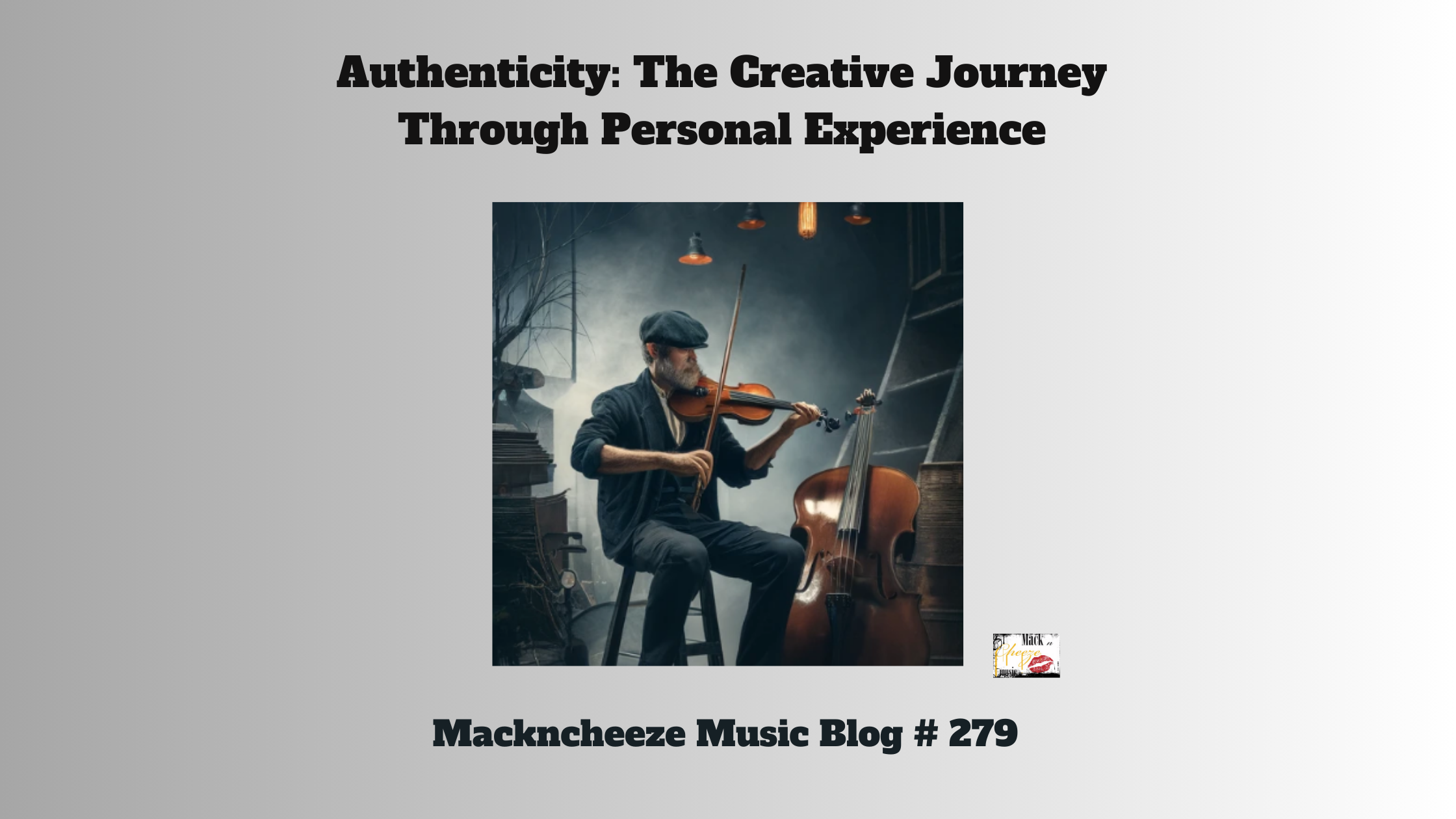
Authenticity fuels the artist’s journey. It’s the essence of creation. A core truth.

Estimated reading time: 10 minutes
Musicians, painters, writers, we creatives – each have battles and epiphanies. Our craft is honed by true grit.
Each of us have stories forged in the fires of real-life experience and relentless pursuit. From the first note to the final brushstroke, authenticity is carved by honing the raw, unvarnished paths artists tread.
Let’s start. See how deep, authentic creativity blooms from living the art.
Table Of Contents
Authenticity: My Story
From the moment I struck my first note in Junior High School band, I knew music would forever be a part of my life. It wasn’t an activity; it was an awakening. Not only was there the thrill of concert band, but the marching band fired me up. The exhilarating rush of live performances began to etch a deep mark on my soul. On top of that, I began crafting marching cadences, which called to my creative itch.
My journey into the heart of music wasn’t without its tribulations. By my sophomore year of high school, I faced a pivotal decision. The new music instructor confronted me with intolerable behavior. By today’s educational protocol, he would have faced disciplinary action.
Yet, this setback only deepened my resolve. Clearly, my passion for music transcended the structured confines of school bands. Haunted by the thought of playing out, of sharing my music with the world, I couldn’t let go. That’s when I joined the high school choir.
Funny enough, we weren’t taught music theory in band class. The curriculum involved stringent memorization from rote and working on technique. But in choir, we learned basic music theory. The application was to begin understanding composition. Further, grasping the rules helped us understand the “why” of performance. This new chapter broadened my appreciation of music. Enhanced creative skills added depth to my artistic expression.
The Next Step

College brought on Jazz Lab, Concert Band, and Brass Choir. At the same time, there was the supportive space of my parent’s garage. The various bands I played with came alive with the sounds of ambition and creativity. Our garage became a sanctuary where the free flow of melodies prevailed.
We committed to the neighborhood by wrapping up rehearsals by 7 PM. This fostered an environment of respect and harmony. The sessions were loud. They were raw. There was vitality.
On The Road Again
The real turning point came when I joined a country rock band. Our eyes were set on touring the robust music circuits of the time. It was the late ’70s, and disco was beginning its loud, glittering ascent. Yet, the traditional nightclub circuits still thrived with live music. We played night after night, from one club to another, each gig spanning two-to-six weeks. Each week, five-to-six nights, five-to-six hours. Those nights were grueling but rewarding. We grew tighter as a band, with every chord strummed and every note sung. My connectivity to music deepened.
I began to understand my passion’s authenticity. Those were formative experiences. There were setbacks and the joy of relentless pursuit. Each step solidified my commitment to music. I still hear the echoes of my parent’s garage. I can smell cigarette smoke from the stages of darkened nightclubs.
Authenticity isn’t only about finding passion. It’s about embracing, living, and resonating with the journey. The dream still thrives in every part of my being.
The Tenet
“One’s personal experience gives the stamp of authenticity and sincerity of opinion.” Nassim Nicholas Taleb, from his book – Antifragile
Each person’s experience is unique to that individual. Their perspective is, at its core, authentic. People’s opinions spring from their experiences. Experience carries the weight of real-world encounters and emotions. The joy and travails of life can add depth and credibility to their viewpoint.
Sincerity in opinion often comes from a place of genuine feeling or belief. Again, it boils down to experience. True feelings and thoughts, shaped by life’s trajectory, reflect a person’s mindset.
The way people process experiences and form opinions is complex. There is the interplay of cognition and emotion. Personal values, beliefs, and attitudes are deeply ingrained and emotionally charged.
Part of a person’s authenticity is subjectivity. Emotional connections are powerful. Each of us has a plethora of cognitive biases which we draw upon. It is only natural that we base who we believe we are from our life’s journey.
The convictions we adhere to can be relatable. Sometimes to those who have had similar perspectives. Sometimes to those who do not. This relatability can make such opinions more persuasive. These insights do not come from abstract reasoning alone. They come form life experience.
Authenticity: Sincerity And Emotional Truth
In the realm of creativity, connecting with your audience is fundamental. Emotional resonance is often the bridge between the creator and the audience. Sincerity is the honest expression of a creator’s thoughts, feelings, and intentions. Throw pretense out the window. Authenticity in expression is what can forge a meaningful connection with your audience. Communication isn’t only heard, but felt.
Sincerity is key to building trust with an audience. Honesty in a creator’s work signals trust to the audience. Trust, once established, turns casual observers into loyal followers or fans.
Sincere expressions are contain genuine emotions, which are contagious in nature. This shared emotional experience creates a powerful symbiosis. The art becomes more memorable and impactful. For instance, a musician’s heartfelt performance can stir deep emotions in listeners.
For creators, maintaining sincerity is essential for preserving their artistic integrity. Their work must reflect their true vision and personal ethos. Integrity distinguishes great artists. This resonates through their work, influencing all who see it.
Auguste Rodin

Auguste Rodin’s story relates how experience and expression shape an artist. These attributes contributed to his work and unique style.
Rodin is one of the most celebrated sculptors in the medium’s history. His work signifies a departure from traditional themes of the time. The work he created pivoted towards more naturalistic and detailed representations. The style he embraced marked the beginning of modern sculpture.
Rodin, a maverick in his time, defied the prevailing academic traditions that favored mythological and allegorical subjects. Instead, he chose to focus on more naturalistic and emotionally charged forms, a move that revolutionized sculpture. His dedication to authenticity, to capturing the truth of human experience, was unwavering. In his pursuit, he cast aside idealized versions of humanity, a bold and transformative step.
Rodin’s path to success was not without its hurdles. He faced rejection from the École des Beaux-Arts, a setback that would have deterred many. But Rodin was undeterred. He was largely self-taught, drawing inspiration from his visits to Parisian museums. In his early years, he honed his skills in decorative arts and ornamentation, a stepping stone to the detailed sculptural work that would define his career.
Success
Rodin’s first major work, “The Age of Bronze” (1877), caused a significant stir. The sculpture was so lifelike that critics accused Rodin of casting it from a living model. Initially, this controversy cast a shadow over his career. But it also brought him to the attention of prominent patrons, which helped to establish his reputation. He became known as a sculptor capable of conveying intense emotion and dynamic movement.
He persisted through these challenges. Personal insight and creative ethos were Rodin’s driving forces. His example shows that his true vision endures. His authenticity marked the world of art.
Rodin was prolific throughout his life, creating thousands of sculptures and drawings. His style of capturing light, rough, and unfinished surfaces was revolutionary. He had the unparalled ability to convey complex emotions and human struggles.
In the final years of his life, Rodin became a national hero in France. In 1916, he donated his entire collection of works to the French state. His conditions were that they turned his studio into a museum dedicated to his works. The Musée Rodin in Paris opened in 1919, two years after his death.
Subjectivity, Bias, And Authenticity

We all have a personal perspective; it makes us who we are. Our experiences and cultural context impact the creative process. Subjectivity is a double-edged sword. Our biases skew interpretation and perception. We can’t escape that. That is part of our unique voice.
Subjectivity in creativity is inevitable; this does not imply negative connotations. How we interpret life allows deep personal expression. Articulating our individual vision can have a profound effect on our audience. Isn’t that what we are looking for?
Each artist’s subjective perspective brings a unique flavor to their work. New interpretations and insights into common themes come to life. This approach helps diversify the artistic landscape and fosters a richer cultural dialogue.
Subjectivity can also lead to bias. Predilictions are often unconscious and shaped by the artist’s life experience. In some cases, bias might limit the scope of creative exploration. Stereotypes and certain viewpoints may perpetuate. An artist’s prejudices could hamper their receptiveness to new ideas. An artist’s culture may suppress perspectives outside of its own society. This can lead to a need for more diversity in artistic expression.
Navigating these challenges requires a conscious effort.
Self-reflection can help us to understand the motivation of our work. How do your personal biases manifest?
Do we want to expose ourselves to diverse influences? It is possible to mitigate a narrow or biased viewpoint.
Working with other artists from different backgrounds can help challenge preconceived notions. We can learn new insights, reducing the impact of individual biases.
Seeking and embracing constructive feedback from peers and audiences provides insight. Sometimes, it’s the data. The Devil is in the details.
Use all the tools available to you to foster the truth in your voice as much as possible.
And In The End
Staying true to your authentic artistic vision has an impact. This perseverance shapes careers and sets benchmarks. Your voice’s personal integrity is sacrosanct. Staying true to your creative convictions can have a lasting effect. Your journey is unique. Shape your artistic evolution by staying true to your inner voice.
Can We Help You?

Thank you for taking the time to read through our exploration on staying true to an authentic artistic vision. Hopefully, this has helped in your personal journey. There is a broad tapestry in the world of art and we are the color and textures. Your engagement fuels our community and keeps the dialogue around true artistic expression vibrant and alive.
We would love to hear your thoughts and reflections on this topic. What has your experience been with maintaining your artistic integrity amidst external pressures? How has your personal commitment to your art influenced your work and those around you? Please share your insights and stories in the comments below. Your perspective enriches our collective understanding and inspires others within our community.
If this message resonated with you, or you believe it could inspire others in your circle, please consider sharing this post. Each share extends the reach of our community’s voice, broadening the impact of our collective passion for authentic artistic expression and its vital role in the art world.
Finally, if you haven’t already, please subscribe to stay updated on our latest discussions and features. Join our community of dedicated artists and enthusiasts who are all striving to bring depth, diversity, and authenticity to the art world. Your subscription ensures you never miss out on the insights and inspirations that could spark your next big idea or masterpiece.
Want More Mack-n-Cheeze?
Videos - Bryan At Mackncheeze on YouTube
Podcasts – Bryan At Mackncheeze Apple Podcasts, Fountain, Spotify
Leave a Reply