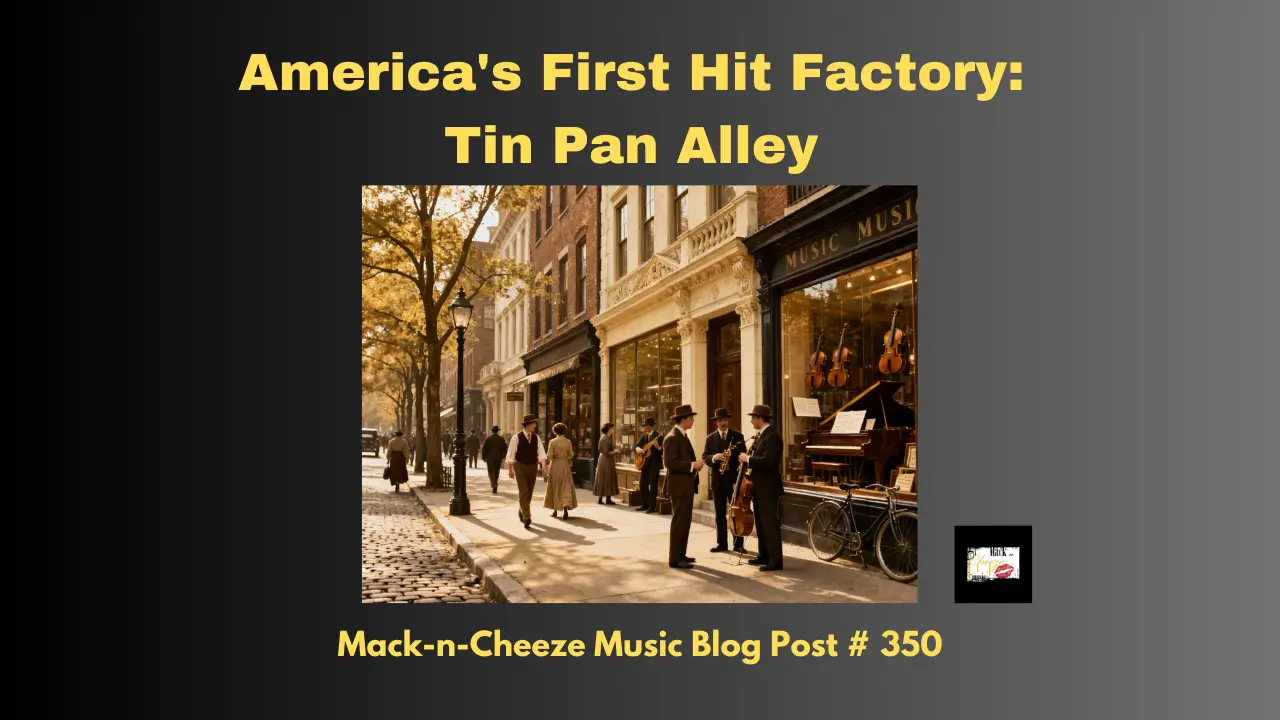
Before Spotify playlists or vinyl spinning on a turntable, America had Tin Pan Alley, its first real hit factory. But this wasn’t a factory of smoke and gears. It was a row of cramped rooms in New York City. A street where battered upright pianos rattled all day long.
Estimated reading time: 10 minutes

Image generated by GeniGPT
Table Of Contents
Inside, songwriters sweated over melodies, hoping one of them might catch fire. This was where America’s soundtrack was being forged, one chorus at a time.
Between 1885 and 1935, the Alley’s composers and lyricists wrote the music Americans danced to, marched to, fell in love to, and sometimes even went to war with.
The Birth of America’s First Hit Factory
In the late 1800s, music in America’s homes wasn’t about hits; it was about hymns and piano lessons. With the arrival of mass-produced upright pianos, family entertainment meant gathering around the keys and singing together. Sheet music publishers made their money selling church songs and teaching pieces, not chasing the next big thing.
But as upright pianos became more affordable, the middle class had an instrument parked in their living rooms. What they needed wasn’t another hymn; they wanted songs they could actually enjoy.
Sensing the opportunity, New York entrepreneurs got to work. They hired composers and lyricists, and told them to crank out music people would buy. It was less an art studio, more an assembly line, a place where songs were manufactured for mass consumption.
Journalist Monroe Rosenfeld walked down West 28th Street. He heard the din pouring out of those windows, dozens of pianos clanging at once, melodies colliding into a metallic racket. He likened it to the sound of tin pans being beaten together, and the nickname stuck. This noisy block in Manhattan would go down in history as Tin Pan Alley.
The Early Mega-Hit
At the turn of the century, America craved drama in song. Sentimental ballads ruled the day, melodies that didn’t just say “I love you,” but painted the whole picture: meeting the girl, losing her, standing over her grave in winter. Audiences wanted stories wrapped in melody, and they wanted them big.
No song proved that more than Charles K. Harris’s After the Ball. Published in 1892, it told the tale of love lost through misunderstanding, set to a tune both tender and unforgettable. The sheet music flew off shelves—more than five million copies sold. For the first time, a song became a national obsession.
After the Ball was a revelation. A three-minute song could capture the emotions of an entire country, making a fortune in the process. From that point on, Tin Pan Alley wasn’t just about writing songs.
For perspective, that’s like a Spotify single today, racking up billions of streams. It was the Billie Eilish moment of its day, a cultural takeover that no one saw coming.
Rag Time Shakes It Up

Image generated by Dalle
Ragtime was born from African-American traditions; it swung with syncopated rhythms and rolling stride-piano lines that made feet tap without permission. And the words? They sounded like the street corner, the back porch, the everyday: “my baby,” “hello honey,” “ragtime gal.” Flirty, playful, a little rough around the edges, the everday langauge of the everyday people. Ragtime felt alive because it belonged to the people who lived it. Instead of telling listeners what they should feel, it reminded them of what they already knew: music is at its best when it talks the way you talk.
Tin Pan Alley discovered the formula: grab the slang and stories people were already living, wrap them in a catchy rhythm, and turn them into songs everyone wanted to buy. That formula hasn’t changed. The slang of ragtime was the blueprint for jazz scat, blues idioms, rock ’n’ roll swagger, hip-hop flow, and even the hashtag-driven hooks of today’s pop hits.
Scott Joplin set the standard with Maple Leaf Rag, but Irving Berlin’s Alexander’s Ragtime Band proved that this new sound could move the masses. And move they did. Ragtime sparked national dance crazes from the turkey trot to the bunny hug. For the first time, popular music wasn’t just something to be sung; it was something to embody.
Critics howled, calling ragtime vulgar and corrupting, but that resistance only underscored its power.
Tin Pan Alley was a reflection of American culture. What people said on the street became what they sang in the parlor, and eventually what they stream in their earbuds.
Shaping Identity and Reflecting America
New York City has always been a hub for immigrants. The songs created by Tin Pan Alley echoed that reality. Some tunes poked fun at thick accents and culture clashes, turning newcomers into punchlines. Sheet music covers often carried crude caricatures, the kind that reduced whole communities to stereotypes. It was ugly, and it left scars.
But not all of it was mockery. By writing about immigrants at all, Tin Pan Alley pulled them into America’s story. Songs about Italians, Jews, and Irish might exaggerate or stereotype. Still, they also acknowledged: you’re here, you’re part of the mix. For many, hearing themselves, even in parody, meant being seen in the national conversation.
And therein lies the paradox. Tin Pan Alley shadowed America’s flaws and diversities, struggling to figure out who belonged, and using music to wrestle with the answer.
Songs of War and Patriotism

Image generated by GeniGPT
When World War I broke out in Europe, America hesitated. That hesitation echoed in Tin Pan Alley’s songs. One of the biggest sellers of the day was I Didn’t Raise My Boy to Be a Soldier, a mother’s plea for peace, sung in parlors across the country. It caught the mood perfectly. War was Europe’s problem, not ours.
But music shifts with the nation, and once the United States entered the fight in 1917, neutrality songs vanished overnight. Suddenly, the same Alley that had sung about staying home was churning out rallying cries. George M. Cohan’s Over There became the anthem of the war, blasting from stages and training camps, uniting soldiers and civilians with its call to “make your daddy glad.”
Even Irving Berlin, drafted into the army, found a way to turn misery into melody. Stationed at Camp Upton on Long Island, he wrote Oh! How I Hate to Get Up in the Morning, a comic gripe about reveille that every private could relate to. It wasn’t lofty patriotism; it was trench humor. And that’s what made it stick.
In wartime, Tin Pan Alley mirrored America once again: from wary isolation to full-throated unity, from earnest anthems to songs that let soldiers laugh through the grind.
The Roaring Twenties
After the war, America exhaled. The music turned light, cheeky, and full of bounce. Songs like Ain’t We Got Fun shrugged off hardship with a grin, “the rich get rich and the poor get children,” and people sang it like an inside joke everyone was in on. The decade’s defining tune, The Charleston, got the whole country on its feet, a syncopated shout that life was meant for dancing, not worrying.
And if the law said you couldn’t drink, the music said otherwise. Prohibition turned basement clubs and speakeasies into the hotbeds of culture. Jazz bands wailed, dancers kicked up their heels, and Tin Pan Alley tunes slipped into the haze of bootleg whiskey. The songs became soundtracks for rebellion as much as for release.
Broadway caught the fever, and Tin Pan Alley’s writers poured their talent onto the stage. The Gershwin brothers, George at the piano, Ira with the pen, wrote classics that still stop hearts. Someone to Watch Over Me wasn’t just a ballad; it was the sound of longing dressed in sophistication, a reminder that even in an age of wild parties and flapper skirts, the human need for love never went out of style.
In the 1920s, Tin Pan Alley didn’t just echo America’s carefree spirit—it helped define it. The music was playful, rebellious, and unashamedly alive, the perfect soundtrack for a nation eager to forget the trenches, dodge the law, and lose itself in song.
Hollywood Takes Over

In 1927, The Jazz Singer changed everything. It wasn’t just a film—it was the first talking picture, and with Al Jolson’s voice drifting out of the screen, songs suddenly had a new stage: the movie theater. A tune could now reach millions at once, not just those who bought sheet music or a Broadway ticket.
The Hollywood studios saw the future fast. Warner Bros., Paramount, and MGM did not only want the hits. They wanted the people who wrote them. They bought out Tin Pan Alley publishers and lured songwriters like Irving Berlin and the Gershwin brothers to the West, placing them in studio offices. Same grind, different backdrop.
The result was magic. Berlin’s Blue Skies and later standards like Singin’ in the Rain tied music to moving images so tightly they could never be separated again. A song was no longer just something you sang at home. It became the emotional engine of a story, the thing you hummed walking out of the theater.
Tin Pan Alley may have given birth to America’s first hit factory, but Hollywood turned those hits into global souvenirs. Once music and film married, the world never listened or watched the same way again.
Decline and Legacy
By the 1930s, the ground had shifted under Tin Pan Alley’s feet. Phonographs were no longer rare luxuries, and radios filled living rooms across America. Families didn’t need an upright piano to make their own music anymore—they could sit back and let the greats play it for them. For Tin Pan Alley, this should have been a golden opportunity. Records and radio could have carried their songs further than sheet music ever could. But the publishers saw only a threat. Instead of embracing the new technology, they dug in, clinging to their old model until the tide swallowed them.
That lack of vision sealed their fate. Had they leaned into radio partnerships and record production, Tin Pan Alley might have extended its reign. Instead, Hollywood bought up catalogs, pulled the best songwriters west, and left the Alley behind as a relic.
And yet, the system they built, the assembly line of melody and lyric, the knack for mirroring culture in three-minute bursts, became the foundation of modern pop. Every hit factory since, from Motown to Max Martin, owes a debt to Tin Pan Alley.
I smell a lesson here for today’s creators. Radio and records once disrupted the sheet music industry. AI tools, streaming platforms, and new forms of distribution are reshaping how art reaches the world. The tendency of many of my artistsfriends is to dismiss these shifts. They have’nt learned. Tin Pan Alley didn’t, either. What’s to be learned is to adapt.
The blueprint Tin Pan Alley left is clear: songs matter, culture matters, people matter. But if you ignore the tools that carry your work to the audience, your work risks fading before it’s heard.
Can We Help You?

Will today’s creators embrace new technology, or will we repeat Tin Pan Alley’s mistake and get left behind?
Tin Pan Alley left us a blueprint—and a warning. They wrote the soundtrack of America, but they also missed their moment by refusing to adapt. The question now is ours: will we embrace the tools in front of us, or fade like echoes in the alley?
What do you think? Drop a comment, share this with someone chasing their own creative vision, and hit subscribe so you don’t miss what comes next. The conversation and the music don’t stop here.
Want More Mack-n-Cheeze?
Videos - Bryan At Mackncheeze on YouTube
Podcasts – Bryan At Mackncheeze Apple Podcasts, Fountain, Spotify