What questions do you run from?

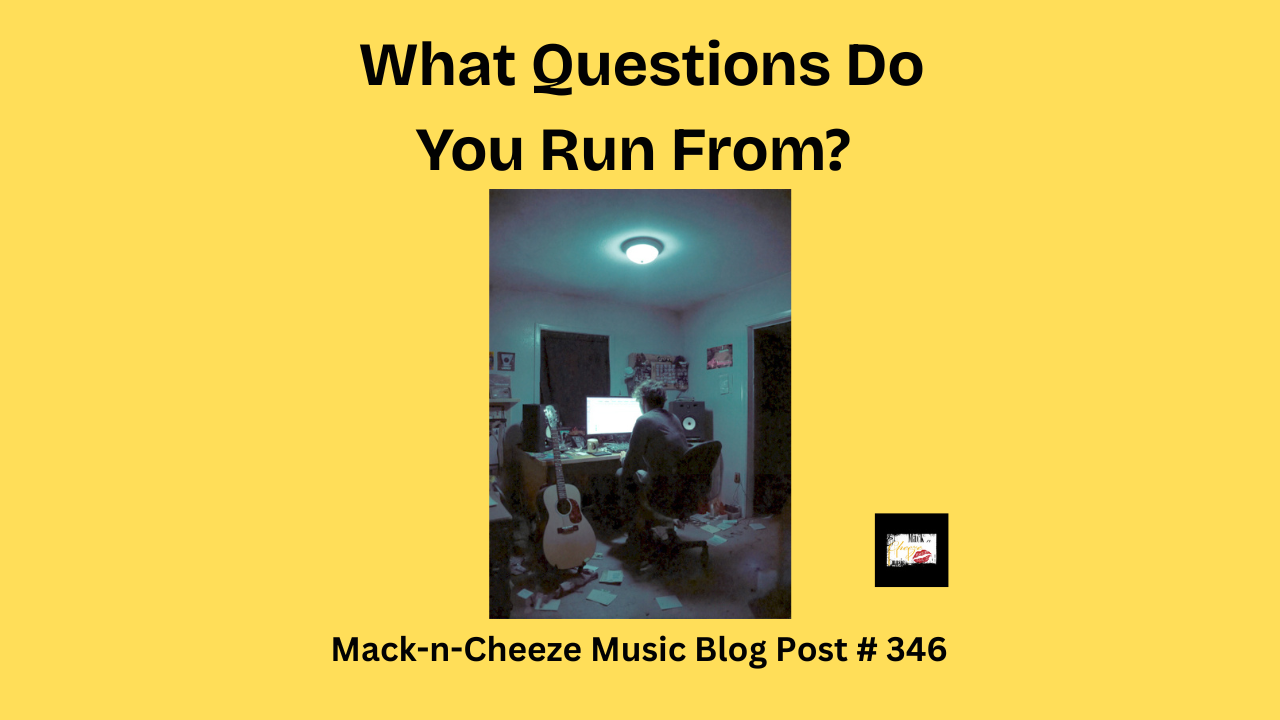
Image Generated by GeniGPT
You’re chasing the muse. The soft lights overhead whisper their 60-hertz hum, and the chair creaks as you settle in. A guitar waits on its stand. The DAW screen glares back, blank, daring you.
You hit a chord; too hard. Not music yet, just muscle. Your hands know the part, but something else is riding shotgun. The echo of a fight you lost. A promise you don’t believe anymore. That one artist you can’t stop stalking online. The one person you love enough to keep going, or hate sufficiently to prove wrong.
You usually suppress the memories, those wrapped in guilt, loss, and fear.
It’s not always there. But the gnawing echoes surface enough to trouble you, especially in this personal space where you forge your craft.
Every act of creation drags something else into the room. Are you ready to face the questions you’ve been running from?
Why do we avoid the hard questions? Because they cut where it hurts most.
Why We Dodge The Hard Questions
The first shield is the ego. Identity feels permanent, like bedrock. But every question that digs too deep threatens to crack it. So we defend, deny, and pretend. Better to guard the mask than risk exposing what’s underneath.
The second is fear. The brain can tolerate pain; it knows how to catalog, store, and replay it. But uncertainty? That’s worse. Fear thrives on the unknown, and hard questions always open doors to rooms we can’t predict.
The third is survival. Your brain would rather save its fuel than burn it on a fight. It leans toward comfort, rather than confrontation. It whispers: take the easy road, stay still, don’t stir the water. That stillness feels safe, but it isn’t.
You may need to face the questions you run from.
We like to believe our work is authentic. But if we are hiding from ourselves, how can we expect our audience to believe us?
Who Am I, Really?
We live behind masks. The role at work. The persona on stage. The curated self online. They all feel permanent, like that’s who we are. But they’re costumes—layers we put on because the real thing feels too fragile to show. And it isn’t just the outward roles. Even self-control is another kind of mask.

Image generated by GeniGpt
As Seth Godin puts it: “If you’re using any sort of self-control… then you’re not being authentic. Only a tantrum is authentic. Everything else we do with intention.” Godin, Seth. The Practice: Shipping Creative Work (p. 147). (Function). Kindle Edition.
The point cuts deep: almost everything we present, inside and out, is managed. Authenticity only flashes through in raw, unfiltered moments we can’t package.
The self underneath is harder to face. Strip away the role, and what’s left? Not the job title, the stage name, or the brand you’ve built. Just you; bare, unguarded, unfinished. That’s the part we dodge, because if it cracks, the whole act collapses.
Your art doesn’t come from the mask. It comes from the fracture lines in the self. The more you cling to the role, the thinner your work feels. The closer you get to the self, the more dangerous and alive your creative work becomes.
What Do I Believe, And What If I’m Wrong?
“Convictions are more dangerous enemies of truth than lies.”
— Nietzsche, Human, All Too Human (1878), §483
The second question digs at the ground you stand on: What do I believe?
Beliefs feel like bedrock. They tell you what matters, what’s right, what’s worth fighting for. They shape every decision, every word, every note. Without them, you’re floating, building castles on sand.
But what if the rock isn’t solid? What if the truth you’ve sworn by isn’t truth at all, only habit or inheritance? What if your beliefs have been handed down like stone tablets, too heavy to lift, too sacred to question?
Most people won’t touch that possibility. It’s easier to protect the foundation, even if it’s false, than to admit you’ve been standing on rubble.
Artists aren’t immune. That’s why clichés spread. Why styles stagnate. Why work calcifies into imitation instead of revelation. Avoiding the question makes the art safe and hollow.
But the work deepens when the ground shifts. When you hold a belief up to the light and it doesn’t survive, what’s left is raw and unsettled. That’s where conviction starts, not in the hand-me-downs, but in the fire-tested truths you’re willing to rebuild on.
“In all affairs it’s a healthy thing now and then to hang a question mark on the things you have long taken for granted.”
— Bertrand Russell, Autobiography of Bertrand Russell (1967)
If you won’t question your ground, don’t be surprised when your work crumbles with it.
What Am I Most Afraid Of?

Image generated by GeniGpt
Fear is a compass. It doesn’t point north; it points straight at the places we don’t want to go. That’s my perspective.
Every time I circle around an idea, avoid a conversation, or dodge the work that burns hottest, fear is sitting there, marking the spot.
The trouble is, fear isn’t fixed. The fears I had yesterday aren’t the same as the ones I carry today. They shift, they mutate. What once froze me doesn’t even register now. And new shadows keep showing up. That’s how fear works. It never leaves. Instead, it inflates and deflates, changing costumes.
Creativity tends to skirt those edges. We polish the safe parts, the pieces that make us look good, while the real work hides in the territory we’re too scared to cross. But the path forward is almost always through the exact place you don’t want to step.
That’s the paradox: the work you’re most afraid of is usually the work you most need to do. Ignore it, and your art stays shallow. Face it, and the work gains depth, honesty, and weight.
“Are you paralyzed with fear? That’s a good sign. Fear is good. Like self-doubt, fear is an indicator. Fear tells us what we have to do.”
— Steven Pressfield, The War of Art (2002)
Who Have I Hurt? Who Has Hurt Me?
This is the section I’d rather skip. Some wounds run so deep I’ve buried them, because pulling them into the light feels unbearable. The same goes for the people I’ve hurt, the times my words cut, my selfishness took over, my ambition steamrolled someone else. It’s easier to act like it never happened. But the truth is, it did.
Everyone leaves scars. Pretending otherwise kills empathy. We like to tally the wrongs done to us, but the more complex question is who’s carrying the scars we left behind. Ignoring it doesn’t erase it. It just means we refuse to learn from it.
The Big Book of Alcoholics Anonymous doesn’t let anyone dodge this. Step Four demands “a searching and fearless moral inventory of ourselves.” Step Nine pushes further: “Make direct amends to such people wherever possible, except when to do so would injure them or others.” Brutal steps, but necessary ones. Recovery depends on owning both sides of the ledger: those who wounded us and those we wounded in turn. Creativity isn’t so different.
Here is my take: art without accountability is shallow. If you won’t face the harm you’ve caused or endured, your work stays limited. However, if you do face the damage, healing begins, and maybe your work will resonate, breathe, and become more human.
The hope is that owning the harm we have endured or created doesn’t make our art softer, but will make it sharper, more dangerous, and more alive.
What do I keep Chasing That Which Will Never Satisfy Me?
Some pursuits feel endless. The treadmill keeps moving, no matter how fast you run. Money, recognition, validation, of course, they matter. You need money to live. You want recognition, so you’re not shouting into the void. You crave validation because otherwise it feels like no one sees you. Those hungers are real.
But they don’t stay satisfied. You reach a milestone, and the bar moves. You get the applause, but it fades. You land the validation, but the high wears off. They’re not meaningless, but they’re never enough.
I’ve chased it in relationships, too. I poured time, energy, and money into black holes, convinced the next relationship would be different. But the common denominator was me. My patterns, my illusions, my refusal to face what I was really after. I drained myself believing I could fill the void, but the more I fed it, the more it demanded.
Maybe yours isn’t love. Could it be status, or the approval of people who barely notice you? Is it possible you need security, as if enough padding will ever silence the fear?
What I’ve seen is that if you don’t recognize what you’re chasing, it has a way of draining you. Denying it doesn’t make it disappear; it just shifts shape and keeps pulling. Some hungers are never satisfied, no matter how much you feed them. I don’t have the answer worked out, but I’ve learned that identifying what it is I’m chasing is the first step to loosening its grip.
What Will Be Left When I’m Gone?

This question unsettles most of us. Nobody likes to stare down the fact that we won’t be here forever. I don’t have progeny, and I don’t need to be Beethoven or the Beatles. That kind of immortality isn’t the point.
But what does remain? There’s the first death, when the body goes. Then there’s the second death, the last time someone speaks your name. That second one is the one we avoid thinking about, because it strips away illusion. Fame, wealth, and even family eventually fade. What outlasts us is thinner and more fragile than we want to admit.
For creators, the second death sharpens the question: what, if anything, lingers after the lights go out? Sometimes it’s a song or a book that keeps circulating. Sometimes it’s just a memory, one night, one performance, one piece of work that left a mark on someone else. The scale varies, but the principle is the same: our work is the only footprint we leave.
I don’t have a clean answer to this. I’m still facing it. But I know this much: the silence can come sooner than we want, and the only way to push back against that silence is to create while we can.
If I Never Succeed, Will It Still Have Been Worth It?
This is the killer question. The one that most creators avoid until it catches up to them. If the world never applauds, if the money never comes, if the doors never open, was the work still worth it?
The question separates a hobby from a calling. A hobby is nice when it pays off, convenient when it entertains, easy to set down when life gets crowded. A calling is different. A calling gnaws at you, whether or not anyone notices. It keeps you up at night, drags you back into the room, refuses to let go.
And it circles back to belief. What do I believe about my work, about myself, if success never comes? Am I wrong to keep going? Am I fooling myself, mistaking obsession for purpose? The answer shifts with the day. Sometimes, creating is its own justification, that it matters even if no one sees it. At other times, I wonder if that belief is just a way to dull the sting of failure.
The tension doesn’t resolve. That’s why it’s the most challenging question: you can’t bluff your way through it. You either keep showing up, or you don’t. And in the end, maybe that act of showing up is the only belief that really holds.
Can We Help You?
Are you willing to face the truths you’ve been running from, even if they unsettle who you think you are?

Thanks for reading and sitting with the hard questions. If this stirred something in you, don’t keep it to yourself, share it with someone else who needs it. Leave a comment and add your voice to the conversation. And if you want to keep pushing into these questions with me, subscribe so you don’t miss what comes next.
Want More Mack-n-Cheeze?
Videos - Bryan At Mackncheeze on YouTube
Podcasts – Bryan At Mackncheeze Apple Podcasts, Fountain, Spotify